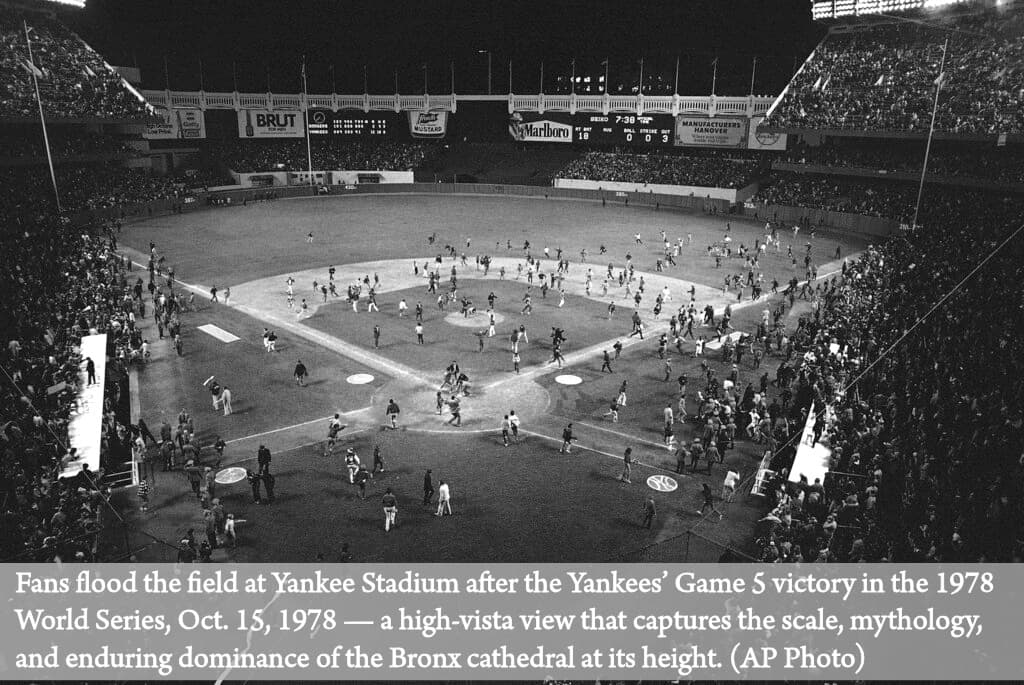
BASEBALL IN FULL VIEW
The Spectacle, the System, and the Future of the American Game
PART 2 OF 4
THE STRUCTURAL ARGUMENT BEGINS
THE LEDGER OF IMBALANCE (1995 → 2025)
THE YANKEES’ DRIFT
ADDENDUM — THE STANDARD: CHAMPIONSHIPS
Part 2 Preamble
If Part 1 honored the beauty and global rise of the sport, Part 2 turns to the machinery beneath it. This is where the architecture reveals itself — ownership psychology, institutional capital, and the widening gulf between ambition and capability. It is the section where sentiment ends and structure begins. To understand where baseball is going, we must first understand what is driving it.
THE STRUCTURAL ARGUMENT BEGINS
(Steinbrenner vs. the heirs, Guggenheim vs. the field, the monarchy quintet)
If you want to understand the modern game — not the rumor mill, not the noise, not the daily churn of speculation — you must begin with ownership psychology. Because in today’s MLB, the competitive destiny of a franchise is determined less by scouting departments or analytics teams than by the worldview of the people who sign the checks.
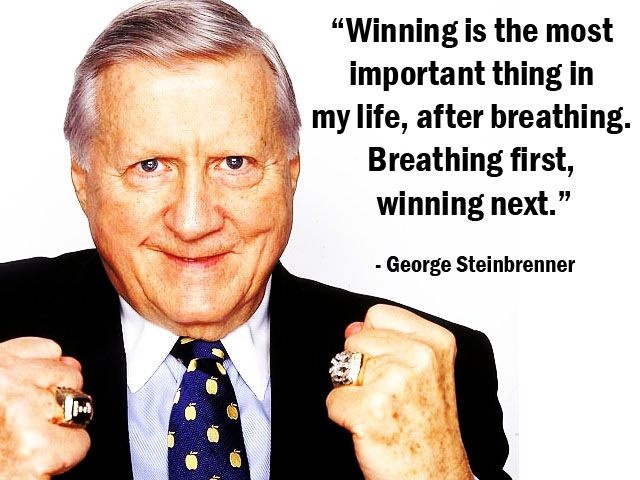
George Steinbrenner spent to dominate.
His heirs spend to maintain.
That is the difference between a dynasty and a brand.
The Boss operated with a conqueror’s mentality — impatient, volatile, often maddening, but always driven by the singular demand to win. His heirs operate with the caution of stewards managing a global asset. They spend enough to sustain the illusion of the Yankees, but not enough — nor with the clarity — to restore the burden of the Yankees.
And this distinction matters, because the modern game is no longer shaped just by wealthy owners. It is shaped by institutions.
The Dodgers are not simply rich.
They are Guggenheim — a financial organism with multi billion dollar liquidity, diversified risk tolerance, compensation engineering, and a worldview shaped by private capital logic. Mark Walter is the face. Guggenheim is the spine. And the Dodgers are the result: a dynasty engineered with institutional clarity.
The Mets are Point72 — private capital machinery with the will to dominate but still searching for their Stick Michael, the architect who can translate resources into reign.
The Phillies, Giants, Rangers, and Blue Jays are corporate landlords — wealthy, yes, but not structurally comparable to Guggenheim. They can sign stars. They can make splashes. But they cannot out engineer a financial institution.
This is the monarchy quintet of modern baseball — the clubs whose capital structures allow them to outbid entire divisions, absorb mistakes, and operate with a margin of error the rest of the league cannot fathom.
And this is why the rumor mill feels so predictable.
Why the same handful of teams circle every elite player.
Why the Peraltas and Skubals of the world are hunted by the same predators.
Why smaller clubs operate like incubators — developing talent for others to harvest.
Why dynasties today are not accidents but outcomes.
This is the architecture beneath the sport.
This is the underbelly the December editorial must expose.
THE LEDGER OF IMBALANCE (1995 → 2025)
To understand how we arrived at this moment — where five or six clubs can tilt the entire competitive landscape — you must look at the economic ledger of the last thirty years. Baseball’s imbalance is not cultural. It is structural. It is financial. It is the predictable outcome of a system that evolved faster than its rules.
In 1995, the average MLB salary hovered around $1.1 million. The Yankees led the league with a payroll of roughly $45 million. The spread between top and bottom existed, but it was not yet destiny. A well-run club could still compete with a well-funded one. A brilliant GM could still outmaneuver a billionaire. A developmental pipeline could still overcome a checkbook.
That world is gone.
By 2025, the average salary exceeds $4.5 million. The Dodgers’ payroll alone dwarfs entire divisions. The top five clubs account for nearly half of all player compensation. And the contracts themselves tell the story: 1995’s apex was Albert Belle’s $55 million deal. Shohei Ohtani’s $700 million contract briefly appeared to be the new summit — until Point72 and Steve Cohen shattered it with Juan Soto’s record-breaking $765 million pact, the largest contract in the history of professional sports. These numbers don’t merely reflect inflation; they reflect the institutionalization of private capital in baseball.
What was once ego driven spending has become capital driven inevitability.
This is why the Peraltas of the world — earning $8 million, a fortune to any normal person — are considered “pittance” by baseball’s new aristocracy. This is why Detroit may as well trade Skubal. Even if they win with him, they cannot outbid the Guggenheim Dodgers, the Point72 Mets, the corporate landlords in Philadelphia or Toronto, or the Yankees’ brand maintenance machine.
This is why the rumor mill feels like déjà vu.
This is why the same predators circle the same prey.
This is why the incubator economy has taken hold — smaller clubs develop talent for larger clubs to harvest.
And this is why the sport’s competitive soul feels increasingly predetermined.
The imbalance is not a glitch. It is the system.
THE YANKEES’ DRIFT
(Leadership, Stewardship, and the Burden of the Standard)
And nowhere is the architecture of modern baseball more revealing — or more painful — than in the case of the New York Yankees. My team. My inheritance as a fan. The franchise that once defined excellence so completely that the rest of the sport measured itself against its shadow.
The Yankees’ issues are not just roster issues.
They are not injury issues.
They are not analytics issues.
They are not “one move away.”
They are structural.
They are psychological.
They are cultural.
They are leadership based.
For six years, Aaron Boone has been entrusted with a role that demands a rare combination of strategist, psychologist, tactician, room reader, forecaster, and field general. A modern manager must use analytics as a tool, not a crutch. He must sense the pulse of a clubhouse. He must anticipate the moment before it arrives. He must command respect without theatrics. He must be part strategist, part Tony Robbins, part Reverend, part historian of the game.
Boone is not that figure.
And it is not cruelty to say so.
It is clarity.
Brian Cashman, once the boy wonder, has become the embodiment of institutional inertia — a man who should have been replaced long before Boone ever arrived. The Yankees’ front office has drifted into a culture of maintenance, not mastery. They have become a brand management operation, not a championship engine.
And this is where the line lands with its full weight:
The Boss spent to dominate.
His heirs spend to maintain.
They maintain the business.
They maintain the brand.
They maintain the revenue streams.
They maintain the talking points.
They maintain the illusion of the Yankees.
But they do not maintain the burden.
The burden of expectation.
The burden of excellence.
The burden of consequence.
The burden of being the New York Yankees.
This is not an attack on individuals.
This is not resentment toward wealth.
This is not bitterness toward people who have succeeded in life.
It is a critique of stewardship — the moral obligation that comes with inheriting a public trust disguised as a private asset. Millions of ordinary people work tirelessly to support their families. If you are entrusted with the New York Yankees, earning millions to lead or oversee the most storied franchise in American sports, the standard must be higher.
The Yankees are not failing because they lack money.
They are failing because they lack clarity.
They are failing because they lack an architect.
They are failing because they lack a field general.
They are failing because they have forgotten the difference between a dynasty and a brand.
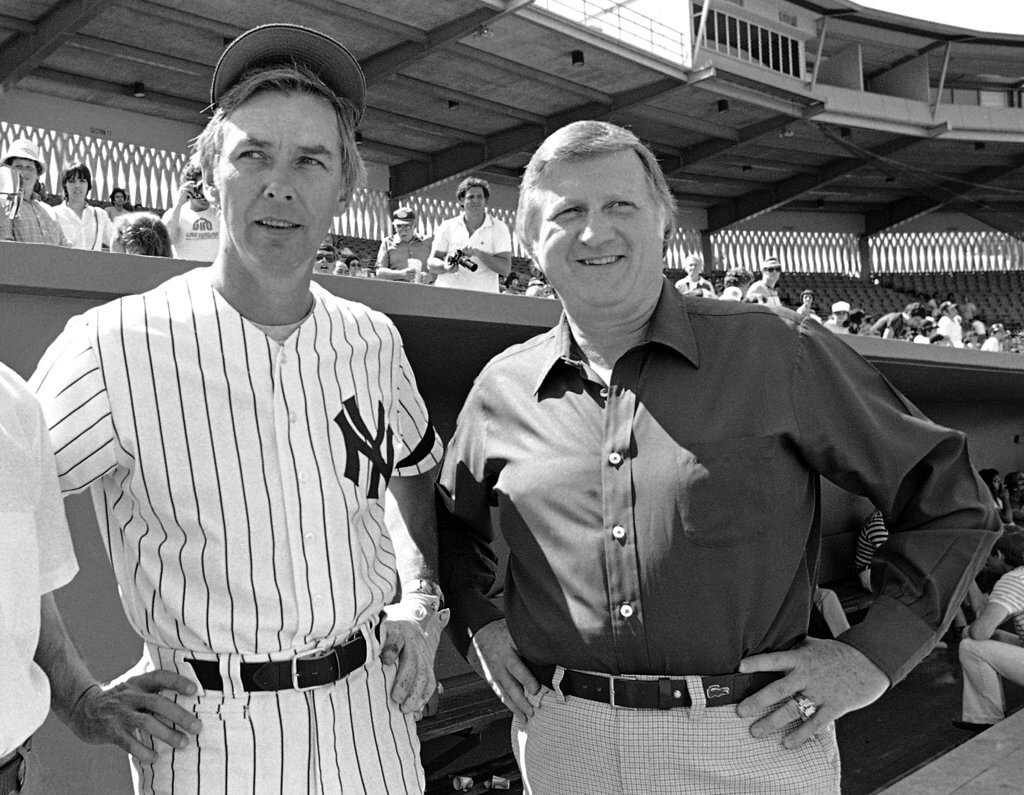
Photo – In this March 1, 1981, file photo, New York Yankees manager Gene Michael, left, and team owner George Steinbrenner are shown during a team workout in Fort Lauderdale, Fla. Gene Michael, the slick-fielding shortstop nicknamed Stick who went on to manage the Yankees and then as a front-office executive built a power than won four World Series titles in a five-year span, died Thursday, Sept. 7, 2017. He was 79. Michael had a heart attack, the Yankees said. (AP Photo/Kathy Willens, File)
And it must be remembered that the last great Yankee dynasty was built not by impulse, but by restraint. Gene “Stick” Michael — running baseball operations during George Steinbrenner’s suspension under Commissioner Fay Vincent — protected the core that would become the Jeter era. He kept the organization from making rash decisions and allowed a young nucleus to develop. In my on-camera interview with Jim Leyritz this summer at the Nick Loeb Foundation 4th Annual Party With The Police in Purchase, NY, he recalled that after the Yankees lost in ’97 on Sandy Alomar Jr.’s home run, George wanted to fire Joe Torre and trade Mariano Rivera. Torre is now a revered figure in the sport. Mariano became the only unanimous Hall of Famer in baseball history. Stick Michael prevented catastrophe — and in doing so, laid the foundation for their last dynasty, now long in the past.
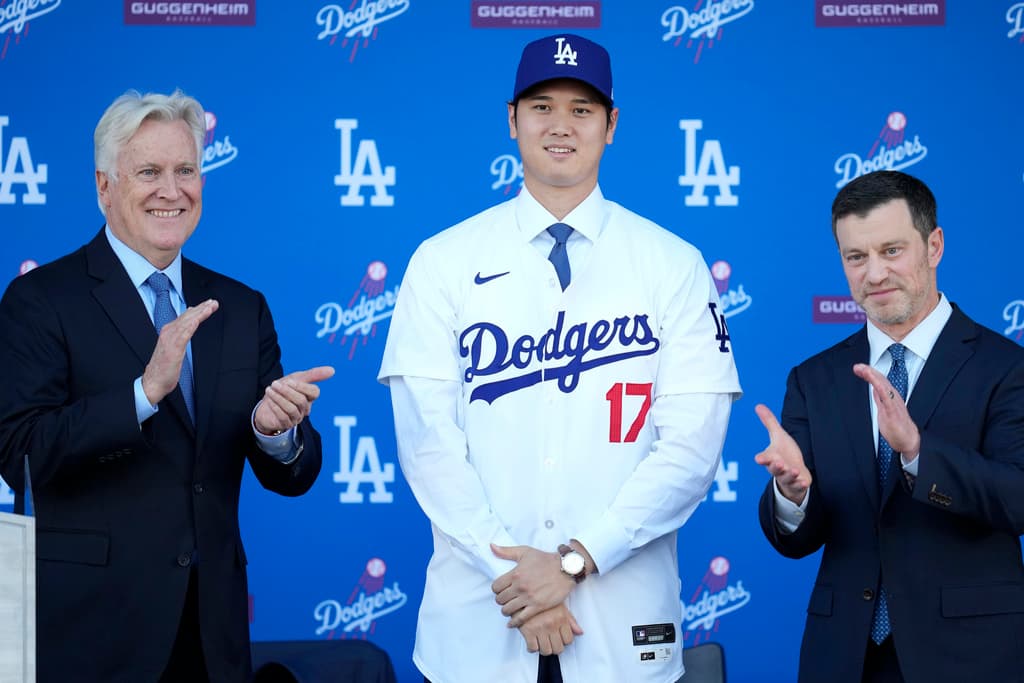
Photo: Los Angeles Dodgers’ Shohei Ohtani, middle, stands as owner & chairman Mark Walter, left, and president of baseball operations Andrew Friedman applaud during a news conference at Dodger Stadium Thursday, Dec. 14, 2023, in Los Angeles. (AP Photo/Ashley Landis)
And in a league now dominated by institutions like Guggenheim — where capital scale meets operational excellence — the cost of drift is no longer measured in seasons. It is measured in eras.
ADDENDUM — THE STANDARD: CHAMPIONSHIPS
Because the Yankees’ standard has never been “competitiveness.”
It has never been “just making the playoffs.”
It has never been “being in the mix.”
The Yankees’ standard — the only standard that ever mattered — is championships.
For nearly a century, the Bronx Bombers won at least one title in every decade except the 1980s, when the Mets briefly owned the city. That was the aberration. That was the outlier. That was the decade that stung because it violated the natural order.
But this century?
One title.
One.
In twenty five years.
The New York Yankees — the franchise that once treated October as its birthright — have become something unthinkable: a legacy brand with a legacy drought. A team that still sells the mythology of dominance while living on the fumes of a dynasty built by men who are no longer in the building.
And this is where the uncomfortable comparison emerges:
Have the Yankees become the Montreal Canadiens of Major League Baseball?
A once unassailable dynasty.
A cathedral franchise.
A global brand.
A team whose history is richer than its present.
A team that still commands reverence but no longer commands fear.
The Canadiens still matter.
They still draw.
They still carry the weight of their crest.
But the era of automatic dominance is gone.
And the Yankees — painfully, unmistakably — are drifting toward that same fate.
Not because they lack money.
Not because they lack fans.
Not because they lack history.
But because the sport has entered an era where wealth alone is no longer enough. Several clubs today are owned by billionaires with private-capital pedigrees — Baltimore, San Francisco, Texas — but that is fundamentally different from what exists in Los Angeles. The Dodgers are not simply the project of a wealthy individual; they are supported by the full scale and liquidity of Guggenheim. Mark Walter is a steward of that institution, not a solo operator. And Guggenheim’s financial architecture — in depth, in durability, in risk-tolerance — exceeds even the considerable resources of Steve Cohen’s Point72. That is the leverage the Dodgers carry, and soon the Lakers.
And this is the contrast that makes the Yankees’ drift so stark.
Because they lack the architecture, the leadership, and the worldview that once made championships inevitable— a deficit that now extends beyond the Bronx and shadows much of Major League Baseball itself.
The Boss demanded rings or death trying.
His heirs maintain the business.
That is the difference.
That is the drift.
That is the truth the December editorial must speak.