In a week when the nation watched its men’s and women’s hockey teams win Olympic gold — each in overtime, each against Canada, each a reminder of what unity and excellence look like — it felt right to return to another American story of resilience and brilliance. I’ve been a hockey man my whole life, a New York Ranger who still remembers where he was when Mike Eruzione scored, and where I was again when Jack Hughes did the same. And two nights earlier, when the women rose in their own overtime, with Hilary Knight and Taylor Heise leading and Leila Edwards — not just the first Black American woman to play Olympic hockey for Team USA, but one of the stars of the tournament — delivering the primary assist on the gold‑medal winner. USA on the chest means something. It always has.
And the story of Black Americans in baseball is part of that same American inheritance — unity, excellence, and the quiet, relentless work of building something together.
There are stories in American life that do not begin on the field, but the field becomes the place where the country finally sees them. The story of Black Americans in baseball is one of those stories — a lineage that predates the box score, outlives the highlight, and sits inside the deeper architecture of who we are as a nation.
Baseball has always been more than a game. It has been a mirror. A ledger. A record of who was allowed to stand where, and when, and under what terms. For Black Americans, the diamond became both a proving ground and a battleground — a place where excellence was undeniable even when recognition was withheld; where presence was transformative even when access was restricted; where memory was preserved even when the official record refused to hold it.
The Negro Leagues were not an alternative. They were an archive — a parallel institution built by a people who refused erasure. They carried the weight of a country that had not yet reconciled with its own contradictions. They held the brilliance, the artistry, the intellect, the discipline, and the inheritance of a community that understood the game long before the game understood them.
Integration did not erase that archive. It complicated it. It folded it into a new chapter of American life — one where Black presence reshaped the sport’s identity, its economics, its culture, and its memory. But it also marked the beginning of a slow, quiet decline in representation, visibility, and institutional stewardship. A decline that mirrored broader currents in American civic life.
The Atmosphere, the World, the Truth of the Negro Leagues
Afternoons at these ballparks felt like ceremonies. Fedoras angled with intention, dresses pressed, shoes shined until they caught the sun. Families settled into wooden seats with the ease of ritual, greeting neighbors, unfolding programs, passing food down the row. Brass bands warmed up beyond the outfield fence, vendors called out in practiced rhythms, and for a few hours the weight of the outside world loosened.
The fields themselves varied with the towns that held them. Some were carved out of fairgrounds and borrowed pastures, outfields sloping just enough to change a hop, fences leaning from years of weather and weathering. Others — Rickwood for a night, Forbes Field when the Grays took it over — felt like borrowed stages transformed by the energy of the crowd. Under flickering lights or in the heat of a sunbaked afternoon, the game moved with a speed and imagination that made the ballparks feel too small to contain it.
And the country’s other league — the one with the marble plagues and the official record — understood more than it ever admitted. The barnstorming circuits made sure of that. In those offseason contests, the best of the white majors faced the best of the Black leagues, and the results were not polite. They were not ambiguous.
Babe Ruth. Lou Gehrig. Dizzy Dean. A handful of others whose reputations would later be carved into Cooperstown marble. They came for the spectacle, for the challenge, for the money — and they left with a new understanding of the game they thought they had mastered.
Josh Gibson sent balls into the night that made outfielders turn and walk. Satchel Paige bent time and space with a grin that suggested he knew something they didn’t. Oscar Charleston cut angles in the outfield no one else could see. Pitchers threw every day. Hitters squared up anything thrown at them.
The truth didn’t need to be spoken aloud. It was right there, ninety feet at a time.
The Players, the Depth, the Inevitability
Across the Negro Leagues, brilliance appeared in forms the country had never bothered to imagine. Josh Gibson hit baseballs that rose instead of falling. Satchel Paige named his pitches like characters in a play — the Bee Ball, the Bat Dodger, the Trouble Ball — each one carrying its own mischief and precision. Oscar Charleston moved through the outfield as if he were reading a map no one else could see. Bullet Rogan pitched and hit with a balance that made him feel like two players stitched into one. Cool Papa Bell ran so fast the stories about him became their own folklore.
Women carved their own place in this world. Toni Stone, Connie Morgan, Mamie “Peanut” Johnson — stepping into a game that barely had room for the men who looked like them and still expanding it with a defiance that made the league feel larger than the country around it.
And behind the legends stood Rube Foster, who built not just a league but an institution — a vision of what Black baseball could be when it wasn’t forced to ask permission. He organized, strategized, negotiated, and imagined a future the country wasn’t ready to inherit.
These were not supporting characters in someone else’s narrative. They were the architects of the game’s imagination.
And the bench behind them was deep. Pitchers who could have dominated a season. Hitters who could have carried a lineup. Fielders who could have changed the geometry of a ballpark. A reservoir of brilliance the majors refused to tap.
The pressure for change was already visible — in the crowds that crossed color lines, in the whispers of scouts, in the barnstorming results no one could deny. By the time the door finally cracked open, the question was never whether Black players were ready.
The question was which of the many would be allowed through.
The Hinge: The Moment the Door Finally Cracked
By the mid‑1940s, the pressure that had been building for decades could no longer be ignored. Scouts had seen enough. Writers had whispered enough. Fans who crossed color lines to watch the Negro Leagues knew exactly what the majors were missing. The question was no longer whether Black players could succeed at the highest level. The question was who would be allowed to prove it.
There were candidates everywhere. Power pitchers like Ray Brown, who once won fourteen straight decisions and carried a career ERA that hovered near 3.00 across more than a decade of work. Hilton Smith, whose curveball was so sharp that Satchel Paige used to pitch the first three innings just to hand him the ball. Leon Day, who struck out eighteen batters in a single game and could play seven positions when he wasn’t on the mound.
In the field, there were players who could have changed the geometry of any ballpark in the majors. Willie Wells, a shortstop whose glove was so sure that major league scouts compared him to the best they had ever seen. Judy Johnson, the third baseman whose teammates nicknamed him “Judy” because he was, in their words, “as steady and reliable as a good woman’s judgment,” a man with hands soft enough to quiet any infield and a lifetime batting average over .300. Turkey Stearnes, whose power and speed made him a threat in every direction — a man who led his league in home runs seven times.
Some believed the first player through the door should have been a pitcher — someone who could seize a game every fourth day and force the country to reckon with excellence it could not deny. Others pointed to Larry Doby, whose steadiness and quiet resolve made him as prepared as anyone.
Branch Rickey understood the storm that would follow the first Black player into the major leagues, and he chose Jackie Robinson because he believed Jackie could withstand it. Not because he was the only one who could have — but because he possessed a rare combination of temperament, intelligence, and athletic brilliance. Robinson had been a world‑class competitor across sports — a football star, an elite basketball player, a track standout, and an infielder, primarily a second baseman, whose instincts bordered on clairvoyant.
But none of that — not the speed, not the strength, not the competitive fire — would have been enough without the steel beneath it. And that steel was not his alone.
Rachel Robinson, whom he married in 1946, was the quiet architecture behind his resolve. Her steadiness, her intellect, her unshakable belief in him, and her refusal to let the world’s hatred define their home life became part of the armor he carried onto the field. She was not just a partner in the modern sense; she was a co‑combatant in a battle neither of them asked for, but both understood. Without that character, that backbone, that shared fortitude, no amount of talent would have carried him through what awaited.
On April 15, 1947, Robinson stepped onto the field in Brooklyn, and the hostility arrived before the first pitch. The taunts, the threats, the isolation — all of it pressed in from every direction. Yet he played with a force that made the noise feel small. His rookie season was not simply impressive; it was undeniable. Rookie of the Year. A .297 average. Twenty‑nine steals. A presence that shifted the way the game imagined itself.
Just a couple of months later, on July 5, 1947, Larry Doby joined the Cleveland Indians in the American League, walking into clubhouses where no one had prepared a place for him. His courage was quieter, less mythologized, but no less immense. He endured the same slurs, the same cold shoulders, the same weight — and still found a way to play with a grace that made the field feel like neutral ground, even when it wasn’t.
Robinson’s greatness only deepened. The stolen bases, the line drives, the way he turned a routine play into a moment that changed the afternoon. The Dodgers rallied around him — Pee Wee Reese, the future captain, with the gesture that became legend, teammates who learned to see him as the center of the team rather than the exception to it. And in 1955, when Brooklyn finally won its only championship, Robinson stood at the heart of a triumph that felt larger than the sport.
The door had opened, but only a crack. The lineage behind it was still waiting.
The Flood of Talent, the Reshaping of the Game
Once the door cracked open, the game changed with a speed that made the old arguments look absurd. The talent that had been kept outside for decades began to flow into the major leagues, and the sport was forced to expand its imagination. What arrived was not a handful of players but a generation — a wave of brilliance that reshaped the geometry of the field and the rhythm of the season.
The early years brought stars who had been ready long before the majors were. Monte Irvin, whose grace and power made him a natural in any era. Don Newcombe, a pitcher with a fastball that seemed to rise and a presence that could anchor a staff. Roy Campanella, commanding behind the plate with an authority that made pitchers better just by throwing to him. Ernie Banks, smiling through summers on the North Side while hitting forty home runs as if it were routine.
And then came the players who redefined what elite meant.
Willie Mays, a center fielder whose instincts bordered on the supernatural. He hit 660 home runs, stole 338 bases, won 12 Gold Gloves, and made catches that seemed to bend the laws of the afternoon. He didn’t arrive first — but when he arrived, the majors finally saw what had been waiting behind the wall.
And on the mound, a new kind of force emerged. Bob Gibson, fierce, disciplined, and unrelenting, became the pitcher who made hitters rethink their courage. His 1968 season — a 1.12 ERA that felt like a personal challenge to the sport — forced baseball to lower the mound the following year. He was a forerunner of what would later be called the Black Aces, and a reminder that the next era would not simply feature Black stars; it would be shaped by them.
Even the teams that had resisted integration the longest were forced to change. The New York Yankees, who had dominated the 1950s without a single Black player, finally opened their doors with Elston Howard in 1955, followed by Al Downing in 1961 and Roy White in 1965 — a slow, reluctant evolution that mirrored the country’s own uneven progress.
The Negro Leagues, once the center of Black baseball life, began to thin. Crowds that had filled their ballparks followed the stars into the majors. Teams that had carried the game through segregation found themselves losing the very players who had defined them. It was a paradox — progress that carried a cost, integration that came with erasure.
And yet the inheritance was unmistakable. The speed. The imagination. The daring on the basepaths. The defensive brilliance. The power that arrived from every angle of the lineup. The style that made the game feel alive in ways it never had before.
The majors had not simply added new players. They had absorbed an entire tradition — a way of playing, a way of competing, a way of understanding the game that had been perfected outside their walls.
The country had changed, and baseball changed with it. But the cost of the delay — the decades of exclusion, the careers cut short, the legends the majors never saw — remained part of the story. The game had gained immeasurably, but it had also lost something it could never fully recover.
And waiting just ahead, though not yet named in this movement, was another kind of courage — the kind that would challenge the game’s economic structure itself. The kind Curt Flood would one day embody.
The lineage that had waited behind the door was now on the field. And the field would never look the same again.
The 1960s: Brilliance, Pressure, and a System That Refused to Move
By the early 1960s, the presence of Black players had become undeniable — not in isolated bursts, but across the entire landscape of the sport. The decade opened with a depth of talent that stretched across both leagues, across every position, across every style of play.
In the American League, Frank Robinson became the kind of force who could tilt a pennant race by himself. His arrival in Baltimore in 1966 didn’t just strengthen a lineup — it shifted the balance of the entire league. His Triple Crown season felt like a declaration that the AL’s center of gravity had moved.
Willie Horton in Detroit became a hometown anchor, a power hitter who carried the weight of a city on his shoulders. Tommy Davis in Los Angeles won batting titles with a swing that felt inevitable. Don Buford brought intelligence and versatility to every team he touched. Earl Battey in Minnesota became one of the best defensive catchers of his era — a quiet master of the craft.
In the National League, the spread was just as deep. Bob Gibson turned pitching into a form of controlled fury — a man whose presence alone changed the strike zone. Lou Brock, after arriving in St. Louis, transformed the basepaths into a weapon. Billy Williams in Chicago became the picture of reliability — a hitter who showed up every day and made the afternoon feel solvable. Dick Allen, explosive and misunderstood, hit baseballs that sounded different off the bat.
And beneath all this excellence, the economics remained stuck in another century.
The reserve clause still bound every player to his team indefinitely. A man could be an MVP, a batting champion, a 20‑game winner — and still earn a salary that would barely support a family of four. There were no long‑term deals. No arbitration. No leverage. No mobility.
The contradiction was glaring:
Black players were transforming the sport while being structurally trapped inside a 19th‑century labor system.
The 1960s were a decade of brilliance and pressure — a decade where the talent soared and the economics refused to evolve. A decade where the game expanded but the system stayed chained to the past. A decade when the stars rose higher and the walls around them stayed the same height.
By the end of the decade, the tension was unbearable. Someone was going to challenge the system. Someone was going to say the sentence that would change everything.
That man was Curt Flood. But his movement — the economic emancipation of the modern player — belongs to the next chapter.
Flood, Freedom, and the Decade of Black Ascendancy
1970–1972. Curt Flood’s stand had cracked the old order, and Marvin Miller, arguably the finest labor lawyer in American history, turned that crack into a structural breach. Miller’s genius was not theatrical — it was procedural. He taught players how to read contracts, how to negotiate, and how to understand leverage. He built a union in a sport that had never imagined one. Flood was the conscience; Miller was the engineer.
The Supreme Court ruled against Flood in 1972, but the ruling only exposed the reserve clause as a relic. And in 1975, arbitrator Peter Seitz issued the decision that effectively ended it. Free agency was born.
Flood never benefited from the freedom he created. But every player who came after him did.
And then the decade erupted.
The 1970s: The Apex of Black American Baseball
Vida Blue — 1971 MVP & Cy Young
Stat: 24–8, 1.82 ERA
Trait: A left arm that felt supernatural — electricity disguised as a delivery. At 21 years old, he became the youngest MVP in decades and the face of a new pitching era.
J.R. Richard — The Unhittable Force (1976–1980)
Stat: 303 strikeouts in 1979
Trait: A fastball that seemed to hiss — intimidation as physics. Hitters didn’t swing early; they prayed late.
Dock Ellis — The Provocateur (1970)
Stat: No‑hitter on June 12, 1970
Trait: Swagger — a man who pitched like he was daring the world to blink. He embodied the era’s defiance and its edge.
Dave Parker — The Cobra (1978 MVP)
Stat: .334 average, 30 HR, 117 RBI in 1978
Trait: Presence — he walked to the plate like he owned the next three minutes. He was the prototype of the modern power‑athlete outfielder.
Joe Morgan — The Engine of the Big Red Machine (1975–76 MVP)
Stat: .466 on‑base percentage in 1975
Trait: Intelligence — he played the game one pitch ahead. He was the best second baseman of his generation.
Lou Brock — The Master Thief (1974)
Stat: 118 stolen bases in 1974
Trait: Kinetic genius — he turned the basepaths into a weapon. He made pitchers nervous before he even took a lead.
Willie Stargell — The Captain (1979 co‑MVP)
Stat: 32 HR at age 39 in 1979
Trait: Gravitas — he led with a presence that made clubhouses stand taller. He was the heartbeat of “We Are Family.”
The Landmark Moment — September 1, 1971
The Pittsburgh Pirates fielded the first all‑Black starting lineup in major league history — American‑born and Afro‑Latino together. It wasn’t a stunt. It wasn’t a statement. It was simply the truth of the era: Black excellence was everywhere.
The Cultural High Notes of the Decade
1973 — Willie Mays Retires
Stat: 660 HR, 338 SB, 12 Gold Gloves
Trait: Completeness — the most fully realized player the game has ever seen. His farewell felt like the closing of a chapter in American memory.
1974 — Hank Aaron Breaks Ruth’s Record
Stat: Home run #715 on April 8, 1974
Trait: Endurance — he absorbed hatred and kept swinging. Supported by Billye Aaron’s steadiness, he endured death threats and venom to surpass the most mythic number in sports.
1977 — Reggie Jackson’s Three Swings
Stat: Three home runs on three pitches in Game 6
Trait: Audacity — he performed like the lights were built for him. It was the most theatrical moment in World Series history.
The Decade’s Meaning
The 1970s were the decade when Black players didn’t just shape baseball — they led it.
• On the mound (Blue, Richard, Ellis, Stewart emerging late)
• In the field (Morgan, Brock, Parker, Stargell)
• In October (Reggie)
• In the labor movement (Flood)
• In the culture (Aaron, Mays)
It was the decade when baseball was still America’s pastime — and the Black American player was at the center of its heartbeat.
And yet, even as the game modernized, the seeds of a future decline were being planted — structural, cultural, and economic forces that would reshape the landscape in the decades to come.
But for this moment — this decade — the game belonged to them.
The Shift: When the Center Began to Move
The 1980s didn’t begin with a collapse. They began with a glow — the afterlight of the 1970s, when Black players had stood at the center of the sport. But as the decade unfolded, the glow softened. Not because the talent disappeared, but because the world around the game began to change.
The new generation arrived with brilliance, charisma, and presence — yet their emergence coincided with a cultural shift that baseball was slow to recognize.
Dwight “Doc” Gooden was the first sign that the old magic still lived. His first three seasons were a phenomenon — a teenager striking out the league, a 20‑year‑old posting a season that still feels unreal, a 21‑year‑old leading the Mets to a title and briefly making them the kings of New York. He pitched with the electricity of a young Satchel Paige — crowds leaning forward, expecting something impossible.
Eddie Murray became the quiet anchor of the decade — a switch‑hitting metronome whose steadiness felt like a modern echo of Buck Leonard. He didn’t chase attention; he accumulated legacy. He was the kind of player who made a franchise feel stable.
Ozzie “The Wizard” Smith played shortstop like it was choreography. His range, his acrobatics, his instinct — it all felt like a living echo of the Negro Leagues’ defensive artistry, where style and substance were never at odds. He made the position feel alive again.
Darryl Strawberry swung like he was uncoiling the sky. There was Josh Gibson in the sound of the ball off his bat — not in the literal power, but in the awe, the way the crowd inhaled when he stepped in. He made the future look limitless.
Rickey Henderson turned the basepaths into a kind of theater. He didn’t just steal bases; he manipulated pitchers, bent innings, rewrote the geometry of the game. He was the modern embodiment of Cool Papa Bell’s imagination — speed as pressure, speed as spectacle.
The talent was still there. The brilliance was still there. The presence was still there.
But the pipeline was beginning to thin.
This is where the decade turns.
In the 1980s and 1990s, Black kids — the same kids who once filled sandlots, schoolyards, and city parks with baseball — began turning elsewhere. Football offered visibility, scholarships, and a cultural spotlight that baseball no longer held. Basketball offered accessibility — a ball, a hoop, a court — and a rising generation of Black superstars who felt closer, more relatable, more immediate.
Baseball, meanwhile, was becoming expensive. Travel teams replaced sandlots. Equipment costs rose. Urban fields disappeared. The game that had once been the easiest to pick up — a stick, a ball, a patch of dirt — was becoming the hardest to enter.
And the sport itself was changing.
The 1981 strike fractured trust. The 1994 strike fractured the country. The steroid era distorted the narrative, overshadowing the contributions of Black stars who played clean, played hard, and played brilliantly.
Yet even amid the shift, there were players who held the line — players whose presence reminded the sport of what it had been and what it could still be.
Ken Griffey Jr. arrived with the most beautiful swing the game had ever seen — a reminder of joy. Barry Bonds, before the era turned strange, played with a completeness that felt like a modern Oscar Charleston. Frank Thomas treated every at‑bat like a negotiation. Gary Sheffield’s bat whipped through the zone like a blade.
They were brilliant. They were essential. They were the last great wave before the decline became undeniable.
By the end of the 1990s, the numbers told the truth: The percentage of Black American players in MLB had begun to fall — slowly at first, then steadily. The reasons were structural, cultural, economic. The game had changed. The country had changed. And the pipeline that had once produced the greatest decade of Black baseball was narrowing.
The Void, the Reckoning, and the First Sparks of Return (2000s–2010s)
The new century opened with a silence that felt unfamiliar.
For the first time since Jackie Robinson broke the line, baseball no longer felt like a natural part of Black American life. The dugouts looked different. The draft boards looked different. The youth leagues looked different. The sport that had once been a cultural inheritance now felt distant — something gated, something slipping away.
The decline that had begun in the 1980s and deepened in the 1990s was now undeniable. Black participation in Major League Baseball fell into single digits. Entire teams went seasons without a single Black American player. The game that had once been central to Black athletic identity — from the Negro Leagues to the 1970s apex — now felt like it belonged to someone else.
The shift had roots everywhere.
Football had become the cultural giant — visible, lucrative, omnipresent. Basketball had become the language of the playground — accessible, expressive, immediate. Baseball, meanwhile, had grown expensive and specialized. Travel ball replaced sandlots. Showcases replaced schoolyards. Private coaching replaced pickup games. The sport drifted toward the suburbs, away from the communities that had once defined it.
And yet — even in the void — there were people who refused to let the story end.
In 1989, Major League Baseball launched RBI — Reviving Baseball in Inner Cities. It was the first institutional acknowledgment that something precious had been lost: fields refurbished, equipment donated, leagues formed, coaches trained. It did not reverse the decline, but it planted the first seeds of return.
By the 2000s, the effort widened. Partnerships were formed with community centers, churches, schools, and local organizers who had been sustaining youth baseball long before MLB noticed. Former players, philanthropists, and civic leaders stepped in — people who understood that baseball had once been a cultural inheritance, not a luxury.
Then came the next wave — more intentional, more structured, more ambitious.
The Hank Aaron Invitational, gathering the best Black high school talent in the country. The Dream Series, spotlighting Black pitchers and catchers — the positions where representation had fallen the furthest. The Jackie Robinson Training Complex, a year‑round development hub. The Breakthrough Series, connecting underserved players with scouts and college programs. The MLB Youth Academies in Compton, Houston, New Orleans, Philadelphia, Washington, and beyond — modern echoes of the sandlots that once shaped the game.
These were not slogans. They were pipelines.
And the geography began to matter again.
Georgia emerged as the epicenter — the modern cradle of Black baseball talent. From Stockbridge to Snellville, from McDonough to Stone Mountain, the state produced a wave of players who would define the renaissance: Michael Harris II, CJ Abrams, Kyle Lewis, Jason Heyward, Dexter Fowler, Brandon Phillips. They were shaped by travel circuits, high‑school powerhouses, and community leagues that turned Georgia into the new California.
Florida became a year‑round proving ground — Miami, Tampa, Orlando, Fort Lauderdale. Triston McKenzie, Jazz Chisholm Jr. (Bahamas‑born but Miami‑developed), and Andrew McCutchen emerged from Florida’s relentless baseball ecosystem.
Texas built its own engine — Houston and Dallas becoming hubs of Black baseball development. The Houston MLB Youth Academy became a lifeline, producing players and coaches who understood the stakes. Texas bred players like Carl Crawford, Michael Bourn, James Loney, Chris Young (OF), Khris Davis (developmentally), and Ke’Bryan Hayes proved that the state remained a true fount of Black baseball talent.
California remained a legacy source — Los Angeles, Long Beach, the Bay Area — producing Hunter Greene, Dominic Smith, J.P. Crawford, Aaron Hicks. The West Coast still carried the echoes of the 1960s–80s Black baseball lineage.
Tennessee, quiet but real, produced Mookie Betts and Tony Kemp — Nashville and Middle Tennessee showing that the renaissance was not confined to the coasts or the Sun Belt.
Signs of return began to appear in places where baseball had once been a birthright.
Little League teams from Chicago’s Jackie Robinson West, from Houston’s RBI programs, from Atlanta’s inner‑city leagues, from the Mid‑Atlantic region — teams with majority‑Black rosters — began appearing on national broadcasts. High‑school programs in Georgia, Florida, and Texas produced waves of Black talent. College rosters, once nearly empty, began to show life — Vanderbilt, Georgia Tech, UCLA, Louisville, Florida State.
The renaissance had not yet arrived — but the architecture was being built.
And in the major leagues, a new generation of Black players began to appear — not in the numbers of the 1970s, not yet, but enough to signal that the story was not over.
They were the first children of the new pipeline. The first proof that the void was not permanent. The first sparks of return.
The Renaissance
The renaissance didn’t arrive with fireworks or fanfare. It arrived the way a season turns — quietly at first, then unmistakably, until you look up and realize the game has changed shape. What returned to baseball wasn’t just talent; it was presence — Black American presence across the field, the mound, the dugout, the suite, and the league office.
You could feel it in the way the game moved. You could hear it in the dugout noise. You could see it in the looseness, the swagger, the joy.
Aaron Judge hit 62 home runs with the calm of a man who knew exactly who he was. Mookie Betts won championships in two cities, stacking Gold Gloves and Silver Sluggers like he was collecting receipts. Marcus Semien played every day like durability was a superpower. Tim Anderson brought expression back to shortstop. Cedric Mullins went 30–30. Byron Buxton moved like a rumor. Michael Harris II glided in center. CJ Abrams ran like he was trying to outrun gravity. Jazz Chisholm Jr. turned baseball into color. J.P. Crawford steadied a franchise. Ke’Bryan Hayes vacuumed third base like he was cleaning up after everyone else.
And the pitchers — the renaissance was loudest on the mound. Hunter Greene threw 100 mph with the ease of a man fulfilling a prophecy. Triston McKenzie, thin as a wire and electric as a storm, carved hitters with a surgeon’s touch. Josiah Gray rose. Taj Bradley rose. Marcus Stroman pitched with a chip and a smile. Jordan Hicks turned sinkers into physics problems. CC Sabathia had said it years earlier: the Black Aces weren’t gone — they were coming. And now they were here.
The dugout reflected the shift. Frank Robinson had broken the line decades earlier, the first Black manager, the first Black manager of the year, the man who carried the weight of two jobs at once: managing a team and managing history. Dusty Baker carried that lineage with a toothpick and a calm that made chaos look organized, winning a World Series as if he’d been waiting for the sport to catch up to him. Dave Roberts didn’t just guide the Dodgers — he built a modern dynasty. Three championships, a stack of division titles, and a résumé that places him alongside the greatest managers the franchise has ever had. If he delivers a third straight title, he will stand shoulder‑to‑shoulder with Walter Alston in the Dodgers’ record books — the most successful Black manager in history, and one of the most successful managers the sport has ever seen. Cito Gaston won back‑to‑back titles. Willie Randolph, Lloyd McClendon, Ron Washington — each one a chapter in the story of Black leadership.
The suite shifted too. Tony Reagins shaped the modern league office. Michael Hill oversaw the game’s on‑field heartbeat. Damon Jones brought his voice into the Dodgers’ front office. De Jon Watson and Billy Owens continued their long tenures as respected evaluators and architects. Elaine Weddington Steward remained a senior executive in Boston, a pioneer whose presence still mattered.
The renaissance wasn’t just statistical. It was cultural. It brought back the looseness, the humor, the joy.
Torii Hunter once said, “If you hit it in the air, I’m gonna catch it,” and spent a decade climbing walls like he was checking the roof shingles. Jimmy Rollins declared, “We’re the team to beat,” and then went out and won MVP like he’d already seen the script. Dontrelle Willis kicked his leg so high it looked like he was trying to swat a fly off the ceiling and said, “I pitched like I was having fun because I was.” Adam Jones saved America in the WBC with a catch so outrageous bald eagles probably saluted and shrugged, “I just wanted to make a play for my country.”
This was the renaissance — not nostalgia, not a replica of the 1970s, but a modern expression of a lineage that had never disappeared, only dimmed. The game had drifted away from Black Americans; now it was opening back up.
The Constellation
Baseball is a game of memory, and Black Americans have given it memories that refuse to fade. You can trace the lineage across decades like stars in a night sky — each one bright, each one distinct, each one shaping the game in ways that statistics alone can’t hold.
In the years when America was learning to watch itself on television, Don Newcombe comes into view first — the Brooklyn pillar, Jackie Robinson’s teammate, the man who won Rookie of the Year in 1949, anchored the Dodgers’ first World Series title in 1955, and in 1956 became the first Cy Young winner in baseball history. That same year he won MVP, completing a trifecta no pitcher has matched since. A multiple 20‑game winner, one of the original Black Aces, and a lifelong Dodger statesman, Newcombe proved — before anyone else on this list — that a Black pitcher could dominate the major leagues.
As the 1950s opened into a new kind of baseball, Willie Mays rose — the Say Hey Kid, the greatest all‑around player the sport has ever seen. Six hundred sixty home runs, twelve Gold Gloves, two MVPs, and a defensive genius whose catches became American folklore. A player whose joy and brilliance made baseball feel limitless.
Hank Aaron followed with quiet thunder — seven hundred fifty‑five home runs, twenty‑five All‑Star selections, a 1957 MVP, and a career built on consistency, dignity, and courage. On April 4, 1974, in Cincinnati, he hit home run number 714 to tie Babe Ruth. Four days later, on April 8, 1974, in Atlanta, he hit number 715 and passed him. He didn’t chase Ruth; he moved beyond him, carrying the weight of America while doing it.
Frank Robinson stepped forward with authority — the only man to win MVP in both leagues, a Triple Crown winner, a 586‑home‑run force, and later the first Black manager in Major League history. Dominant as a player, pioneering as a leader.
Bob Gibson entered like a storm — two Cy Youngs, a 1.12 ERA in 1968 that forced baseball to lower the mound, and a postseason presence that felt mythic. When Gibson took the ball, hitters felt the temperature drop.
Lou Brock glided into the frame — not just a base stealer, but a World Series force, a man who hit when it mattered, ran when it mattered, and lifted St. Louis in October. Nine hundred thirty‑eight stolen bases, yes — but also a .391 World Series hitter.
Billy Williams appeared with elegance — four hundred twenty‑six home runs, a swing so smooth it looked inevitable, a Hall of Famer whose consistency defined the Cubs of the 1960s and early ’70s.
Joe Morgan followed with precision — back‑to‑back MVPs in 1975 and 1976, the engine of the Big Red Machine, a second baseman who controlled games with intelligence, patience, speed, and power. One of the greatest to ever play the position.
Elston Howard stepped in with quiet significance — the first Black Yankee, the 1963 MVP, a catcher who changed the franchise and symbolized the end of the Yankees’ long, shameful delay in integrating.
Al Downing joined him — the first Black American pitcher in Yankees history, a foundational figure, and the man who delivered the pitch Hank Aaron turned into home run number 715 on April 8, 1974. A moment that tied eras together: a Black Yankee on the mound, a Black legend at the plate, and a nation watching a record fall that once felt untouchable.
In the decade when cities were burning and music was changing shape, Willie Horton comes into view — Detroit’s heart in 1968, a man who hit with force and lived with purpose. He wasn’t just a star; he was a civic figure, a stabilizing presence in a city that needed one.
Willie Stargell follows, Pops, the captain of the “We Are Family” Pirates, smiling like he knew the whole sport was supposed to be fun. “They don’t say ‘work ball,’” he liked to remind people. “They say ‘play ball.’” His home runs weren’t just long — they were majestic, towering arcs that seemed to pause mid‑flight to admire themselves.
Dave Parker emerges with presence — The Cobra, a man who hit baseballs like they owed him money. “When the leaves turn brown, I’ll be wearing the crown,” he said, and for a long stretch of the 1970s, he wasn’t lying. In the ’79 All‑Star Game, he threw a ball from right field so hard it arrived before the runner knew he’d hit it. That wasn’t a throw — it was a declaration.
Reggie Smith takes his place in the frame — 314 home runs, seven All‑Star selections, a switch‑hitting force whose swing looked poured, not swung. One of the most underrated greats the game has ever known. A man whose numbers whisper “Hall of Fame” even if the voters never listened.
George Foster enters with the force of a detonation — 52 home runs in 1977, the only 50‑homer season of the entire decade, the muscle of the Big Red Machine. A hitter who didn’t just change games; he changed seasons.
Vida Blue follows with the calm of a young ace who knew the ball belonged to him. Twenty‑four wins, a 1.82 ERA, MVP and Cy Young at age 21. The electric left‑hander at the front of a dynasty that won three straight World Series. A star who pitched with brilliance and carried himself with grace.
In the years when cable television turned athletes into icons, Darryl Strawberry enters like a comet — elegance and violence in the same swing. Eight All‑Star selections, four rings, 335 home runs, and a presence that felt mythic. His swing looked like it was drawn with a compass — perfect, smooth, inevitable.
Eric Davis follows with quiet electricity. Thirty‑seven home runs and fifty steals in 1987. Power, speed, grace, menace. A center fielder who moved with the smooth, predatory glide of a gazelle. Peers still talk about him in reverent tones — the player ahead of his time.
Mookie Wilson appears with a moment that became folklore — the ball that rolled through Bill Buckner’s legs in Game 6 of the 1986 World Series. Wilson didn’t just hit a ground ball; he hit a cultural memory.
Cecil Fielder arrives with thunder — fifty‑one home runs in 1990, a season that felt like a shockwave. Power incarnate. A man who hit baseballs so hard and so far that his son, Prince, grew up thinking that was normal.
In the decade when the internet rewired fame, Barry Larkin steps forward with the calm of a master craftsman — Hall of Famer, 1995 MVP, twelve All‑Star selections, one of the greatest shortstops the game has ever seen. The bridge between Ozzie Smith and Derek Jeter.
Frank Thomas enters like a cathedral bell — The Big Hurt. Five hundred twenty‑one home runs. Two MVPs. A right‑handed swing that felt like a sermon. Power with discipline, force with patience.
Ken Griffey Jr. glides into view — the silhouette. Six hundred thirty home runs. Thirteen All‑Star selections. The most beautiful swing ever created. A cultural icon whose backwards cap became a national symbol of joy.
Gary Sheffield steps in with menace — five hundred nine home runs, a bat waggle that became a warning, and a presence in the box that made pitchers rethink their life choices.
Fred McGriff stands beside him — The “Crime Dog”. Four hundred ninety‑three home runs. Consistency incarnate. A Hall of Famer who never needed noise to be great.
Barry Bonds casts the longest shadow — seven MVPs, seven hundred sixty‑two home runs, seventy‑three in a single season, more intentional walks than some Hall of Famers have hits. “The greatest hitter who ever lived” isn’t hyperbole — it’s arithmetic. “I don’t have to prove my worth to anyone,” he said — and he didn’t. His Hall of Fame snub, in my opinion, is ridiculous, and history will correct it.
In the years when baseball became a global broadcast, Derek Jeter entered with quiet command — 3,465 hits, five rings, and a calm that made chaos look organized. “The last thing you want to do is finish playing and wish you’d worked harder,” he said — and he never did. He didn’t need flash. He was the flash.
CC Sabathia anchors the era — Cy Young winner, 251 victories, the last great Black American ace before the Greene/McKenzie generation. A workhorse who carried teams on his back and never blinked.
David Price steps into the constellation with the dignity of a man too often forgotten — Cy Young winner, postseason force, a modern ace whose excellence deserves to be remembered alongside the greats.
Torii Hunter arrives with a grin — nine Gold Gloves, climbing walls like he was checking the roof shingles. “If you hit it in the air, I’m gonna catch it,” he said — and pitchers believed him. He robbed Barry Bonds in the All‑Star Game and smiled like he’d just stolen a cookie.
Adam Jones brings charisma — five All‑Star selections, four Gold Gloves, and the catch in the World Baseball Classic that made bald eagles salute. “I just wanted to make a play for my country,” he said, as if he hadn’t just rescued a nation on live television.
Jimmy Rollins slides into the constellation — MVP, champion, the engine of the Phillies’ golden era, who he went out and proved it with thirty homers, forty‑one steals, and enough swagger to power a city.
Andrew McCutchen brings warmth — 2013 MVP, five All‑Star selections, the heartbeat of Pittsburgh’s revival. A smile that lifted a franchise and a city.
These men are the constellation — the stars that shaped the sky the modern players play under.
And the modern players are not just inheritors; they are heirs. Judge carrying the Captain’s mantle with grace. Betts winning everywhere he goes. Semien showing up every day. Mullins disrupting. Buxton flashing brilliance that still feels mythic when his body allows it.. Harris II gliding through center as if the grass were tilted in his favor. Abrams turning speed into a spectacle. Jazz moving with the rhythm and bravado of Hip Hop itself. Crawford anchoring a franchise with quiet authority. Hayes defending third like it’s a family heirloom.
The lineage extends beyond the field. As a reminder, Reagins shaping the league office. Hill overseeing the game’s heartbeat. Damon Jones has a seat in the Guggenheim Dodgers’ front office. Watson and Owens evaluating talent with the authority of men who’ve seen everything. Elaine Weddington Steward still shaping Boston’s front office decades after breaking barriers.
And Magic Johnson — a limited partner in Chavez Ravine — stands as a reminder that the lineage is not confined to the field. Black ownership still has a distance to travel, but it is no longer unthinkable.
This is the constellation — the players, the moments, the voices, the architects, the heirs. The stars that shaped the sky the modern renaissance rises under.
The Roll Call: Black American MVPs & Cy Young Winners
A ceremonial record of the lineage
Most Valuable Players
• Jackie Robinson — 1949
• Willie Mays — 1954, 1965
• Hank Aaron — 1957
• Frank Robinson — 1961, 1966
• Elston Howard — 1963
• Joe Morgan — 1975, 1976
• George Foster — 1977
• Willie Stargell — 1979 (co‑MVP)
• Don Baylor — 1979
• Rickey Henderson — 1990
• Barry Bonds — 1990, 1992, 1993, 2001, 2002, 2003, 2004
• Ken Griffey Jr. — 1997
• Jimmy Rollins — 2007
• Andrew McCutchen — 2013
• Mookie Betts — 2018
• Aaron Judge — 2022, 2024, 2025
Cy Young Award Winners
• Don Newcombe — 1956
• Bob Gibson — 1968, 1970
• Vida Blue — 1971
• Dwight Gooden — 1985
• CC Sabathia — 2007
• David Price — 2012
The Stewardship
Before there was a renaissance, there was a beginning — and the beginning was the Negro Leagues. That league was more than a circuit; it was a declaration that Black excellence didn’t need permission to exist. It was a world built by men who refused to wait for an invitation, and no one embodied that spirit more than Buck O’Neil. Buck didn’t just play the game — he carried its memory, protected its stories, and insisted that the world understand what Black baseball had given America.
Bob Kendrick inherited that charge. Not as a curator. As a steward.
Under his voice, the Negro Leagues Baseball Museum stopped being a museum and became a national monument — a cathedral of American memory. You don’t walk through it; you move through it the way you move through a story that belongs to you. Kendrick doesn’t just preserve the past — he throws it forward. He is the living bridge between the men who built the game in shadows and the players who shine under stadium lights today.
There’s an old saying: Father throws the ball far. Son throws it farther. Buck threw it far. Kendrick is throwing it farther. And the sons and daughters of this lineage — the players, the managers, the executives, the women shaping the sport — are throwing it farther still.
Because the renaissance we see today is not a surprise. It is not a miracle. It is not a return from absence.
It is the continuation of a story that never stopped. A story carried by men who refused to be forgotten. A story protected by stewards who understood that memory is a form of power. A story now being written by a generation that knows exactly what it stands on.
And baseball is better for it — just as America is better for the rise of Black Americans across every walk of life. From the father and the hardworking son, to the wife, mother, and professional; from the small business owner to the leaders in the C‑suite; from the neighborhoods that shaped them to the White House itself. Through thick and thin, in triumph and in trial, Black Americans have carried their share of the American story — and more. Baseball is simply one of the places where that story has been told in public, in motion, in full view of the nation.
The men and women in today’s game stand on shoulders that were broad enough to lift generations. They are paying forward a legacy that was earned in sweat, brilliance, courage, and faith — a legacy as powerful and indelible as any in American life.
The Negro Leagues were the beginning. The constellation is the inheritance. The renaissance is the proof.
And the future — the one rising right now — is the next chapter of a story that has always belonged to us.
And just as those gold medal teams reminded us of who we are at our best, this story does too. Black Americans in baseball — from the Negro Leagues to the renaissance rising now — are part of the same American arc: unity, excellence, and the belief that the future is ours to build together. USA is not a chant. It is an inheritance. And this story belongs inside it.
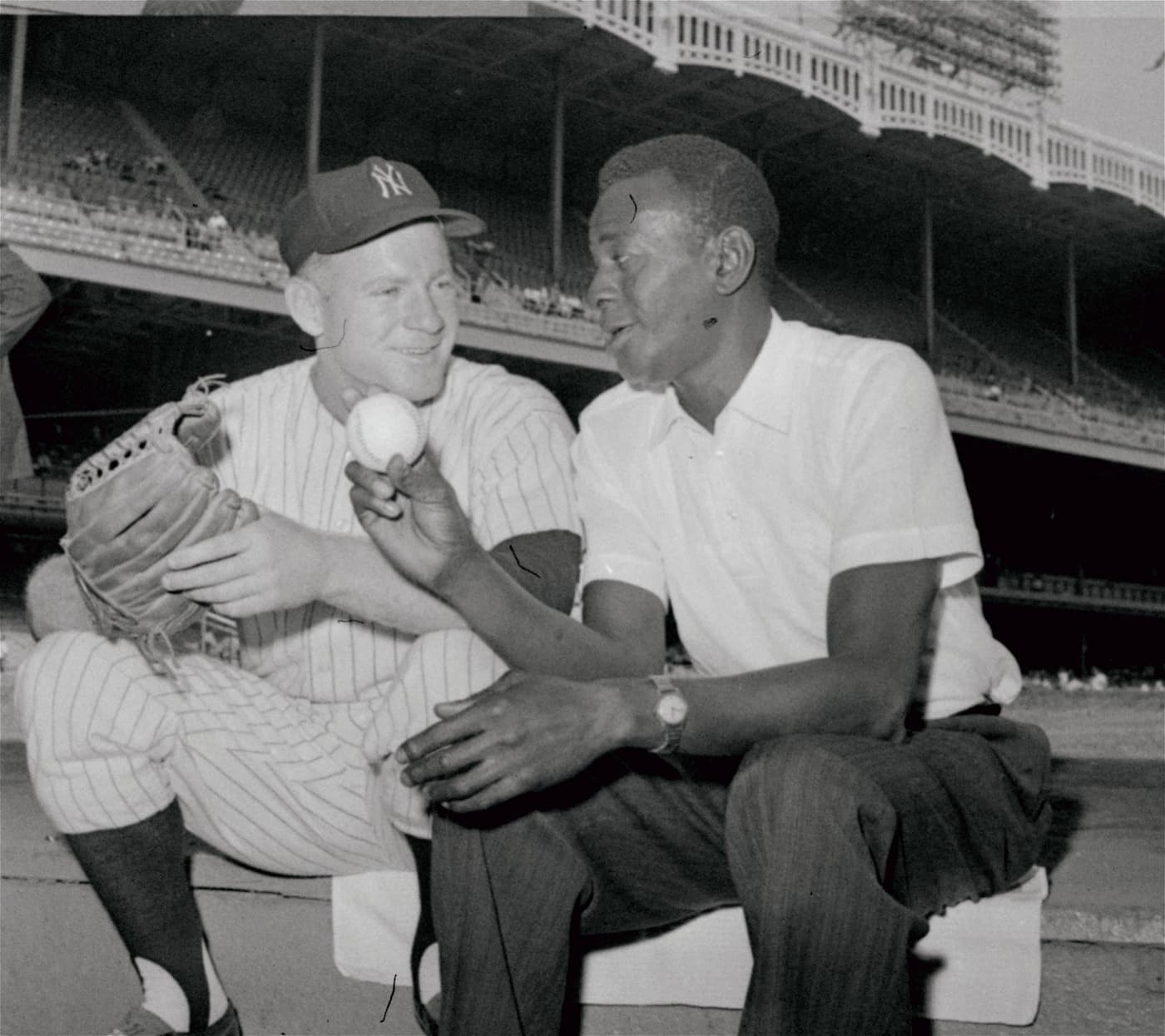
Photo: New York Yankee pitcher Whitey Ford, left, and Satchel Paige, star Negro League pitcher and former major leaguer, swap pitching talk on steps of the Yankee dugout in New York on August 17, 1961. Paige and Ford talked before the Yankee game with Chicago White Sox. Yanks won game, 5-3. (AP Photo)