And the story of Black Americans in baseball is part of that same American inheritance — unity, excellence, and the quiet, relentless work of building something together.
There are stories in American life that do not begin on the field, but the field becomes the place where the country finally sees them. The story of Black Americans in baseball is one of those stories — a lineage that predates the box score, outlives the highlight, and sits inside the deeper architecture of who we are as a nation.
Baseball has always been more than a game. It has been a mirror. A ledger. A record of who was allowed to stand where, and when, and under what terms. For Black Americans, the diamond became both a proving ground and a battleground — a place where excellence was undeniable even when recognition was withheld; where presence was transformative even when access was restricted; where memory was preserved even when the official record refused to hold it.
The Negro Leagues were not an alternative. They were an archive — a parallel institution built by a people who refused erasure. They carried the weight of a country that had not yet reconciled with its own contradictions. They held the brilliance, the artistry, the intellect, the discipline, and the inheritance of a community that understood the game long before the game understood them.
Integration did not erase that archive. It complicated it. It folded it into a new chapter of American life — one where Black presence reshaped the sport’s identity, its economics, its culture, and its memory. But it also marked the beginning of a slow, quiet decline in representation, visibility, and institutional stewardship. A decline that mirrored broader currents in American civic life.
The Atmosphere, the World, the Truth of the Negro Leagues
Afternoons at these ballparks felt like ceremonies. Fedoras angled with intention, dresses pressed, shoes shined until they caught the sun. Families settled into wooden seats with the ease of ritual, greeting neighbors, unfolding programs, passing food down the row. Brass bands warmed up beyond the outfield fence, vendors called out in practiced rhythms, and for a few hours the weight of the outside world loosened.
The fields themselves varied with the towns that held them. Some were carved out of fairgrounds and borrowed pastures, outfields sloping just enough to change a hop, fences leaning from years of weather and weathering. Others — Rickwood for a night, Forbes Field when the Grays took it over — felt like borrowed stages transformed by the energy of the crowd. Under flickering lights or in the heat of a sunbaked afternoon, the game moved with a speed and imagination that made the ballparks feel too small to contain it.
And the country’s other league — the one with the marble plagues and the official record — understood more than it ever admitted. The barnstorming circuits made sure of that. In those offseason contests, the best of the white majors faced the best of the Black leagues, and the results were not polite. They were not ambiguous.
Babe Ruth. Lou Gehrig. Dizzy Dean. A handful of others whose reputations would later be carved into Cooperstown marble. They came for the spectacle, for the challenge, for the money — and they left with a new understanding of the game they thought they had mastered.
Josh Gibson sent balls into the night that made outfielders turn and walk. Satchel Paige bent time and space with a grin that suggested he knew something they didn’t. Oscar Charleston cut angles in the outfield no one else could see. Pitchers threw every day. Hitters squared up anything thrown at them.
The truth didn’t need to be spoken aloud. It was right there, ninety feet at a time.
The Players, the Depth, the Inevitability
Across the Negro Leagues, brilliance appeared in forms the country had never bothered to imagine. Josh Gibson hit baseballs that rose instead of falling. Satchel Paige named his pitches like characters in a play — the Bee Ball, the Bat Dodger, the Trouble Ball — each one carrying its own mischief and precision. Oscar Charleston moved through the outfield as if he were reading a map no one else could see. Bullet Rogan pitched and hit with a balance that made him feel like two players stitched into one. Cool Papa Bell ran so fast the stories about him became their own folklore.
Women carved their own place in this world. Toni Stone, Connie Morgan, Mamie “Peanut” Johnson — stepping into a game that barely had room for the men who looked like them and still expanding it with a defiance that made the league feel larger than the country around it.
And behind the legends stood Rube Foster, who built not just a league but an institution — a vision of what Black baseball could be when it wasn’t forced to ask permission. He organized, strategized, negotiated, and imagined a future the country wasn’t ready to inherit.
These were not supporting characters in someone else’s narrative. They were the architects of the game’s imagination.
And the bench behind them was deep. Pitchers who could have dominated a season. Hitters who could have carried a lineup. Fielders who could have changed the geometry of a ballpark. A reservoir of brilliance the majors refused to tap.
The pressure for change was already visible — in the crowds that crossed color lines, in the whispers of scouts, in the barnstorming results no one could deny. By the time the door finally cracked open, the question was never whether Black players were ready.
The question was which of the many would be allowed through.
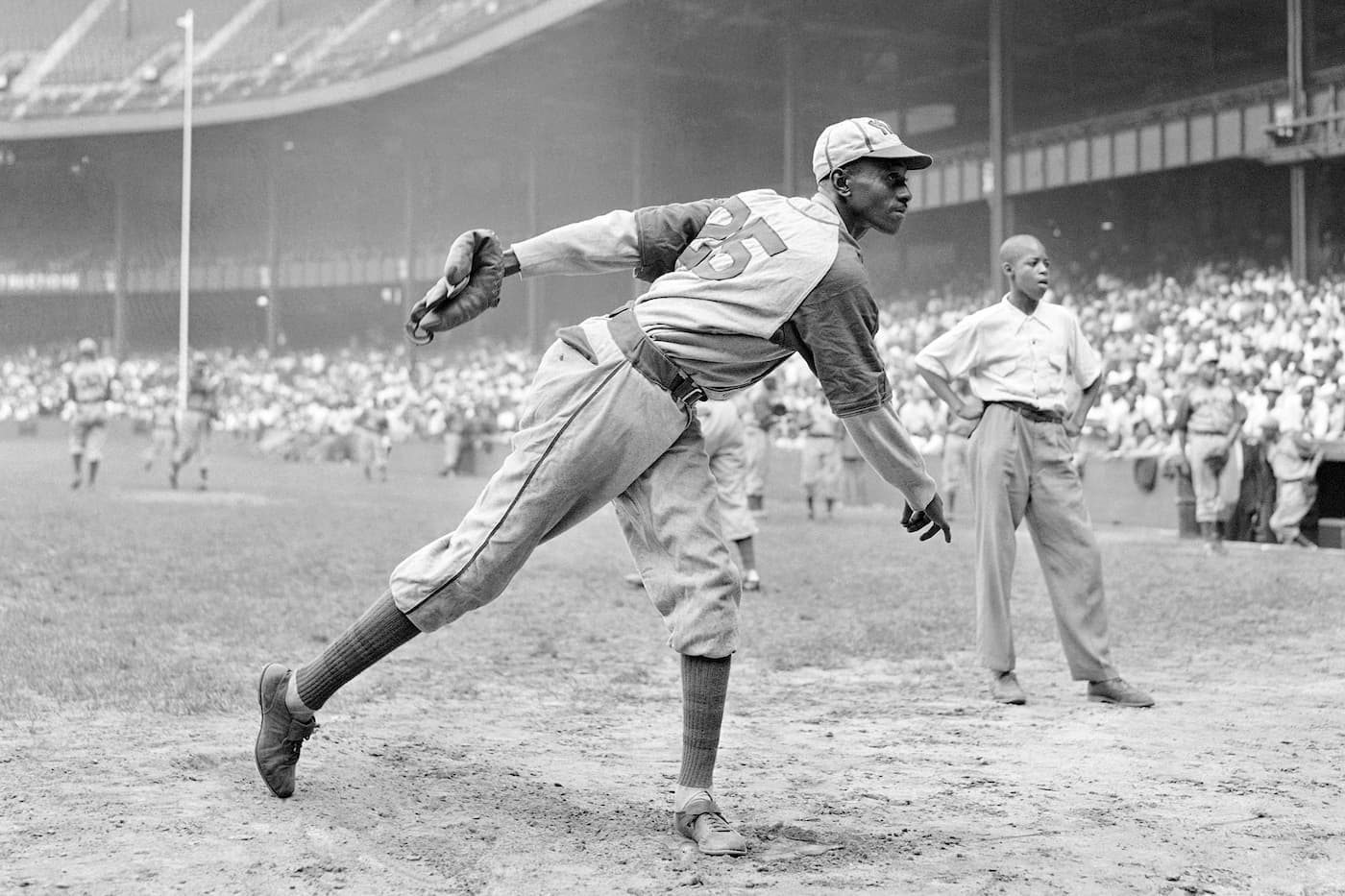
Photo: Satchel Paige warms up at New York’s Yankee Stadium before a Negro League game between the Kansas City Monarchs and the New York Cuban Stars on Aug. 2, 1942. (AP Photo/Matty Zimmerman, File)