ORLANDO, Fla. – In Part One, “Jeff Kent Gets the Call: Inside the Contemporary Era Vote — Part One, Live from the Winter Meetings in Orlando,” World Baseball Network broke down how Jeff Kent became the lone player elected to the National Baseball Hall of Fame Class of 2026 by the Contemporary Baseball Era Committee.
Part Two turns to the two most decorated names left standing outside Cooperstown: Roger Clemens and Barry Bonds, whose Hall of Fame chances took a significant blow in Orlando when both received fewer than five votes from the 16-member committee.

Photo: Houston Astros catcher is Brad Ausmus, right, signals for an intentional walk from pitcher Roger Clemens, left, against San Francisco’s Barry Bonds during the first inning in Houston, Wednesday, April 7, 2004. (AP Photo/Brett Coomer)
Under the Hall of Fame’s updated rules, any player who receives fewer than five votes in a Contemporary Era cycle is ineligible for the next one. That means Clemens and Bonds will not appear on the 2028 ballot. Their next opportunity will not come until 2031, and if they again fail to reach five votes, their candidacies will effectively end under the current guidelines.
The tone around the Hyatt and convention floors here in Orlando reflects that reality. On Foul Territory, Ken Rosenthal framed the moment bluntly, saying Bonds’ and Clemens’ Hall of Fame chances are now “in real peril” after the committee’s decision:
Jeff Kent shares his thoughts on Barry Bonds' Hall-of-Fame debate ???? pic.twitter.com/QjmD89CtWt
— SF Giants on NBCS (@NBCSGiants) December 8, 2025
Even newly elected Hall of Famer Jeff Kent was asked about Bonds’ candidacy in the aftermath of his own election. Kent stayed neutral, but his comments underscored how complicated this debate has become for the players who lived it.
Barry Bonds and Roger Clemens' Hall of Fame chances are in real peril after not being elected by the Contemporary Baseball Era committee, says @Ken_Rosenthal. pic.twitter.com/aRdvg288FU
— Foul Territory (@FoulTerritoryTV) December 8, 2025
Roger Clemens
Roger Clemens’ career remains one of the most decorated in Major League history. He was named to 11 All-Star Games, won two World Series championships with the New York Yankees in 1999 and 2000, and captured the 1986 American League Most Valuable Player Award. He earned seven Cy Young Awards across both leagues, twice won the pitching Triple Crown, led his league in wins four times, in earned run average seven times, and in strikeouts five times. Clemens is also one of the few pitchers in MLB history to record 20 strikeouts in a nine-inning game twice, and his dominance was recognized with the Commissioner’s Historic Achievement Award, a place on Major League Baseball’s All-Century Team, and induction into the Boston Red Sox Hall of Fame.
Barry Bonds and Roger Clemens belong in the Hall of Fame. Arguably the best hitter and pitcher of all time, respectively.
The idea that they are not getting the votes is a stain on baseball history.
— JohnRocker (@itsJohnRocker) December 8, 2025
Clemens’ international spotlight came after his first retirement from MLB, when he played for the United States in the inaugural World Baseball Classic in 2006. He went 1–1 with Team USA and threw 8.2 innings in two starts, posting a 2.08 ERA, allowing seven hits, two earned runs, and one hit batter, while striking out 10. The United States was eliminated in Pool 1 at Angel Stadium in Anaheim, Calif., finishing 1–2. Team USA ended with the same record as eventual champion Japan but did not qualify for the semifinals due to the Total Quality Balance run differential format.
Clemens made his mark with scouts when he began his college career pitching for San Jacinto College North in 1981, where he posted a 9–2 record before transferring to the University of Texas the following year. With the Texas Longhorns, Clemens compiled a 25–7 record in two All-American seasons and helped the program win the 1983 College World Series at Johnny Rosenblatt Stadium in Omaha, Neb. He became the first player to have his baseball uniform number retired at Texas after an extraordinary run that included 35 consecutive scoreless innings, an NCAA record that stood until Justin Pope broke it in 2001.
Roger Clemens and Kody Clemens have combined for 4673 strikeouts. The most ever by a Father/Son duo in MLB History. pic.twitter.com/pw7LSw8cGG
— Baseball’s Greatest Moments (@BBGreatMoments) December 7, 2025
Prior to the 2004 season, the Rotary Smith Award, which recognized the best college baseball player in the United States, was renamed the Roger Clemens Award, honoring the top pitcher across NCAA Division I.
Clemens was first selected by the New York Mets in the 12th round of the 1981 MLB Draft after his junior college season but did not sign, instead continuing his development in Austin. He was later drafted in the first round, 19th overall, of the 1983 MLB Draft by the Boston Red Sox, beginning his professional career soon after.
Over 24 Major League seasons, Clemens pitched for the Boston Red Sox from 1984–96, the Toronto Blue Jays from 1997–98, the New York Yankees from 1999–2003 and again in 2007, and the Houston Astros from 2004–06. His final statistics included a 138.7 WAR, 707 starts in 707 appearances, a 354–184 record, 118 complete games, 46 shutouts, a 3.12 ERA, and 4,916.2 innings pitched. He allowed 4,185 hits, 1,707 earned runs, and 363 home runs, walked 1,580 batters, struck out 4,672, and finished with a 1.173 WHIP.
Clemens was alleged by the Mitchell Report to have used anabolic steroids late in his career based on testimony from his former trainer, Brian McNamee. Clemens denied those allegations under oath in front of the United States Congress, which led congressional leaders to refer his case to the Justice Department on suspicions of perjury. On August 19, 2010, a federal grand jury in Washington, D.C., indicted Clemens on six felony counts, including perjury, false statements, and contempt of Congress. He pleaded not guilty, and the proceedings were complicated by prosecutorial misconduct that resulted in a mistrial. In June 2012, Clemens was found not guilty on all six counts of lying to Congress.
Despite his dominance, Clemens never received the 75 percent of votes required for induction in his ten years of BBWAA eligibility, peaking at 65.2 percent in 2022 before shifting to the Contemporary Era Player Ballot. His failure to reach five votes in this committee round now leaves his fate to a final review in 2031.
A Presidential Push from the Donald J. Trump
Even before the committee met in Orlando, former President Donald Trump weighed in on Clemens’ candidacy on social media, calling the pitcher’s legal saga a “Witch Hunt” and saying that if Clemens did not get into the Hall of Fame, he “should sue the hell out of Major League Baseball.”
( @realDonaldTrump – Truth Social Post )
( Donald J. Trump – Dec 07 2025, 1:45 PM ET )Roger Clemens, who won 354 games, went through his own Witch Hunt. HE WAS ACQUITTED OF ALL CHARGES!!! If he doesn’t get into the Hall of Fame, he should sue the hell … pic.twitter.com/jodO9GjTZw
— Donald J Trump Posts TruthSocial (@TruthTrumpPost) December 7, 2025
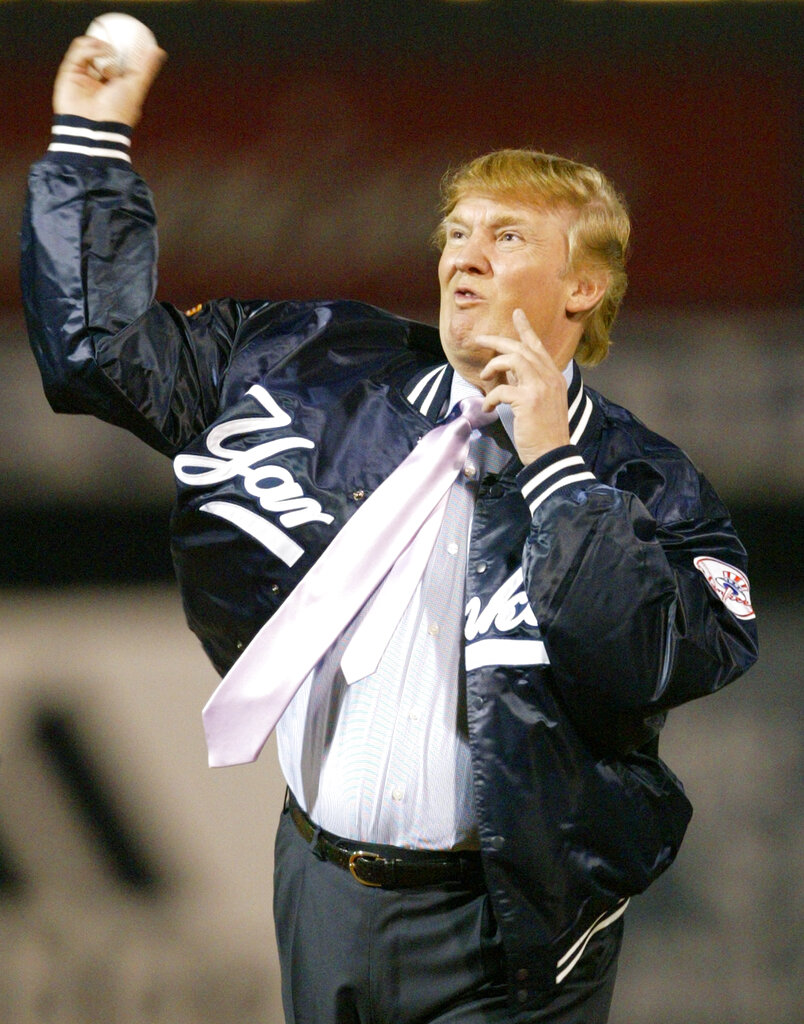
Businessman Donald Trump throws out the first pitch before the New York Yankees faced the Houston Astros, Friday, March 12, 2004, at Legends Field in Tampa, Fla. (AP Photo/Kathy Willens)
Barry Bonds
Barry Bonds’ list of accomplishments is as long as any player in the sport’s history. He was a 14-time All-Star, winning selections in 1990, from 1992–1998, from 2000–2004, and again in 2007. He earned seven National League Most Valuable Player Awards, three of them in the early 1990s and four more during his historic run from 2001–2004. Bonds claimed eight Gold Glove Awards in left field, 12 Silver Slugger Awards, three NL Hank Aaron Awards, two batting titles, two home run crowns, and one RBI title. His number 25 is retired by the San Francisco Giants, and he is a member of both the Pittsburgh Pirates Hall of Fame and the San Francisco Giants Wall of Fame.
Bonds holds multiple all-time MLB records, including 762 career home runs and 73 home runs in a single season. He also owns the records for 2,558 career walks, 232 walks in a single season, and a .609 on-base percentage in a single season.
Before his Major League career, Bonds represented the United States at the 1984 Amateur World Series in Havana, Cuba, where he won a bronze medal and hit .304 with three home runs, 16 RBIs, and 10 runs scored in 11 games. He helped the United States defeat Japan 8–4 at Estadio Latinoamericano.
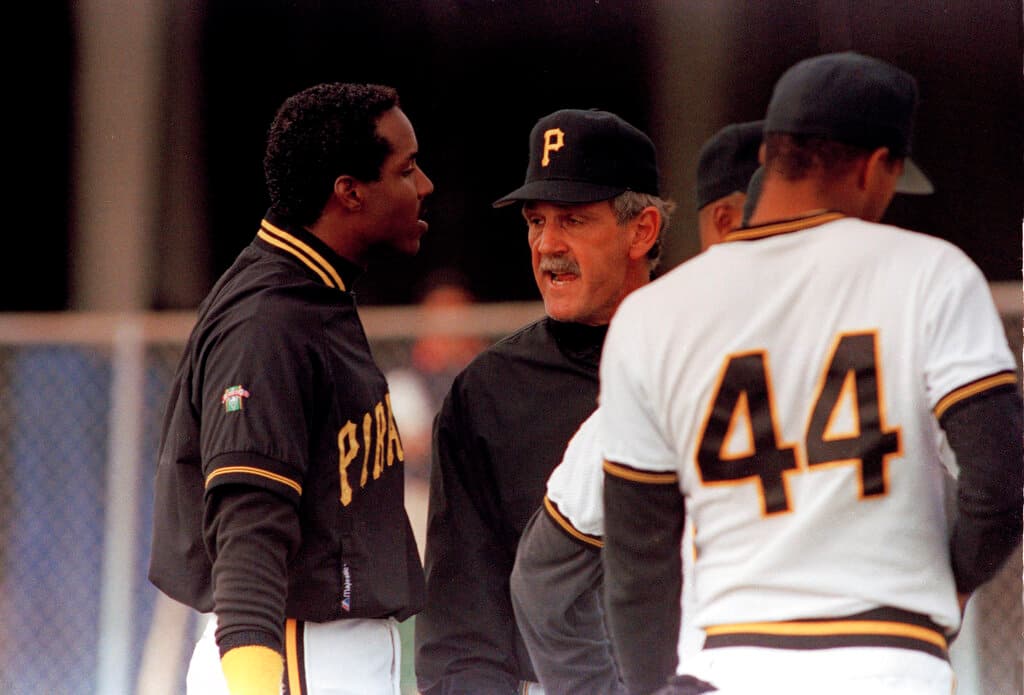
Pirates outfielder Barry Bonds, left, shrugs as manager Jim Leyland angrily tells him if he is not happy he should get out of camp during a confrontation in Bradenton, Fla., March 4, 1991. (AP Photo/Rusty Kennedy)
At Arizona State University, Bonds played two seasons in 1984 and 1985, batting .347 with 45 home runs and 175 RBIs before being selected by the Pittsburgh Pirates as the sixth overall pick in the 1985 MLB Draft.
Bonds played 22 seasons in the Major Leagues, with the Pittsburgh Pirates from 1986–92 and the San Francisco Giants from 1993–2007. He won seven National League MVP Awards and eight Gold Gloves, becoming MLB’s all-time home run leader and setting single-season records for home runs, walks, and on-base percentage. He led the National League in on-base percentage ten times and twice led the league in batting average. His career WAR of 162.8, along with his 2,558 walks, 688 intentional walks, and 762 home runs, is unmatched in MLB history.
In 2007, Bonds was charged with perjury and obstruction of justice for allegedly lying to a grand jury during the federal government’s investigation of BALCO, a manufacturer of an undetectable steroid. After the perjury charges were dropped, Bonds was convicted of obstruction of justice in 2011, but he was exonerated on appeal in 2015.
From his ten years of eligibility on the BBWAA ballot, Bonds fell short of the 75 percent threshold required for induction. His annual percentages from 2013 through 2022 were 36.2, 34.7, 36.8, 44.3, 53.8, 56.4, 59.1, 60.7, 61.8, and 66 percent, appearing on 260 of 394 ballots in his final year.
Over 22 seasons, Bonds played in 2,986 games with 12,606 plate appearances and posted a lifetime batting average of .298. He recorded 2,935 hits, 601 doubles, 77 triples, 1,996 RBIs, 514 stolen bases, and 1,539 strikeouts, with a career OPS of 1.051.
What Their Committee Results Mean Going Forward
Here in Orlando, the outcome of the Contemporary Era vote has added new weight to numbers that were already historic. Clemens and Bonds now stand one cycle away from the end of their Hall of Fame road under the current structure.
They will not appear when the Contemporary Era Players Committee reconvenes in 2028. Their next opportunity will be in 2031, and if they once again receive fewer than five votes, the Hall of Fame’s position on two of the most dominant players in baseball history will be effectively set.
For now, the plaque room in Cooperstown will add Jeff Kent — the all-time home run leader among second basemen and their longtime contemporary — while Bonds and Clemens remain on the outside, waiting on one last committee room many years from now.
World Baseball Network will continue its live coverage from Orlando in Part Three, focusing on Carlos Delgado, Fernando Valenzuela, and the international case for Cooperstown in the wake of this ballot.