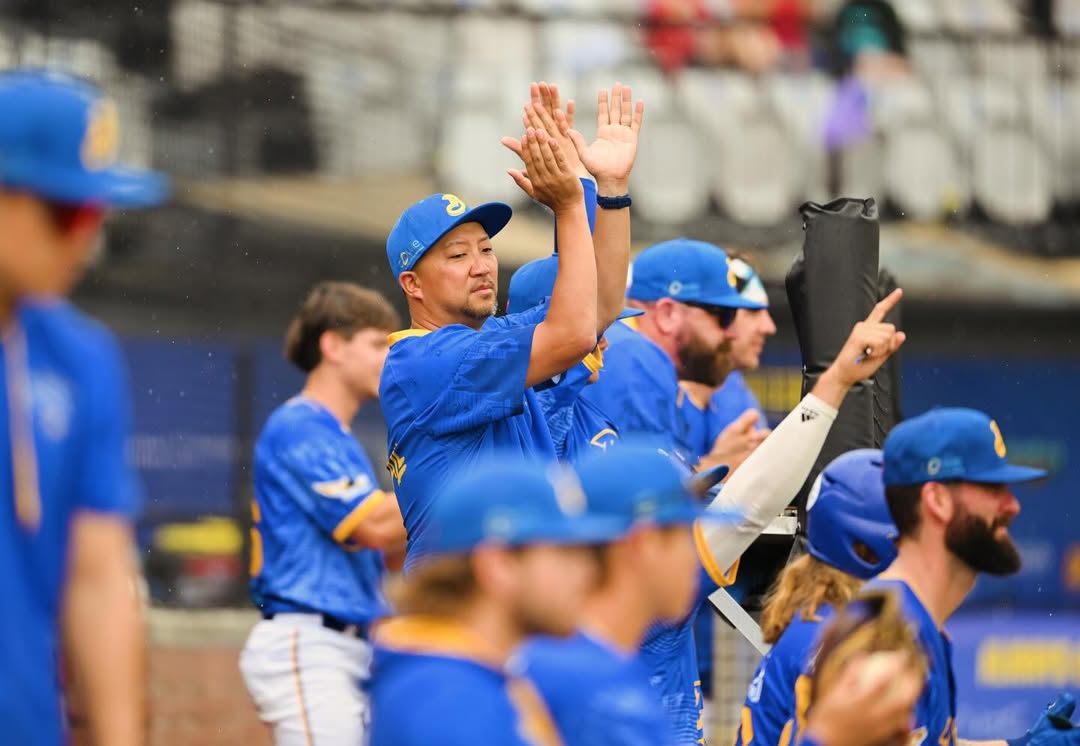
Following the exhibition game between the Yokohama DeNA Baystars and Team Australia at Yokohama Stadium on February 28, the World Baseball Network’s Yuri Karasawa had the opportunity to sit down with Takuya Endo, DeNA’s mental performance coach, for an exclusive interview.
Endo also served as a guest mental strength coach for the Brisbane Bandits in the Australian Baseball League this past season. With a background in soccer and academic training in kinesiology from his time studying in the United States, Endo brings a unique perspective to player development, particularly in Nippon Professional Baseball, where his position became the first of its kind when he joined the Baystars in 2022.
The interview, conducted primarily in Japanese and translated into English for publication, spans a wide range of topics from the growing importance of mental training in baseball to his experiences in Australian baseball, the evolving future of mental performance roles, and much more.
First of all, how did you learn English?
“Until high school, I really couldn’t speak English. In fact, it was my worst subject. But I studied abroad at California State University, Fullerton, while playing collegiate soccer, and that’s when my English really started to improve.”
What did you do before joining the Yokohama DeNA Baystars?
“I worked at the Japan Sport Council, where I was involved with the women’s national softball team and the wheelchair rugby national team. We were able to win medals at the Tokyo Olympics and Paralympics.”
How did you end up becoming a mental performance coach?
“My background is in soccer, and I was the captain of my team. But no matter how much I practiced, I couldn’t win. I had the ability, but I wasn’t able to perform at my best during games. I experienced that myself and saw many others struggle with the same issue. I realized that success isn’t only about skill or physical ability. It must also involve the mental side of the game.
That’s when I picked up the book Heads-Up Baseball by Ken Ravizza and Tom Hanson. I read the Japanese version, and it had a huge impact on me. It made me want to study the mental side of performance more deeply. Around that time, Japanese soccer was often criticized for being mentally weak, and I wanted to help Japan become a mentally resilient nation. Then, I went to the United States to study.”
Is there a difference between studying general psychology and sports psychology?
“I studied kinesiology, which includes a branch of sports psychology. But now my focus isn’t limited to sports since it’s about mental skills and performance psychology more broadly. I work with people on developing those kinds of skills and building the right mindset.”
How do you think that helps players, and what kind of training do you provide them with?
“There’s a tendency for players to get caught up in the past, which can cause them to worry or dwell on it. At the same time, they can think too much about the future and become anxious about what might happen.
That’s why it’s important to focus not on the past or the future, but on the present moment. I talk with them about how to do that. Separating what they can control right now from what they can’t. Then we focus on what’s within their control and let go of what isn’t. That’s my approach.”
A mental performance coach is pretty rare in NPB, but are there other teams that currently have this role?
“When I first joined the Baystars — I think it was 2022 — I was the first one. So this will be my fifth season. But when our team won the Japan Series in 2024, other teams took notice of the potential need for a mental performance coach. So I think it’s starting to grow.”
Do you think all 12 NPB franchises will eventually carry a mental performance coach?
“Yes, I do. In Major League Baseball, all teams have this role at the big league level, and it’s also seen at the minor league level. And they can have multiple roles for English and Spanish speakers. So I feel a responsibility to make an impact in this field to make sure this becomes the norm in NPB for the future.”
What kinds of players do you think benefit the most from receiving mental coaching?
“I talk with a lot of players, but I think veterans benefit the most. Part of my role is to help them clear out negativity. There are elements related to mental health, but the foundation of mental performance starts from zero and builds back up step by step.
One of my strengths is working with veterans who may be approaching milestones or helping a legend become an even greater legend. I support top athletes from the mental performance side, and that definitely includes veterans who are in the later stages of their careers.”
There’s a perception that some Japanese coaches still take a more old-school, Showa-era approach, with stricter or harsher methods compared to their American counterparts. Do you think that’s changing with the current generation? And from a mental performance standpoint, is there still value in some of those traditional elements?
“I think there are always trends, both in coaching and in how players get new perspectives through YouTube and social media. I think Japanese people tend to be open to taking on new challenges, so new ideas are becoming more common. Especially when it comes to learning from America — not simply copying, but adopting the good elements.
You have to consider which approaches will resonate with players and become a positive influence. I’m not sure that old-school ideas like pure ‘willpower’ or ‘toughness’ are as effective anymore. I think those concepts — like going all out, giving your all, or showing willpower — are important as well. But what really matters is helping players understand how to apply those ideas during games from a scientific perspective.
As a mental performance coach, my role is to explain the benefits clearly and help shape each player’s approach.”
The Baystars are considered one of the more advanced organizations in NPB when it comes to things like data and sabermetrics. How important is it for the analytical side of baseball and the mental performance side to work together?”
“Numbers are results, of course. But if you don’t have the literacy to interpret those results properly, it becomes very difficult to succeed. Results belong to the past, and if you let yourself be overly affected by them, that will carry over negatively into the future.
So the key is understanding how to use things like sabermetrics to help you in the present moment. When you can mix those things, I think it’s fantastic.”
How was your experience coaching in Australia, and how did it differ from coaching in Japan?
“My experience in Australia was incredibly valuable to me. The language, culture, and environment were all different, and I was figuring out how to communicate with other players, coaches, and the manager in order to win. Through that process, I realized that the commitment to elevating performance is universal.”
What kind of conversations did you have with players in Australia?
“This was something that surprised me, but the Australian players already had a strong understanding of mental skills, especially since many of them had attended American universities or received mental performance coaching in the United States. It was simply easy to have conversations with them about mental performance.
Players not only have a high level of understanding about the mental side of the game, but they are also aware of mental health. They asked me how they could grow not just as players, but as humans. In Japan, the focus can often be on immediate results, but I was able to engage with Australian players about their personal philosophy, self-worth, and way of thinking.”
Is it difficult to engage in mental performance training in Japan when players are not very familiar with it? Are there players who think “this isn’t for me” and don’t want the help?
“I wouldn’t say it’s difficult, but I’d compare it to how a baby can’t eat meat right away. Babies start with milk, then move to baby food. With some players, you have to explain things in that same basic way at first. But it’s not hard, because many players genuinely want to learn and improve. It’s a gradual progression — from milk to baby food, to soft foods, and eventually to steak.
But some players just want to focus on their physical skills. In Japan, the trinity of mind, technique, and body has long been considered essential. But formal mental training itself hasn’t been emphasized. Because of that, some players aren’t quite sure where to begin or what to learn.
I think that reflects a part of Japanese nature. They may come to me when they’re struggling, but they’re less likely to seek me out when things are going well.”
There’s a perception that Munetaka Murakami began to struggle in 2022 after tying Sadaharu Oh’s record with his 55th home run. He also struggled early in the 2023 WBC before delivering the walk-off hit against Mexico. For a superstar like Murakami in that situation, how would you approach the mental side of those struggles?
“Players like that already have an extensive résumé. But when they’re chasing a record or facing heightened expectations, they can sometimes try to go beyond who they are to become someone different. That’s when their rhythm gets disrupted, and performance can suffer.
It’s important for them to understand their strengths, weaknesses, and identity. The key is to focus on one pitch at a time and simply be themselves. My approach would be to help them stay grounded in the present moment. When you’re fully in the present, it will lead to good things in the future.”
Getting back on the topic of Australia, do you think more Japanese players should consider playing in the ABL during the offseason? And on the other hand, should more Australian players aim for NPB opportunities rather than just pursue MLB?
“I feel strongly that both sides should pursue those opportunities. Changing your environment has value that goes beyond what happens on the field. When you step into a new setting, the things you once took for granted can fall away, and you’re forced to recognize that different perspectives exist.
So absolutely, I believe more Australians should come to Japan, and more Japanese players should go to Australia. That kind of experience helps them grow as people, which in turn translates into better performance.”
What did you think about the level of play in the ABL when compared to the Japanese minor leagues?
“When I spoke with other Baystars players who were with me on the Brisbane Bandits, we all went in thinking it would be easy. But it wasn’t. The overall level of play was higher than we expected. It may not always show up in team results, but on an individual level, the quality is definitely there.
You have prospects from MLB organizations, good minor leaguers, Korean players, European players — it’s very international, with a lot of hungry players. And for domestic Australian players, strong performances can even lead to WBC selection. So for them, the timing was especially important.”
Do you think Australian baseball is stronger than most fans realize?
“Yes, I think so. The players are physically strong and have good abilities, so I never felt the level was low at all. The environment, like the stadiums or facilities, might not always be at the same standard, but it has a strong sense of community. In terms of the players, coaching, and management, the level is certainly high.”
In terms of style, did you feel the ABL is closer to the traditional Asian small-ball approach or the modern MLB game?
“That really depended on the manager. For example, Sydney emphasized the running game, while Brisbane focused more on hitting. So it varies from team to team. And of course, teams with Latin players brought energy and flair.”
What do you think about this year’s Australian national team entering the WBC?
“Australia is hot right now, but they held their training camp in Fuchu, where it was cold. That kind of environmental adjustment can be challenging. However, they have the ability. It just comes down to physical and mental conditioning.
They’re a team with a strong sense of family and unity. If everything clicks, they have the potential to break through in a big way.”
Lastly, how would you like to see sports psychology evolve in the future?
“We’re entering an AI-driven world. Things like measuring body temperature or quantifying muscle performance will increasingly become standardized as data points. The key question isn’t whether a number is good or bad — it’s how we use that data to translate into performance. That’s the world we’re moving toward.
For example, we might identify that when a player’s heart rate reaches a certain level, that’s when they begin to feel pressure. So what do we do if it reaches 210? Maybe the player feels fine, but the data shows their heart rate has spiked. In that moment, they can take a breath — a pitcher might step off the rubber, or a hitter who tends to get overly aggressive under pressure might focus on staying back, taking a deep breath, and adjusting their position to regulate their emotions.
We might also learn from data that certain players perform better when they communicate with specific teammates or staff members, so we can intentionally curate those interactions more often. That’s the direction I think we’re heading — using objective data as a tool to better understand ourselves and enhance performance.”
___
Photo: Australian Baseball League’s Brisbane Bandits / via @takuya_endo_jp on Instagram