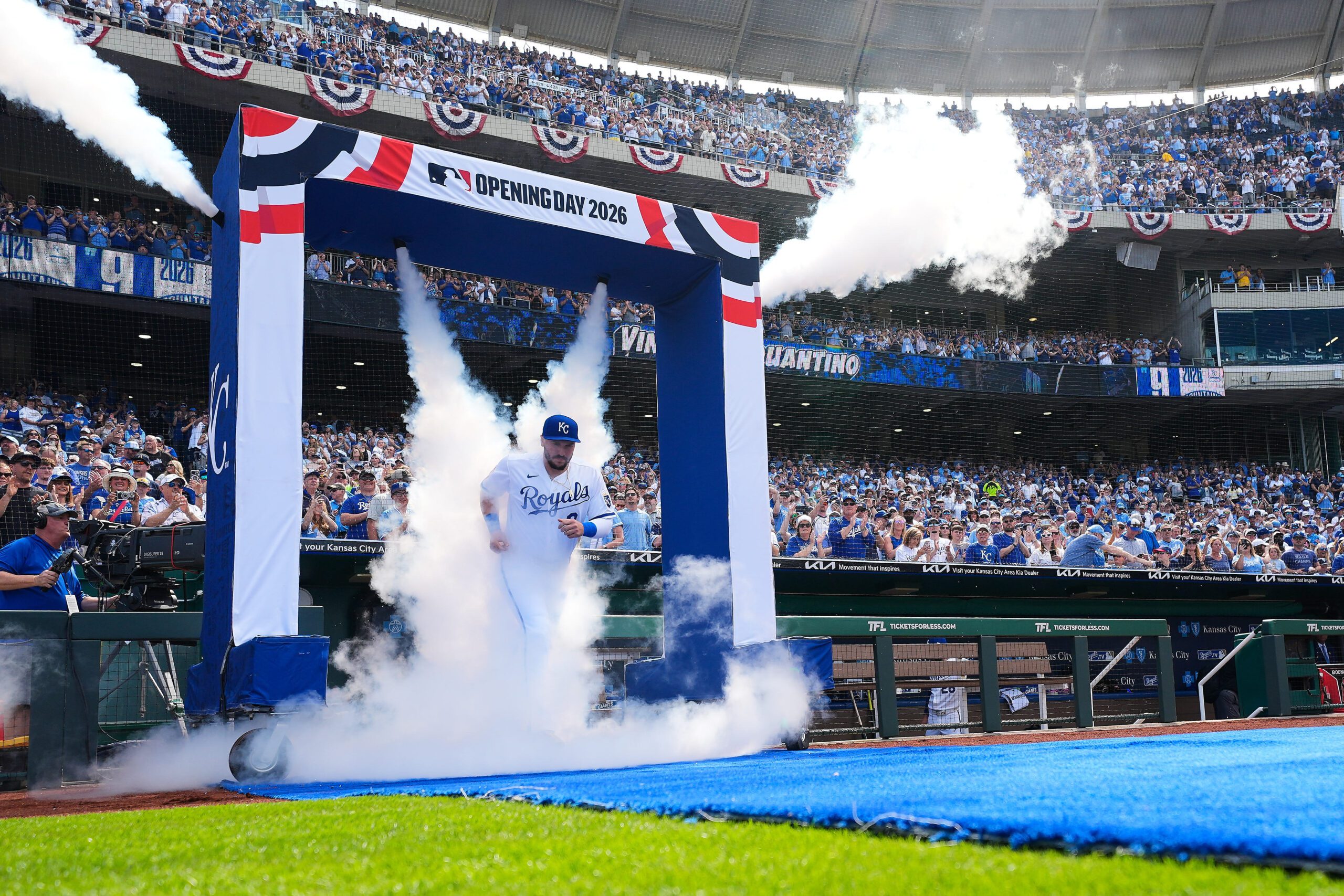
For anyone who watched Vinnie Pasquantino during the World Baseball Classic, you saw more than a middle-of-the-order bat. You saw a leader.
In press conferences, he carried the voice of Italian baseball with poise, speaking about respect, responsibility, and culture in a way that felt authentic and intentional. It was a masterclass in sports diplomacy from a player still early in his career.
At 28, in just his fifth big league season, Pasquantino’s voice already carries weight. He blends charisma with credibility, equally comfortable representing a clubhouse as he is connecting with fans. It is not hard to envision a future in media when his playing days are done, but for now, his leadership is very much rooted in the present. And this week, it showed again.
When teammate Carter Jensen overslept and was scratched from a game, Pasquantino was asked to respond. In just over a minute, 72 seconds to be exact, he delivered something far more meaningful than a routine quote. He delivered a leadership blueprint.
I’ve had the opportunity to know Pasquantino through Team Italy, and his authenticity off the field matches what you see publicly. As I continue my doctoral research in leadership studies, I find myself both proud and fascinated by how naturally he applies principles that scholars have spent decades defining. So I broke down his response through a research lens.
Transformational leadership in real time
“It’s a growing moment… He’ll learn from it.”
What Pasquantino demonstrated here aligns directly with the work of Bernard M. Bass and Bruce J. Avolio. Transformational leaders don’t just correct behavior. They develop people.
Instead of framing the mistake as failure, he reframed it as growth. That shift matters. In any high-performance environment, development is what separates short-term correction from long-term improvement.
Relationships drive accountability
“We’re here for him… it’s not like anybody’s mad at him.”
This reflects Leader-Member Exchange theory, pioneered by George B. Graen and Mary Uhl-Bien.
High-performing teams are built on trust. When individuals feel supported, they are more likely to take ownership of mistakes and respond with accountability rather than defensiveness. Pasquantino reinforces that Jensen is still part of the group and the group will support him. That matters.
Because accountability without relationship leads to resentment. Accountability with a relationship leads to growth.
The balance of psychological safety
“He’s going to have to wear it… but we’re here for him.”
This is where leadership becomes nuanced. Amy Edmondson defines psychological safety as an environment where individuals can take risks and learn without fear of exclusion. Pasquantino doesn’t remove accountability. He reinforces it. But he pairs it with belonging.
That balance is what creates high-performing cultures. Not comfort. Not fear. Both clarity and safety.
Situational leadership on display
“He’s really young… He’ll learn from it.”
Pasquantino adjusts his tone based on experience level, a principle central to Paul Hersey and Ken Blanchard.
This is not a veteran being addressed. This is a young player in a developmental moment being spoken about by another young player.
So the response blends: Direction: “It can’t happen” … Coaching: “He’ll learn from it” … Support: “We’re here for him.”
Great leaders don’t treat everyone the same. They treat everyone appropriately.
Ethical leadership and fairness
“He’s going to have to wear it… the same way anybody would have to.”
There is no favoritism here. This aligns with ethical leadership research from Michael E. Brown and Linda K. Treviño, which emphasizes consistency as the foundation of trust. Standards only matter if they apply to everyone. The moment leaders start making exceptions, culture erodes.
A learning organization mindset
“You gotta learn from mistakes like that…”
This is straight out of Peter Senge. Mistakes are not endpoints. They are inputs. The best teams, whether in sports, media, or business, treat errors as opportunities to refine systems, habits, and preparation.
Growth mindset in action
“He’ll learn from it, grow up a little bit.”
This reflects the work of Carol S. Dweck. The belief that ability is developed, not fixed, is critical in leadership. When individuals are encouraged to grow from failure, they become more resilient, more confident, and ultimately more effective.
What this moment really shows
In just over a minute, Pasquantino did four things that define elite leadership. He set a clear standard and held a teammate accountable, protected the individual, and reinforced growth.
That balance is not easy. Too many leaders lean entirely on discipline or entirely on empathy. The best ones understand that both are necessary. It was a real-time example of what leadership looks like when theory meets practice.
The bottom line, Pasquantino nailed in one sentence: “There are some things that can not happen, and that’s one of them.” Jensen should learn his lesson after this.
And it’s a reminder that sometimes, the best leadership lessons don’t come from textbooks. They come from a clubhouse, a mistake, and a leader who knows exactly how to respond.
Chris R. Vaccaro, a media executive, author, and professor, is a senior editorial advisor of World Baseball Network. He is completing his doctoral work in leadership studies at LSU.
(AP Photo/Charlie Riedel)
The full Pasquantino Transcript
“You got a 36-year-old catcher who’s preparing to DH today, and his work gets a little rocked that an hour and a half before the game, he’s not going to be DHing. Credit to Salvi today for being ready.
First and foremost, we’re glad Carter is okay. That was kind of the initial thought when we were trying to get a hold of his parents.
But once you find out he’s okay, it’s like alright, it’s a growing moment. He’s really young. There are some things that can not happen, and that’s one of them.
He’s going to have to wear it on the chin, the same way anybody would have to. It can’t happen, and hopefully it doesn’t happen again. It’s one of those things that you can’t afford mistakes like that in this game.
You gotta move forward the best that he can. I know he feels really bad. I know it wasn’t his favorite drive to the field this morning, but it wasn’t our favorite morning either, trying to figure out what was going on.
He’ll learn from it and grow up a little bit. We’re here for him, though; it’s not like anybody’s mad at him. Things happen, but you gotta learn from mistakes like that and maybe get another alarm clock or something at home.”