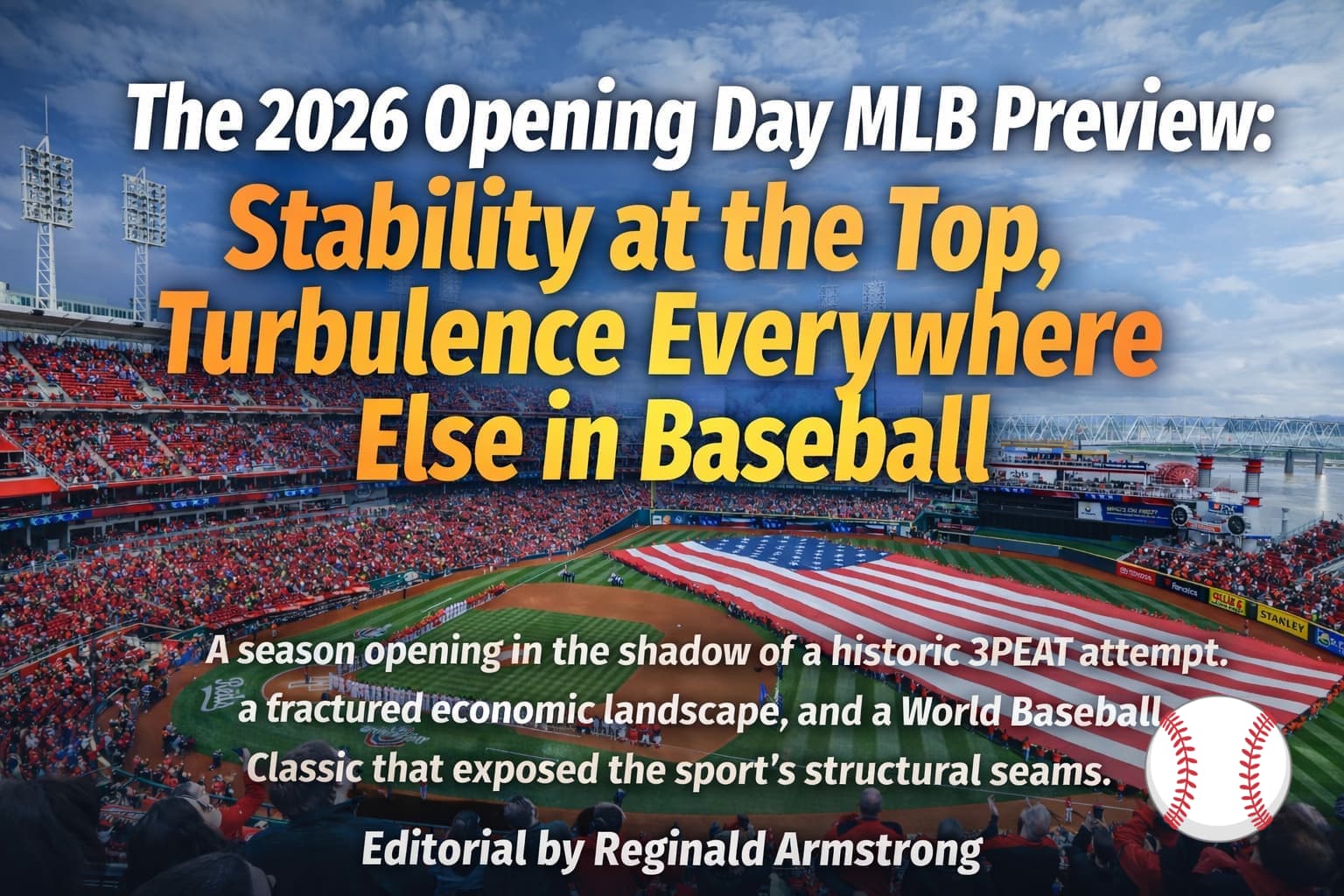
A season opening in the shadow of a historic attempt by the Dodgers, a fractured economic landscape, and a World Baseball Classic that exposed the sport’s structural seams.
The 2026 season opens in the afterglow of a Fall Classic worth remembering, under the shadow of a historic attempt by the Los Angeles Dodgers to win a third straight World Series, and in the wake of a World Baseball Classic that revealed both the sport’s emotional power and its structural seams.
The Dodgers enter 2026 positioned to be the first team to win three consecutive World Series this century — a conclusion I reached before the calendar turned and will not revisit until it is settled on the field.
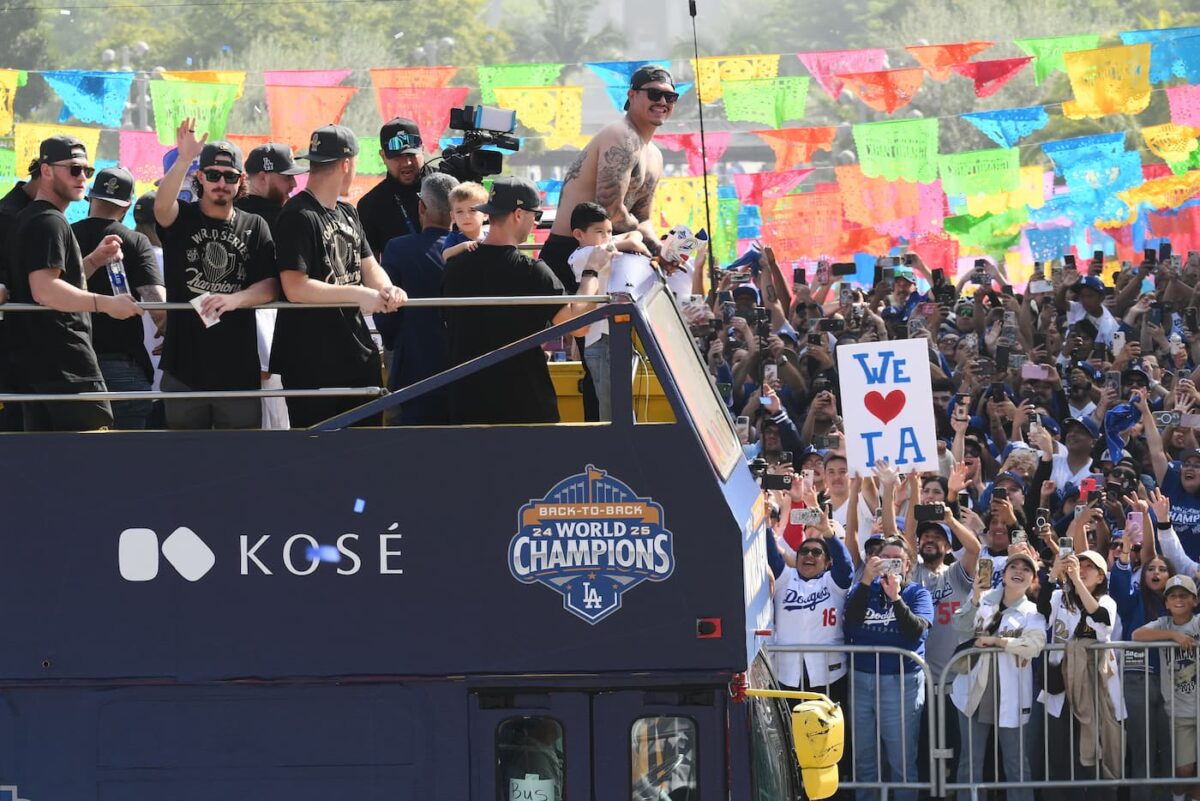
Los Angeles Dodgers’ Clayton Kershaw and Kiké Hernández wave and film fans during a parade in honor of the baseball team’s World Series win on Monday, Nov. 3, 2025, in Los Angeles. (AP Photo/Kyusung Gong)
The WBC delivered its own emotional peaks — none more powerful than what Team Venezuela meant to its nation and to the South Florida expatriates who filled the ballpark with a sound that lingered for days as the new champion. Their path to the title ran through an American team that had advanced only after surviving the tournament’s best club in a semifinal defined by controversy rather than resolution.
Team Dominican Republic, the tournament’s most complete roster, carried the momentum even after Gunnar Henderson’s fourth inning home run put the Americans up 2–1 — the score that would hold. Despite two self-inflicted baserunning mistakes — Fernando Tatis Jr. being cut down at third by an Aaron Judge outfield assist, and Austin Wells hesitating on contact and failing to score on a separate play — the Dominicans still had the game in front of them. A borderline pitch ended the semifinal before the players could decide it themselves, a reminder of why the ABS era cannot arrive soon enough.
Team USA, for its part, played with the energy of a group fulfilling an obligation rather than seizing an opportunity. The contrast was striking. The WBC is entertaining, but it is neither the World Cup nor does it carry the legacy and prestige of the Olympics, whose medals still define athletic consequence. Bryce Harper was right: baseball belongs on the Olympic stage. An Olympic gold medal — or even a silver — carries a permanence the WBC cannot match. And unlike March, when players are still ramping up, the Summer Games would showcase athletes in full flight.
It is worth remembering why the Olympics are played every four years. The term Olympiad itself refers to the fouryear interval between Games — a quadrennial rhythm that gives the event its weight, its ceremony, and its tradition. Baseball could easily align with that cycle. The league could suspend the AllStar break for two weeks every four years, send its best to the Olympics, and resume the season without losing anything but a handful of contentcalendar games.
The injury risk argument rings hollow. Injuries happen in April, in August, in October. They happen in preseason and postseason. They happen to Bo Nix in the NFL playoffs. They are part of sport. The timing only changes the recovery window, not the reality. A player hurt in March is no more “lost” than a player hurt in July; the only difference is whether the calendar allows for a return.
But the WBC is not the only place where baseball’s structure shows its seams. The sport enters 2026 with a widening divide between the HAVES, the HAVE NOTS, and the incubators who sit between them. The HAVE NOTS survive on development, timing, and hope. And the incubators — the clubs that draft and develop stars only to watch them leave when the bill comes due — are not innocent. They manipulate service time, suppress payroll, and sell the future as a product.
Ten clubs enter 2026 with new managers — a turnover rate that reflects the impatience of owners, the volatility of windows, and the widening gap between the sport’s monarchs and everyone else.
The HAVES — the Guggenheim Dodgers, the Corporate Yankees, the Point72 Mets, and even a rung below, like the Phillies, the North Siders in Chicago, among others — operate on a different economic plane.
The next Collective Bargaining Agreement is unlikely to solve these structural issues. The players are too well compensated to recreate the solidarity of the Flood/Miller era, when even elite players struggled to support a family of four. Today’s economic incentives do not align with systemic reform.
This is the part the baseball experts rarely confront directly. A team like the Reds can assemble a wave of young talent — Elly De La Cruz, Matt McLain, Noelvi Marte, Hunter Greene — but when those players reach their earning years, Cincinnati will not outbid Los Angeles or New York. The parent club raises the child; the super HAVE adopts him. And the fan, who invested in the player from debut to stardom, is told to “trust the process” and embrace the next wave. Loyalty becomes a oneway street.
This dynamic will be on full display when Tarik Skubal leaves Detroit. The Tigers cannot outbid the monarchs of MLB, particularly the Dodgers and the Mets. The outcome is not in doubt; only the timing is.
This is the structural reality beneath the standings. It shapes every roster, every window, every decision. It explains why some clubs reload while others rebuild, why some teams can afford mistakes and others cannot, and why the middle class of baseball has eroded. The 2026 season will be played on the field, but it will be defined by the architecture in the Csuite and the capital behind it. Of course, any team in any given year can win the World Series. Injuries, bad luck, failed execution, and destiny all contribute to what determines a champion.
What follows is my unvarnished look at each club — as hope springs eternal and a new season begins.
AL EAST
2026 BOSTON RED SOX — PREVIEW
Manager: Alex Cora
2025 Record: 89–73 (Wild Card)
The Story
The Red Sox enter 2026 as the most structurally complete team in the AL East — not the most explosive, not the most starladen, but the one with the fewest fault lines. Their identity is clarity: athleticism in the outfield, youth in the infield, a rotation with real innings and real upside, and a bullpen that finally has both power and depth. This is no longer the patchwork roster Cora managed through 2023–2024. This is a coherent team with a rising core — Roman Anthony, Ceddanne Rafaela, Wilyer Abreu, Marcelo Mayer — supported by a rotation that can actually hold a season together. Boston may not have the highest ceiling in the division. But they have the highest floor, and in the AL East, that matters.
Lineup Notes
- Roman Anthony is the franchise’s new axis: patience, lift, and a mature approach that belies his age. A .350 OBP with 20+ HR is on the table.
• CeddanneRafaela is a defensive star in center field — elite range, elite instincts, and enough pop to matter.
• Wilyer Abreu brings lefthanded thump and surprising defensive value.
• Jarren Duran is the chaos engine — speed, pressure, and a 2–3 WAR floor.
• Trevor Story is no longer a star, but he remains a stabilizer at shortstop if healthy.
• Willson Contreras gives them a middleorder bat at first base and DH.
• Marcelo Mayer is the hinge — if he hits, Boston’s ceiling jumps instantly.
This is not a polished lineup, but it is modern, athletic, and capable of long stretches of real production.
Rotation Notes
- Garrett Crochet is the ace by stuff — a lefthanded hammer with strikeout dominance.
• Sonny Gray remainsthe adult in the room, still capable of a 3.50 ERA season.
• Ranger Suárez is the silent killer — soft contact, ground balls, stability.
• Brayan Bello is the developmental hinge; if he takes a step, Boston’s rotation becomes legitimate.
• Johan Oviedo provides innings and competence.
• Patrick Sandoval and Kutter Crawfordgive them depth most teams lack.
This is not a topfive rotation, but it has range — and Crochet alone gives them a puncher’s chance in any series.
Bullpen Notes
- Aroldis Chapman still throws fire — volatile, but capable of dominance as the closer.
• Garrett Whitlock is the Swiss Army knife —multiinning weapon, highleverage arm.
• Greg Weissert, Justin Slaten, and Zack Kelly provide underrated swingandmiss depth.
• Danny Coulombe and Jovani Moran give them lefthanded stability.
• Crawford and Sandoval can absorb innings when needed.
This group can shorten games if the rotation holds.
WBC / Exhibition Notes
- Anthony looked like a star — patience, lift, confidence.
• Rafaela’s defenseremains elite; the bat is the question.
• Crochet’s workload is the biggest storyline.
• Mayer’s spring atbats will determine his arrival date.
• Duran looks healthy and explosive.
2026 Outlook
The Red Sox project as an 86–92 win team, the most structurally stable roster in the AL East. If Anthony, Rafaela, and Mayer hit their developmental marks — and if Crochet stays healthy — Boston has a clear path to the division. They may not have the highest ceiling, but they have the fewest fault lines, and in a volatile division, that gives them the inside lane.
2026 TORONTO BLUE JAYS — PREVIEW
Manager: John Schneider
2025 Record: 94–68 (American League Champions)
The Story
The Blue Jays enter 2026 in a posture rare for the AL East: competent, stable, and structurally balanced, even if not spectacular. They are the defending American League champions, and unlike many surprise pennant winners, their roster still has the architecture to make another run.
The identity of this team has shifted. Bo Bichette is gone. George Springer is aging but still impactful. The offense now orbits around Vladimir Guerrero Jr., Alejandro Kirk, and the imported star Kazuma Okamoto, with Andrés Giménez giving the infield a defensive anchor it has lacked for years.
Toronto is not the flashiest team in the division. But they are the least volatile outside of Boston — and in a division defined by fragility, that gives them real staying power.
Lineup Notes
- Vladimir Guerrero Jr. remainsthe centerpiece — a .290/.380/.520 bat with 30+ HR power and 4–5 WAR upside.
• Alejandro Kirk continues to be one of the most valuable catchers in baseball: elite OBP, elite framing, and a stabilizing presence.
• Kazuma Okamoto is the wild card — if the power translates, Toronto gains a legitimate middleorder threat.
• Andrés Giménez brings Gold Glove defense and stabilizes the infield’s entire geometry.
• George Springer is the veteran stabilizer — OBP, leadership, and still capable of 20 HR when healthy.
• Daulton Varsho and Addison Barger provide athleticism and lefthanded thump, though both come with volatility.
• Ernie Clement remains the glue — not a star, but a steadying presence who fills gaps across the infield.
This is not a topfive offense, but it’s not a bottomfive one either. It’s a lineup that can grind, especially if Okamoto hits.
Rotation Notes
- Kevin Gausman remainsthe Opening Day starter and the adult in the room — still elite when healthy.
• Dylan Cease is the strikeout machine, the chaos agent, the ceiling play.
• Shane Bieber is the hinge: if the velocity holds, he’s a #2; if not, he’s a #4.
• José Berríos is the metronome, the stabilizer, the innings guarantee.
• Max Scherzer is the legend in his final chapter — even 120 competent innings matter.
• Trey Yesavage leads the youth movement that could define the second half, with Ricky Tiedemann a potential midseason addition once his health and command stabilize.
This rotation has range — from dominance to disaster — but the upside is undeniable.
Bullpen Notes
- Jeff Hoffman and Yimi García give themlateinningstability.
• Tyler Rogers adds a righthanded submarine look with a sweeping slider as his out pitch.
• Louie Varland and Tanner Nance provide swingandmiss depth.
• Mason Fluharty and Brandon Fisher round out a bullpen with more power than reputation suggests, with José Rodríguez opening the season in TripleA as depth.
This is not a toptier bullpen, but it’s good enough to survive the AL East.
WBC / Exhibition Notes
- Guerrero looked locked in during WBC tuneups.
• Okamoto’s timing improved as camp progressed.
• Varsho’s swing changes showed flashes.
• Bieber’s health remains the biggest spring storyline.
• Scherzer is pacing himself — as he should.
2026 Outlook
The Blue Jays project as an 82–88 win team, but their structure gives them a realistic path to repeating as AL East champions — and even returning to the World Series — if the rotation stays healthy and Okamoto hits. Their floor is higher than most teams in the division, and their ceiling remains shaped by the same formula that carried them to the pennant in 2025: innings, stability, and timely power.
In my AL East hierarchy, they sit second — not because they lack upside, but because Boston’s floor is even higher.
2026 NEW YORK YANKEES — PREVIEW
Manager: Aaron Boone
2025 Record: 94–68 (lost AL East tiebreaker to Toronto)
The Story
The Yankees enter 2026 as the most polarized roster in the division — a team with an elite ceiling and a fragile floor, capable of looking like a 95win contender one month and a .500 club the next. Their identity is built around star power: Aaron Judge, Gerrit Cole, Max Fried, Carlos Rodón, and the emerging bat of Ben Rice. But the connective tissue — situational hitting, leadership architecture, and lineup depth — remains volatile.
They won 94 games last year and still finished second because Toronto owned the tiebreaker. That is the perfect summary of who the Yankees are: dangerous, talented, and structurally unstable. And beneath the surface sits the deeper truth: the Yankees struggle in the moments that define champions. Their RISP performance has been bottom third for several seasons. Their situational hitting collapses under pressure. Their stars — Judge, Stanton, Chisholm — are built for damage, not for moments. And the leadership ecosystem that once defined the franchise has eroded.
In a division defined by stability at the top (Boston, Toronto), the Yankees’ variance pushes them into your thirdplace slot, even though their best version is the most dangerous team in the AL East.
Lineup Notes
Aaron Judge — RF
Still one of the three best players in baseball. Elite discipline, elite power, elite production. But not a situational hitter. His greatness is real, but his clutch identity is inconsistent — a reflection of temperament, not talent.
Giancarlo Stanton — DH
Still central to the offense. When healthy, he lengthens the lineup and provides righthanded thump. But he shares the same RISP profile: damage first, not situational.
Ben Rice — 1B
A legitimate breakout bat with 25–30 HR potential and real onbase skill. One of the few hitters on the roster with a naturally adjustable swing.
Jazz Chisholm Jr. — 2B
The athletic wildcard. Electric when healthy, but high variance in approach. Expands the zone in big moments.
Anthony Volpe — SS
Needs OBP growth, but his defense on balance and base running remain assets. Will miss the start of the season following offseason labrum surgery. José Caballero is expected to open as the shortstop until Volpe returns in May.
Austin Wells — C/DH
Lefthanded lift, improving receiving, and emerging onbase skill.
Trent Grisham — CF
A real centerfield defender who stabilizes the outfield geometry.
Supporting Cast
Functional, but not deep. When the stars are hot, the lineup looks elite. When they’re not, the bottom third stalls — and the RISP problem resurfaces.
The RISP / Situational Hitting Problem
This is the defining flaw of the modern Yankees.
Over the last several seasons, the Yankees have consistently ranked:
• bottom third in MLB in batting average with RISP
• bottom third in MLB in OPS with RISP
• bottom third in MLB in productive outs
• bottom third in MLB in twostrike contact
• bottom third in MLB in oppositefield hitting
This is not a oneyear blip. It is a multiyear identity.
The Yankees are built for:
• lift
• pull
• slug
• walk
They are not built for:
• shortening swings
• situational contact
• advancing runners
• twostrike adjustments
• lateinning execution
Judge, Stanton, and Chisholm — for all their talent — share the same offensive DNA: damage first, not situational.
This is why the Yankees look explosive in April, streaky in June, and silent in October.
This is why, as a supporter of the Bronx Bombers, alas, they finish third in my predictive hierarchy.
ROTATION NOTES
Max Fried — LHP
The Opening Day starter. Tone setter, stabilizer, and the pitcher whose sequencing aligns with the start of the season.
Gerrit Cole — RHP
Still the ace of the franchise. Healthy entering 2026, still elite, still the north star of the staff.
Carlos Rodón — LHP
Healthy entering the season, but remains the hinge. If he’s even 80% of peak, he’s a No. 2.
Cam Schlittler — RHP
The revelation. Forced his way into the rotation and stayed. A real development win.
Will Warren — RHP
The No. 5 starter per the depth chart. Command, carry, and enough pitchability to turn the lineup over twice.
Depth:
Ryan Weathers (LHP) — now in the bullpen but provides length and spotstart flexibility.
Brent Headrick (LHP) — depth starter or multiinning lefty.
Ryan Yarbrough (LHP) — innings, deception, emergency starter.
Paul Blackburn (RHP) — veteran insurance.
A staff built for October — if they get there healthy.
Bullpen Notes
David Bednar — RHP: One half of an effective lateinning duo.
Camilo Doval — RHP: The other half. Few teams can match this pairing.
Fernando Cruz — RHP: A legitimate leverage arm who sits directly behind Doval in the hierarchy.
Tim Hill — LHP: Groundball specialist who neutralizes tough pockets.
Paul Blackburn / Ryan Yarbrough — RHP/LHP: Length and stability.
Brent Headrick — LHP: Can bridge innings when not used in the rotation.
A bullpen capable of shortening games — but only if the rotation doesn’t overtax them early.
WBC / Exhibition Notes
- Judge and Stanton came into camp hot.
• Schlittler’s postseason momentum carried straight into spring.
• Volpe’s swing changes looked real.
• Jazz looked healthy — the biggest variable in the lineup.
• Rodón’s velocity readings were encouraging.
• Cole looked like Cole.
A sharp spring from the stars — but the structural questions remain.
Leadership & Culture
This is the quiet truth of the modern Yankees:
They lack a leadership ecosystem.
Cashman’s front office is stable but stagnant. Boone is steady but not catalytic. Judge is dignified but not a galvanizer. The clubhouse has no emotional engine. The team has no situational identity.
The captaincy exists in title, not in temperature.
This is not about effort. It is about architecture.
The Yankees do not have the internal spine that defined the Torre era — the O’Neill/Tino/Posada/Pettitte/Cone ecosystem that made Jeter’s temperament work.
Judge is a statesman. But the Yankees need a general.
2026 Outlook
The Yankees project as an 84–94 win team, the widest variance band in the division.
Their best version can win the AL East. Their median version finishes third. Their worst version fights for a Wild Card.
They land third — not because they lack talent, but because they lack the structural stability of Boston and Toronto.
This is the most dangerous thirdplace team in baseball.
2026 TAMPA BAY RAYS — PREVIEW
Manager: Kevin Cash
2025 Record: 77–85
The Story
The Rays enter 2026 in a posture that is unusual for them: retooling, not contending. The roster has turned over dramatically. The bullpen that defined their identity for years is gone. The rotation is rebuilt around returning arms and reclamation projects. The lineup is young, athletic, and uneven.
What remains is the Rays’ core DNA: defense, development, and organizational stability. They won’t crater — they never do. But they also lack the topend talent and innings base to push into the division’s upper tier. In your AL East hierarchy, they sit fourth — above Baltimore because they don’t implode, below the Yankees because they don’t have the firepower.
Lineup Notes
This is a young, athletic, streaky lineup — long on tools, short on certainty.
- Junior Caminero is the franchise pillar — elite bat speed, 30HR upside, and the one player with true star potential.
- Yandy Díaz remains the veteran stabilizer — OBP, contact, professional atbats.
- Jonathan Aranda gives them lefthanded lift and positional flexibility.
- Carson Williams is the defensive anchor at shortstop — range, arm, instincts.
- Gavin Lux is the reclamation project with real upside if the bat returns.
- Chandler Simpson brings elite speed and disruptive baserunning.
- Cedric Mullins now anchors center field — a veteran defender with range and stability.
- Jake Fraley and Jonny DeLuca handle the corners, forming an athletic but uneven outfield group.
- Jacob Melton opens the season in TripleA Durham — a highupside athlete who could force his way back if the bat accelerates.
This lineup will look dynamic in stretches and overmatched in others. It is a developmental year, not a contending one.
Rotation Notes
This is the Rays’ clearest strength — and the reason they won’t collapse.
- Drew Rasmussen is the ace and Opening Day starter — healthy, efficient, reliable.
• Ryan Pepiot is the No. 2 — electric stuff, real upside, and the pitcher they hope makes “the leap.”
• Steven Matz is the veteran stabilizer — innings, professionalism, a lefthanded look.
• Nick Martinez is the swingman turned No. 4 — versatility, command, durability.
• Shane McClanahan is the hope — if healthy, he changes the rotation; if not, he’s a bonus.
This is not the Rays’ classic pitching machine. It’s competence, not dominance.
Bullpen Notes
The most transformed unit on the roster — and the most honest reflection of where the Rays are in their cycle.
- Griffin Jax is the closer — a defined role, rare for Tampa Bay.
• Bryan Baker is a highleverage righthander with real swingandmiss.
• Hunter Bigge brings power and upside.
• Cole Sulser provides middleinning stability.
• Garrett Cleavinger is the primary lefthanded reliever.
• Mason Englert gives them multiinning flexibility.
• Edwin Uceta rounds out the righthanded depth.
• Steven Wilson is part of the mix but may open on the IL.
This bullpen won’t dominate, but it won’t break. It is functional, inexpensive, and exactly what a retooling Rays team looks like.
WBC / Exhibition Notes
- Caminero looked like a star — the bat speed is real.
• Rasmussen’s return looked clean and efficient.
• Pepiot flashed No. 2 starter upside.
• Williams’ defense remains elite.
• Lux showed signs of offensive life.
• Simpson’s speed was the talk of camp.
2026 Outlook
The Rays project as a 72–78 win team, with a stable floor but a limited ceiling. They won’t crater — the defense, bullpen, and organizational discipline prevent that — but they lack the topend talent and innings base to push into the division’s top three. In my predictive hierarchy, they sit fourth — above Baltimore because they don’t implode, below the Yankees because they don’t have the firepower. This is a developmental year, not a contending one, as usual.
2026 BALTIMORE ORIOLES — PREVIEW
Manager: Craig Albernaz
2025 Record: 75–87
The Story
The Orioles enter 2026 in a transitional posture — a roster overflowing with young talent but lacking the stability, innings, and bullpen identity that once defined their rise. The 2023–24 window is gone. The core remains gifted, but the infrastructure that supported it has eroded.
Craig Albernaz arrives as the steward of the next era: development first, detailoriented, tasked with stabilizing a club that has been volatile for two straight seasons. This is a team with a massive ceiling and a catastrophic floor. They can look like a Wild Card team for a week. They can look like a 95loss team for a month.
In my AL East hierarchy, they sit fifth — not because they lack talent, but because they lack the stability that Tampa Bay still possesses.
Lineup Notes
A powerful, athletic, uneven lineup — a mix of emerging stars and volatile bats.
- Gunnar Henderson is the franchise cornerstone — a true MVPcaliber player.
• Adley Rutschman remains the heartbeat — leadership, OBP, receiving.
• Jackson Holliday is the wild card — the talent is real, the growing pains are too.
• Pete Alonso is the new middleorder anchor — 40HR power, presence, stability.
• Tyler O’Neill adds righthanded thump and athleticism.
• Taylor Ward brings professional atbats and lengthens the lineup.
• Jordan Westburg is the glue — versatile, reliable, essential.
• Colton Cowser and Heston Kjerstad offer power but remain streaky.
This is a new offensive identity — more power, less balance.
Rotation Notes
The most surprising part of the Orioles’ 2026 roster — and the clearest reason they remain volatile. The actual 2026 rotation:
- Trevor Rogers — the ace, the breakout, the 2025 Most Valuable Oriole.
- Kyle Bradish — elite when healthy, but coming off injury.
- Chris Bassitt — veteran stabilizer, innings, command.
- Shane Baz — highceiling acquisition, still unproven postinjury.
- Zack Eflin — oneyear deal, reliable, professional.
A rotation with talent, but also fragility.
Bullpen Notes
The weakest unit on the roster — and the clearest reason for their volatility. The actual 2026 bullpen:
- Ryan Helsley — new closer, elite when healthy.
• Andrew Kittredge — veteran leverage arm returning to form.
• Yennier Cano — heavy sinker, groundball machine, leverage option.
• Tyler Wells — multiinning weapon, stabilizer, matchupproof when right.
• Keegan Akin — lefthanded innings and stability.
• Rico Garcia — middleinning depth with strikeout ability.
• Félix Bautista — on the 60day IL, not expected back until late in the season (if at all).
This bullpen is thin, topheavy, and dependent on Helsley and Kittredge holding form. It is the opposite of Tampa Bay’s functional, inexpensive, stable group.
WBC / Exhibition Notes
- Henderson looked like a superstar.
• Holliday flashed talent but also swingandmiss.
• Rutschman was steady as always.
• Rogers looked sharp.
• Baz showed flashes but inconsistent command.
• The bullpen looked thin.
2026 Outlook
The Orioles project as a 68–78 win team, with the widest downside risk in the division. Their young core gives them a real ceiling — they can look like a Wild Card team in spurts — but the lack of innings, bullpen stability, and organizational coherence makes them the most volatile club in the AL East.
In my predictive hierarchy, they sit fifth — not because they lack talent, but because they lack the stability that Tampa Bay still possesses. This is a team in transition, not contention.
AL CENTRAL
2026 CLEVELAND GUARDIANS — PREVIEW
Manager: Stephen Vogt
2025 Record: 88–74
2026 Identity: The only fully coherent, fully integrated baseball operation in the AL Central.
THE STORY
Cleveland enters 2026 in a posture no other AL Central team can match: complete, stable, and structurally coherent. They are not the most explosive team in the league. They are not the most starstudded. They are not the most expensive. But they are the most complete — and in this division, that is the winning formula.
This is the one AL Central club with:
• a top5 rotation
• a top3 bullpen
• a top10 defense
• a top10 player in baseball (José Ramírez)
• a development pipeline that never stops producing
• a manager who extracts value from every roster spot
Cleveland does not win with noise.
Cleveland wins with structure.
They clawed back 15 games on Detroit in 2025 — not because of luck, but because their operation does not wobble. They do not collapse. They do not drift. They simply play clean, efficient, winning baseball.
In a division defined by volatility, Cleveland is the only team built to withstand the full 162.
LINEUP NOTES
The Centerpiece
José Ramírez remains the most complete third baseman in the American League:
• 4.9 WAR projection
• 30 HR power
• elite baserunning
• switchhitting stability
• zero volatility
The Table Setter
Steven Kwan is the perfect Cleveland player:
• .349 OBP projection
• elite contact
• elite defense
• zero wasted motion
The Emerging Core
- Kyle Manzardo — real bat speed, real lift, 20–25 HR potential
• Chase DeLauter — athletic, disciplined, modern corner profile
• Bo Naylor — improving defender with 15–18 HR power
• Brayan Rocchio — stabilizer, not a star, but a winning player
The Wild Cards
- George Valera — tools, but inconsistent
• Angel Martinez — versatile, not yet impactful
ROTATION NOTES
The best rotation in the AL Central.
The Front Three
- Gavin Williams — ace ceiling, 98 with carry, wipeout slider
• Tanner Bibee — command, sequencing, 180inning reliability
• Slade Cecconi — the perfect Cleveland reclamation
The Depth
• Joey Cantillo — upside if healthy
• Jack Peterson / Doug Nikhazy / Will Webb / Will Dion — organizational scaffolding
• Parker Messick — won an MLB rotation spot; stuff ticked up, trusted by the org
• Logan Allen — optioned to TripleA after losing the job to Messick
BULLPEN NOTES
This is where Cleveland quietly wins the division.
- Cade Smith — emerging lateinning weapon
• Hunter Gaddis — power arm, improved command
• Shawn Armstrong — veteran righthanded bridge who can handle leverage when needed
• Eric Sabrowski / Matt Festa / Tim Herrin — Cleveland’s middleinnings machine
• Peyton Pallette / Colin Holderman / Andrew Walters — depth with strikeout upside
WBC / EXHIBITION NOTES
- Gavin Williams’ velocity is back
• Bibee’s command looks sharper
• DeLauter’s approach is maturing
• Manzardo’s swing decisions are elite
• Kwan looks like Kwan
• José Ramírez looks like José Ramírez
2026 OUTLOOK
Cleveland is the only AL Central team with:
• a rotation that can dominate
• a bullpen that can shorten games
• a lineup that doesn’t collapse
• a defense that prevents runs
• a development system that replenishes talent
• a manager who maximizes the roster
They are nota 100win team. They don’t need to be.
In this division, 88–92 wins comfortably, and Cleveland is the only team built to reach that range without requiring a perfect season.
This is the AL Central’s most complete team.
2026 DETROIT TIGERS — PREVIEW
Manager: A.J. Hinch
2025 Record: 87–75
2026 Identity: A talented, ascending roster with a frontline rotation — but carrying the single biggest structural risk in the division.
THE STORY
Detroit enters 2026 as a team on the rise — young, athletic, increasingly coherent — but also as a club carrying the most consequential variable in the AL Central: Tarik Skubal’s contract year.
The Tigers took a real step forward in 2025, finishing 87–75 and briefly holding the division lead before collapsing down the stretch. That collapse — and Cleveland’s 15game clawback — revealed the truth about Detroit’s architecture: the talent is real, but the stability is not yet there.
The core is legitimate. Riley Greene, Colt Keith, Kevin McGonigle, Kerry Carpenter, and Jackson Jobe form a real nucleus. Jobe, recovering from Tommy John surgery, is a secondhalf addition — part of the present and the future, and central to the club’s longterm rotation once Skubal departs.
But everything revolves around Skubal.
He is a true ace entering a contract year Detroit is unlikely to resolve. They cannot outbid the Dodgers or Mets. Many around the league question whether the Tigers are willing to operate in the financial tier those clubs occupy — one they can exceed without hesitation. If Detroit stumbles, a midseason trade becomes a real possibility — and a clubhouse deflator.
And yet, Motown’s leverage would have been strongest before the season. But front offices rarely move an ace that early. The deadline is when contenders panic, overpay, and convince themselves they’re one arm away. Skubal will likely be the most valuable rental on the market, and Detroit knows it — even if their best leverage point has already passed.
With Skubal, Detroit is good enough to contend. They may still not be able to surpass Cleveland, as the Skubal question hangs over the entire season.
LINEUP NOTES
The Offensive Core
- Riley Greene — 4–5 WAR potential
• Kevin McGonigle — OBP machine
• Gleyber Torres — veteran anchor
• Colt Keith — polished lefthanded bat
• Kerry Carpenter — middleorder power, foundational DH
The Question Marks
- Spencer Torkelson — theoretical 35 HR ceiling
• Parker Meadows — elite defender, light bat
• Wenceel Pérez — useful, not a pillar
• Javier Báez — contract anchor
The Depth
Matt Vierling, Kerry Carpenter, Zach McKinstry, Jace Jung — functional, not dangerous.
ROTATION NOTES
Detroit’s competitive advantage.
The Frontline
- Tarik Skubal — generational ace, seeking a Cy Young 3-PEAT
• Framber Valdez — innings, ground balls, stability
• Jack Flaherty — volatile but competitive
• Casey Mize — stuff returning
• Justin Verlander— ceremonial veteran, back to where it all began, 120–140 innings.
Depth Arms
Keider Montero, Drew Anderson, Troy Melton, Ty Madden. Jobe returns midseason — a potential stabilizer and future coanchor with Valdez once Skubal is traded or moves on.
BULLPEN NOTES
The flaw that prevents Detroit from overtaking Cleveland.
- Kenley Jansen — functional, aging
• Kyle Finnegan — volatile
• Will Vest / Tyler Holton / Brenan Hanifee — middle innings
• Brant Hurter / Beau Brieske — depth
WBC / EXHIBITION NOTES
- Greene looks ready for a breakout
• McGonigle’s approach is advanced
• Skubal just being Skubal
• Torkelson’s timing inconsistent
• Meadows’ defense elite
2026 OUTLOOK
Detroit projects as an 84–90 win team, a legitimate contender with a real rotation and rising core. But the bullpen is a structural flaw, the depth is thin, and the Skubal contract year introduces volatility no other AL Central contender carries.
This is the AL Central’s secondplace team. A contender, not yet a champion.
2026 KANSAS CITY ROYALS — PREVIEW
Manager: Matt Quatraro
2025 Record: 82–80
2026 Identity: A team with a superstar, a frontline arm, and a rising core — but still two years away from real contention.
THE STORY
Kansas City is no longer a 100loss team. They now have:
- a top5 player in baseball (Bobby Witt Jr.)
• a legitimate frontline starter (Cole Ragans)
• a middleorder bat and WBC hero (Vinnie Pasquantino)
• a real third baseman (Maikel Garcia)
• a catcher of the future (Carter Jensen)
• a pitching pipeline that is finally stabilizing
But they also have:
• a bottomthird outfield
• a bottomthird bullpen
• a rotation still two arms short
• a lineup that falls off a cliff after Witt, Pasquantino, and Garcia
They are improved. They are interesting. They are not ready.
LINEUP NOTES
The Franchise
Bobby Witt Jr. is the entire architecture:
• 6.7 WAR projection
• 30–35 HR
• 50 steals
• elite defense
• elite baserunning
• elite durability
The Supporting Pillars
- Maikel Garcia — elite defender
• Vinnie Pasquantino — 25 HR, .340 OBP
• Carter Jensen — real bat
• Salvador Perez — presence
The Uncertain Pieces
Jonathan India, Kyle Isbel, Isaac Collins, Lane Thomas, Starling Marte, Jac Caglianone — functional, streaky, or raw.
ROTATION NOTES
The Ace
Cole Ragans — legitimate No. 1, 200 K potential.
The Veterans
Michael Wacha, Seth Lugo, Kris Bubic — stability, not impact.
The Youth Wave
Ben Kudrna, Noah Cameron, Beck Way, Mason Black — upside, but not ready to anchor a contender.
BULLPEN NOTES
The weakest part of the roster.
- Carlos Estévez — volatile
• Lucas Erceg — power, inconsistent
• Matt Strahm — stabilizer
• John Schreiber / Nick Mears / Daniel Lynch IV — middle innings
• A.J. Lange — command issues
WBC / EXHIBITION NOTES
- Witt looks like a 7WAR player
• Ragans looks like a Cy Young candidate
• Pasquantino’s swing is back
• Garcia’s defense elite
• Jensen’s bat real
• Outfield thin
• Bullpen shaky
2026 OUTLOOK
Kansas City projects as a 75–80 win team, with a narrow path to 85 if everything breaks right. They are on the rise — but not yet a threat to Cleveland or Detroit.
2026 MINNESOTA TWINS — PREVIEW
Manager: Derek Shelton
2025 Record: 70–92
2026 Identity: A roster built on volatility — elite upside at the top, unproven youth in the middle, and a rotation that can swing from strength to liability depending on health and development.
THE STORY
Minnesota enters 2026 as the most volatile team in the AL Central — a club with elite talent at the top, a promising youth wave, and a rotation that could be a strength or a liability depending on development and health. They have the highest ceiling in the division outside of Cleveland, but also the widest downside risk.
The franchise hinges on two players: Royce Lewis and Byron Buxton. When they are healthy, Minnesota can look like a division winner. When they are not, the entire structure wobbles. The youth movement — Luke Keaschall, Brooks Lee, Alan Roden, Mick Abel, Zebby Matthews — gives them upside no other Central team has except Detroit.
But the bullpen is functional, not dominant. The rotation is good, not great. And the health variance is enormous.
Minnesota can win the division. Minnesota can finish fourth. Their range is the widest in the AL Central.
LINEUP NOTES
The Franchise Hinge
Royce Lewis — 3B
The axis of the entire roster. When healthy, he is a middleorder force with real lift (.431 SLG projection) and enough athleticism to add value on the bases. His availability determines Minnesota’s ceiling more than any other variable.
The Wild Card
Byron Buxton — CF
Still one of the most dynamic players in baseball when upright. The projection (.489 SLG, 3.6 WAR) tells the story: elite power, elite speed, elite defense… and fragility. Minnesota will manage him aggressively with DH days.
The Emerging Core
- Matt Wallner — RF: underrated power, 30HR potential
• Luke Keaschall — 2B: breakout candidate, OBP + athleticism
• Brooks Lee — SS: highcontact, highfloor infielder
• Ryan Jeffers — C: real pop, improving receiving
Depth / Flex Pieces
Austin Martin, Alan Roden, James Outman, Kody Clemens, Emmanuel Rodriguez (midseason), Walker Jenkins (future star, not 2026)
A lineup with power, athleticism, and youth — but also injury risk and strikeout volatility.
ROTATION NOTES
The Anchor
Joe Ryan — modern No. 2/3 with elite command and deceptive traits.
The Stabilizer
Bailey Ober — tall, efficient, durable, predictable.
The Arrival
Simeon Woods Richardson — finally entrenched as a midrotation arm.
The Wild Card
Taj Bradley — electric stuff, inconsistent execution. If he clicks, Minnesota has a frontline trio.
The Youth Wave
- Mick Abel — pedigree, power
• Zebby Matthews — command, pitchability
Minnesota needs at least one of them to hit.
BULLPEN NOTES
Functional, not dominant — but Minnesota develops relievers well.
- Taylor Rogers — veteran lefthanded anchor
• Cole Sands — multiinning option
• Kody Funderburk — lefthanded leverage
• Justin Topa — lateinning experience
• Anthony Banda — matchup lefty
• Eric Orze — depth with strikeout upside
A fine group — not a separator, not a liability.
WBC / EXHIBITION NOTES
- Lewis looked explosive
• Buxton looked healthy
• Keaschall’s approach maturing
• Wallner’s power loud
• Brooks Lee’s contact skills clean
• Abel and Matthews flashed rotationready traits
Minnesota’s spring looked like their season will: flashes of brilliance, flashes of volatility.
2026 OUTLOOK
Minnesota projects as a 78–84 win team, with the widest range of outcomes in the AL Central.
If Lewis and Buxton stay healthy…
If Keaschall and Lee hit their marks…
If Bradley stabilizes…
If Abel or Matthews arrives cleanly…
Minnesota can push Detroit for second place and flirt with the division lead.
If the injuries return — they fall behind quickly.
This is the AL Central’s most volatile team — capable of anything, predictable in nothing.
2026 CHICAGO WHITE SOX — PREVIEW
Manager: Will Venable
2025 Record: 60–102
2026 Identity: A full rebuild entering its first real year of onfield transition — young, raw, toolsy, and built to develop, not contend.
THE STORY
Chicago enters 2026 with one of the youngest rosters in baseball — a team built not to win now, but to identify which players belong in the next competitive window. The organization has committed fully to a longterm rebuild, and this is the first season where the majorleague roster reflects that commitment.
The future core is visible: Colson Montgomery, Munetaka Murakami, Kyle Teel, Edgar Quero, Braden Montgomery. The pitching wave — Noah Schultz, Jonathan Cannon, Drew Thorpe, Nick Nastrini, Jake Eder — is not far behind.
But the present is thin, inconsistent, and developmental. This is a year to evaluate, not to compete.
COACHING NOTES
Bench Coach
Walker McKinven — a runprevention architect with a Milwaukee pedigree, brought in to build the fundamentals that will determine whether this young core becomes a real window. McKinven spent three seasons as the Brewers’ associate pitching/catching/strategy coach, helping shape one of baseball’s most disciplined runprevention units.
His value to Will Venable is structural: translating developmental habits from the farm to the South Side, stabilizing young catchers, and giving a raw roster the scaffolding it needs to grow into a contender.
LINEUP NOTES
The Pillars
- Munetaka Murakami — 1B: centerpiece bat, OBP + power
• Colson Montgomery — SS: longterm shortstop, power + walks
• Kyle Teel — C: advanced approach, leadership traits
• Edgar Quero — C/DH: batfirst catcher with OBP skill
• Braden Montgomery — RF: future star
The Transitional Pieces
Miguel Vargas, Luisangel Acuña, Everson Pereira, Brooks Baldwin.
The Placeholders
Andrew Benintendi, Austin Hays.
A lineup built to grow, not to score consistently.
ROTATION NOTES
The weakest rotation in the division — but with the most future upside.
The Present
- Erick Fedde — stabilizer
• Shane Smith — projectable innings
• Davis Martin — commandfirst
• Sean Burke — developmental
• Anthony Kay — lefthanded depth
The Future Wave
Cannon, Thorpe, Eder, Nastrini, and the crown jewel: Noah Schultz — 6’9”, wipeout slider, frontline potential.
This is a 2027–2028 rotation, not a 2026 one.
BULLPEN NOTES
A developmental bullpen with one real anchor.
- Seranthony Domínguez — lateinning arm
• Jordan Leasure — leverage potential
• Grant Taylor — depth
• Prelander Berroa — volatility + upside
• Nastrini — may toggle here
• Kay — long relief
Built to evaluate arms, not protect leads.
WBC / EXHIBITION NOTES
- Montgomery showed improved selectivity
• Murakami’s swing played immediately
• Teel looked advanced
• Quero’s bat flashed
• Schultz showed frontline traits
• Cannon and Thorpe looked MLBready in stretches
Chicago’s spring looked like their season will: raw, uneven, but full of future pieces.
2026 OUTLOOK
Chicago projects as a 58–70 win team, with the lowest floor and the most longterm upside in the division.
If Montgomery, Murakami, Teel, Quero, and Braden Montgomery take steps…
If Schultz, Cannon, Thorpe, and Nastrini arrive cleanly…
Chicago will begin to look like a 2027–2028 threat.
But 2026 is not about wins. It is about identifying the core.
This is the AL Central’s lastplace team — but also its most intriguing longterm project.
AL WEST
2026 SEATTLE MARINERS — PREVIEW
Manager: Dan Wilson
2025 Record: 90–72 (ALCS appearance)
2026 Identity: A pitchingfirst contender built around rotation depth, bullpen leverage, and the gravitational pull of Julio Rodríguez. Seattle wins with runprevention, power, and athleticism — a roster engineered for 162 games and hardened for October.
THE STORY
Seattle enters 2026 as one of the most stable contenders in the American League. They have a true star in Julio Rodríguez, a historic middleorder force in Cal Raleigh, and a rotation that can match any staff outside of Cleveland and New York. The Mariners’ identity is unchanged: they suffocate opponents with pitching, shorten games with leverage, and let Rodríguez’s presence help shape everything offensively. The lineup is top heavy but dangerous, the defense is elite, and the pitching infrastructure is among the best in the sport. They are not the Astros of the 2017–2022 era, but they are the most complete team in the AL West entering 2026.
LINEUP NOTES
Seattle’s lineup is built around two gravitational centers:
• Julio Rodríguez (CF) — a potential 5.5–6.5 WAR superstar with power, speed, and elite defense if he ever puts it all together.
• Cal Raleigh (C) — coming off a historic 60homerun season, the most ever by a catcher and the most ever by a switchhitting catcher. His power changes the geometry of every atbat.
Around them, Seattle layers:
• Josh Naylor (1B) — stabilizing lefthanded bat with contact, lift, and competitive atbats.
• J.P. Crawford (SS) — OBP, leadership, steady defense.
• Randy Arozarena (LF) — power, speed, postseason DNA.
• Brendan Donovan (UTIL) — OBP, versatility, lineup glue.
• Cole Young (2B) — developing bat with real approach.
• Colt Emerson (3B) — highcontact, highIQ hitter; future at the position.
• Luke Raley / Dominic Canzone / Victor Robles (RF/DH mix) — platoon power and run prevention.
A strong top, functional middle, matchupdriven depth.
ROTATION NOTES
The best rotation in the AL West and one of the best in baseball.
- George Kirby — command monster; acelevel projection.
• Logan Gilbert — durable, consistent, improving.
• Luis Castillo — veteran anchor with swingandmiss traits.
• Bryce Miller — electric fastball, developing secondaries.
• Bryan Woo — highoctane arm with real upside.
Behind them:
Emerson Hancock, Cooper Criswell, Zach Dunning.
Seattle has more MLBready pitching than any team in the division.
BULLPEN NOTES
A top5 bullpen when healthy.
- Andrés Muñoz — dominant; elite velocity and slider.
• Matt Brash — top5 stuff in MLB when healthy.
• Gabe Speier — lefthanded stability.
• Jose Ferrer — swingandmiss matchup arm.
• Eduard Bazardo — strikeout depth.
• Criswell / Hancock — multiinning leverage options.
Seattle shortens games better than almost anyone.
WBC / EXHIBITION NOTES
- Rodríguez bears MVP potential.
• Raleigh’s power was loud early.
• Arozarena brought energy and lift.
• Donovan looked like the perfect Seattle fit.
• Kirby and Gilbert were in midseason form.
• Woo flashed breakout traits.
• Brash’s health remains the only question.
Seattle’s spring looked like a contender’s spring — sharp, professional, deep.
2026 OUTLOOK
Seattle projects as an 88–94 win team, with a clear path to the AL West title.
If Rodríguez plays like an MVP, if Kirby and Gilbert anchor the rotation, if Raleigh repeats even 70% of his 2025 power, if Arozarena and Naylor stabilize the middle, if Brash stays healthy… Seattle can win the division.
If the lineup goes cold or the bullpen thins, they remain a strong Wild Card team.
A contender — not a juggernaut, but a complete, durable, Octoberready club.
2026 HOUSTON ASTROS — PREVIEW
Manager: Joe Espada
2025 Record: 87–75
2026 Identity: A postdynasty contender built on Peña–Correa stability, Yordan’s superstar bat, and a rotation that is talented but fragile. No longer overwhelming, but still dangerous, still disciplined, and still capable of winning the division if the pitching holds.
THE STORY
Houston enters 2026 in a transitional phase — not rebuilding, not peaking, but recalibrating. The departures of Alex Bregman and Kyle Tucker forced a philosophical shift, and the reunion with Carlos Correa restored the defensive and cultural spine the roster lacked in 2025.
The identity now runs through:
• Yordan Alvarez, one of the five best hitters in baseball
• Jeremy Peña, an elite defensive shortstop with a rising bat
• Carlos Correa, the stabilizer and adult in the room
• Hunter Brown, the new ace by necessity
• Bryan Abreu, the acting closer while Josh Hader recovers
This is a team with pedigree, intelligence, and enough star power to matter — but also enough fragility to fall behind Seattle if the rotation wobbles.
LINEUP NOTES
Houston’s lineup is anchored by three players who define the club’s identity:
- Yordan Alvarez (LF/DH) — a 4.5–5.5 WAR bat with MVPlevel impact when healthy; the entire ceiling of the offense runs through him.
• Jeremy Peña (SS) — elite defense, improving approach, and a projection that pushes him backtoward 4 WAR territory.
• Carlos Correa (3B) — no longer a 6 WAR monster, but still a highfloor defender with disciplined atbats and leadership value.
Supporting them:
• Yainer Díaz (C) — a 2.5 WAR batfirst catcher with real pop and improving receiving.
• Christian Walker (1B) — aboveaverage power, plus defense, and stabilizing atbats.
• José Altuve (2B) — still productive, still competitive, but no longer the engine.
• Jake Meyers (CF) — elite defense and a playable bat; one of the most underrated players in the division.
• Isaac Paredes (DH/UTIL) — OBP, power, positional flexibility; a perfect modern bat.
• Joey Loperfido / Zach Dezenzo / Zach Cole (OF/UTIL depth) — developmental pieces with power and athleticism.
This is not the deepest Astros lineup of the last decade, but it is coherent, disciplined, and anchored by a superstar.
ROTATION NOTES
This is where Houston’s season is defined — a talented but fragile group with enormous variance.
- Hunter Brown — the new No. 1; electric stuff, inconsistent command, but acelevel upside.
- Cristian Javier — a bounceback candidate; if the fastball shape returns, he becomes a frontline arm again.
- Tatsuya Imai — the Framber Valdez replacement; command, poise, midrotation stability.
- Mike Burrows — postinjury upside; could be a midrotation arm or a shortstint weapon.
- Spencer Arrighetti — now the No. 5; rotation/bullpen flexibility and real strikeout ability.
- Lance McCullers Jr. — still recovering from flexor tendon surgery; spring rampup halted, opening the season on a rehab progression.
Depth
- Misael Tamarez — upperminors power arm; bullpen/spotstart profile.
- Roddery Muñoz — MLBadjacent depth; shortburst leverage potential.
This rotation can look like a division winner or a 78win staff depending on health.
BULLPEN NOTES
A top5 bullpen when healthy — but entering 2026 with a major adjustment.
- Bryan Abreu — acting closer; elite stuff, elite swingandmiss.
• Josh Hader — still one of the most intimidating lefthanded relievers in baseball when healthy, but not available to open the season.
• Bryan King — quiet stabilizer with leverage utility.
• Steven Okert — lefthanded matchup value.
• Enoli De Los Santos — power arm with volatility.
• Nate Pearson — highoctane depth.
• Muñoz — developmental leverage piece.
This group is deep, powerful, and capable of shortening games — but only if Abreu holds the ninth and Hader returns cleanly.
WBC / EXHIBITION NOTES
- Alvarez looked like an MVP candidate when on the field.
• Peña showed improved selectivity and gap power.
• Correa looked healthy and sharp defensively.
• Díaz continued to show real lift.
• Brown flashed ace traits.
• Javier’s fastball shape looked closer to 2022 form.
• Imai showed poise and command against MLB hitters.
• Abreu looked dominant in short bursts.
Houston’s spring looked like a contender’s spring — sharp, professional, and stardriven.
2026 OUTLOOK
Houston projects as an 85–88 win team, with a wide range of outcomes.
If Alvarez stays healthy,
If Brown takes a step,
If Javier rebounds,
If Imai stabilizes the middle,
If Abreu holds the ninth until Hader returns,
Houston can win the AL West.
If the rotation breaks,
If the depth is exposed,
If Alvarez misses time,
they fall behind Seattle.
A postdynasty contender — not overwhelming, but still dangerous, still competent, and still capable of October damage if they get there.
2026 TEXAS RANGERS — PREVIEW
Manager: Skip Schumaker (1st season)
2025 Record: 81–81
2026 Identity: A transitionyear roster with star power at the top (Seager, Langford), stabilizers in key spots (Nimmo, Eovaldi), and a rotation built on highend names with major durability questions. Schumaker’s mandate is to modernize the culture, tighten the margins, and extract coherence from a roster that is no longer the 2023 champion but not yet a rebuild.
THE STORY
Texas enters 2026 in a liminal state — not a contender, not a teardown, but a club trying to rediscover its identity. The arrival of Skip Schumaker signals a shift toward structure, discipline, and modernity after the Bochy era. The roster is top heavy, volatile, and dependent on a handful of stars staying healthy.
The identity now runs through:
• Corey Seager, still one of the best hitters in the American League
• Wyatt Langford, the future of the franchise
• Brandon Nimmo, the stabilizer and tone setter
• Jacob deGrom, the ultimate wild card
• MacKenzie Gore, the most important arm in the organization
Texas can look like a Wild Card team or a 74win team depending on health, development, and whether Schumaker can extract consistency from a roster with uneven construction.
LINEUP NOTES
Texas’ lineup is anchored by two true stars:
- Corey Seager (SS) — elite plate discipline, elite contact quality, and a 4.5 WAR projection.
• Wyatt Langford (LF/CF) — power, speed, and presence; a franchiselevel trajectory.
Supporting them:
• Brandon Nimmo (RF) — OBP machine, steady defender, and the kind of stabilizer Schumaker values.
• Josh Jung (3B) — talented but inconsistent; durability and approach determine his ceiling.
• Jake Burger (1B) — power, streakiness, and low OBP; lengthens the lineup but doesn’t anchor it.
• Evan Carter (CF/LF) — elite approach, developing power, still finding his swing.
• Danny Jansen / Kyle Higashioka (C) — defensefirst tandem with occasional power; functional, not a strength.
• Joc Pederson (DH) — platoon weapon against righthanded pitching.
• Josh Smith / Cody Freeman (2B) — OBP from Smith, contact from Freeman, limited ceiling.
Bench depth:
• Ezequiel Duran — tools without role clarity
• Andrew McCutchen — veteran ballast
• Sam Haggerty — speed and defense
Organizational depth — functional, not impact
This is a lineup with a strong top, a thin middle, and a bench that is more patchwork than weaponized.
ROTATION NOTES
This is where the Rangers’ entire season lives or dies — a rotation with enormous names and enormous volatility.
- Jacob deGrom — if healthy, still the best pitcher on earth; if not, the entire structure collapses.
• Nathan Eovaldi — Schumaker’s Opening Day starter; veteran stability and playoff pedigree.
• MacKenzie Gore — the most important arm in the organization; if he takes a step, Texas has a real rotation.
• Jack Leiter — finally arriving; real stuff, inconsistent command; highvariance midrotation profile.
• Kumar Rocker — a wild card; if he throws strikes, he’s a weapon; if not, he’s bullpenbound.
Depth
• Cole Winn — swingman with innings value.
• Cody Bradford — functional depth.
• Latz / Owen White — innings, not upside; TripleA depth and likely callup if injuries hit.
This rotation can look like a playoff staff or a disaster depending on deGrom’s health and Gore’s development.
BULLPEN NOTES
A middletier bullpen that will be overexposed if the rotation breaks.
- Robert Garcia — the closer; missbats, volatility, upside.
• Chris Martin — veteran competence and leverage experience.
• Cole Winn — multiinning flexibility when not starting.
• Jakob Junis — swingman with command.
• Jalen Beeks — lefthanded matchup value.
Depth arms — functional but not dominant.
Notably: This bullpen can survive if the rotation holds; it cannot carry the team.
WBC / EXHIBITION NOTES
- Seager looked like Seager — disciplined, powerful, professional.
• Langford looked like a star in waiting.
• Nimmo brought stability and quality atbats.
• Carter showed improved selectivity but inconsistent lift.
• Gore flashed frontline traits.
• Leiter showed real stuff but erratic command.
• Rocker looked electric in short bursts.
• deGrom’s workload was carefully managed.
Texas’ spring looked like a team with talent, volatility, and no margin for error.
2026 OUTLOOK
Texas projects as an 80–84 win team, with a wide range of outcomes.
If deGrom stays healthy,
If Gore takes a step,
If Langford ascends,
If Nimmo stabilizes the top,
If Jung stays on the field,
Texas can push for a Wild Card.
If the rotation breaks,
If the middle infield collapses,
If the bullpen is overexposed,
they fall toward 72–74 wins.
A team in transition — not the 2023 Rangers, not a rebuilding club, but something in between, searching for a new identity under Schumaker.
2026 ATHLETICS — PREVIEW
Manager: Mark Kotsay
2025 Record: 76–86
2026 Identity: A franchise in transition, playing its home schedule in a temporary setting while preparing for its permanent move to Las Vegas in 2028. The roster finally carries a legitimate young core with real upside. The 2026 Athletics are not competitive, but they are no longer directionless. This is a developmental roster built around future pillars — Kurtz, Wilson, Soderstrom, Butler — with Kotsay stabilizing the environment while the kids learn on the job.
THE STORY
The Athletics enter 2026 with a roster that is young, raw, and finally coherent. After years without a spine, the organization now has one. The identity runs through Nick Kurtz, Jacob Wilson, Tyler Soderstrom, Lawrence Butler, and Denzel Clarke — the players who will define the next era once the new ballpark opens.
This is not a competitive roster. It is a directional roster — a team built to develop, not contend.
The identity now runs through:
• Nick Kurtz, the franchise cornerstone
• Jacob Wilson, the stabilizing shortstop
• Tyler Soderstrom, the batfirst middleorder piece
• Lawrence Butler, the powerspeed athlete
• Denzel Clarke, the loudtools center fielder
• Luis Morales, the future frontline arm
• Hogan Harris, the leverage anchor
The season will be defined by growth, not wins. The question is not whether they compete — it’s whether the core takes shape.
LINEUP NOTES
The lineup is anchored by two foundational pieces:
- Nick Kurtz (1B) — elite OBP, real loft power, and the centerpiece of the rebuild.
• Jacob Wilson (SS) — high contact, high IQ, low chase; a future 3–4 WAR shortstop.
Supporting them:
• Shea Langeliers (C) — power, leadership, and the emotional center of the roster.
• Tyler Soderstrom (LF) — a batfirst player whose power keeps him in the lineup.
• Lawrence Butler (RF/CF) — power, speed, improving approach, playable defense.
• Jeff McNeil (2B) — professional atbats and stability.
• Zack Gelof (2B/3B) — athletic, powerful, inconsistent; developmental priority; optioned to TripleA after shouldersurgery recovery; still part of the longterm core but opening 2026 in Las Vegas.
• Max Muncy (3B) — improving glove, streaky bat, functional placeholder.
• Brent Rooker (DH) — veteran slugger and trade chip.
Bench depth:
• Darell Hernaiz — contact and versatility
• Andy Ibáñez — professional ABs
• Colby Thomas / Cody Thomas — organizational outfield depth; Colby in the majors, Cody in TripleA.
• McNeil — positional flexibility
This is a lineup with a promising core, uneven middle, and a bench built for development rather than competition.
ROTATION NOTES
A volatile, projectionheavy rotation that will learn in real time.
- Luis Morales — the future ace if everything clicks; electric arm, raw command.
• Luis Severino — veteran stabilizer and potential July trade chip.
• Aaron Civale — innings eater and necessary adult presence.
• Gunnar Hoglund / Luis Medina — a rotating cast of prospects and swingmen.
Depth:
Hoglund (if not starting), Medina (if not starting), organizational arms — innings, not upside
This rotation is built for development, not contention.
BULLPEN NOTES
A functional bullpen designed to survive innings, not dominate leverage.
- Hogan Harris — the closer; lefthanded, calm, starter’s mix, trusted in leverage.
• Justin Sterner — emerging swingandmiss arm.
• Mark Leiter Jr. — veteran splitter and stabilizer.
• Scott Barlow — experience and lateinning competence.
• Luis Medina — power arm in multiinning bursts.
• Tyler Ferguson — depth innings and potential callup.
• Eduardo Alvarado — matchup lefty.
• Gunnar Hoglund — swing role when not starting.
This bullpen can absorb volume but cannot carry the team.
WBC / EXHIBITION NOTES
- Kurtz showed advanced approach and real lift.
• Wilson looked polished and professional.
• Soderstrom flashed power but inconsistent defense.
• Butler showed improved swing decisions.
• Clarke displayed elite athleticism and rawness.
• Morales showed frontline traits with erratic command.
• Estes looked poised and competitive.
• Harris handled leverage calmly.
The Athletics’ spring looked like a team with talent, volatility, and a long runway.
2026 OUTLOOK
The Athletics project as a 66–72 win team, with the outcome driven entirely by development.
If Kurtz ascends,
If Wilson stabilizes the infield,
If Soderstrom hits enough to stay in left,
If Butler takes a step,
If Morales grows into his stuff,
…they build the foundation for the next era.
If the kids stall,
If the rotation collapses,
If the bullpen is overexposed,
…they remain in the low 60s.
2026 ANGELS — PREVIEW
Manager: Kurt Suzuki
2025 Record: 72–90
2026 Identity: A franchise trying to stabilize under a firstyear manager with credibility — one of ten new skippers in MLB this season — built around a developing positional foundation while managing the final competitive years of Mike Trout. The roster is not deep, but it is finally coherent, and the arrivals of Grayson Rodriguez and Alek Manoah give the rotation a volatility the Angels have not had in years.
THE STORY
The Angels enter 2026 with a clearer identity than they’ve had in years. The chaos of the postOhtani era has given way to a roster built around players who can actually grow together — Zach Neto, Logan O’Hoppe, and Nolan Schanuel. Kurt Suzuki’s first season is about structure, professionalism, and incremental progress.
The identity now runs through:
• Grayson Rodriguez, a potential frontline arm if healthy
• Alek Manoah, a highvariance bounceback candidate
• Zach Neto, the franchise’s most complete position player
• Logan O’Hoppe, the emotional and developmental centerpiece
• Nolan Schanuel, the OBPdriven first baseman
• Mike Trout, still dangerous but workloadmanaged
• Jo Adell, in his final evaluation year
The Angels are not a playoff team, but they finally look like a team with a direction rather than a collection of mismatched parts.
LINEUP NOTES
The lineup is anchored by the young core:
• Zach Neto (SS) — elite defender, improving bat, high motor; the franchise cornerstone.
• Logan O’Hoppe (C) — power, leadership, and improving defense; a foundational piece.
• Nolan Schanuel (1B) — elite zone control, high OBP, developing power.
Supporting Pieces
- Vaughn Grissom (2B) — contact, versatility, inconsistent glove; the everyday second baseman when healthy.
• Oswald Peraza (UTIL/2B) — defensefirst utility option; covers 2B when Grissom is out.
• Yoán Moncada (3B) — veteran placeholder with streaky offense.
• Josh Lowe (LF) — speed, defense, lefthanded balance.
• Jorge Soler (LF/DH) — righthanded power and matchup value.
• Mike Trout (CF/DH) — parttime CF, parttime DH; still a dangerous hitter.
• Jo Adell (RF) — elite tools, inconsistent execution; 2026 determines his future.
Bench depth
Peraza, Chris Taylor, Adam Frazier, and prospect Nelson Rada (elite defensive CF developing in TripleA).
This is a lineup with a promising young spine, aging stars in reduced roles, and a bench built for flexibility rather than impact.
ROTATION NOTES
A rotation defined by volatility, upside, and uncertainty — but with more ceiling than the Angels have had in years.
- Grayson Rodriguez — former Orioles acetrack arm; if healthy, the Angels’ best pitcher.
• Alek Manoah — former AllStar; reworked mechanics; highvariance bounceback.
• Yusei Kikuchi — veteran stabilizer; reliable innings.
• José Soriano — power arm with frontline flashes; still developing consistency.
• Reid Detmers — inconsistent but talented; still searching for identity.
This rotation can look like a midtier AL staff or a bottomfive group depending on health and command.
BULLPEN NOTES
A veteranleaning bullpen with a mix of experience and developmental arms.
- Kirby Yates — listed as closer entering 2026; veteran reliability.
• Jordan Romano — the true leverage anchor when fully active; lateinning weapon.
• Drew Pomeranz — lefthanded leverage option.
• Robert Stephenson — swingandmiss bridge arm.
• Brent Suter — softcontact lefty; stabilizer.
• Ben Joyce — 102 mph chaos; developmental but electric.
• Chase Silseth — swing role out of the bullpen.
• Taylor Zeferjahn — depth innings.
This bullpen has experience but lacks dominance; it can hold leads but cannot carry the team.
WBC / EXHIBITION NOTES
- Rodriguez showed restored velocity and improved feel.
• Manoah displayed cleaner mechanics and better command.
• Neto looked polished and confident.
• O’Hoppe showed improved receiving and power.
• Schanuel displayed better lift and strength gains.
• Trout looked healthy in bursts but workloadmanaged.
• Adell flashed power and speed but inconsistent contact.
• Joyce touched 102 with erratic command.
The Angels’ spring looked like a team with talent, volatility, and a narrow margin for error.
2026 OUTLOOK
The Angels project as a 70–75 win team, with the outcome driven almost entirely by the rotation’s volatility.
If Rodriguez returns to form,
If Manoah stabilizes,
If Soriano takes a step,
If Neto ascends,
If O’Hoppe becomes a top10 catcher,
…they can flirt with respectability.
If the rotation collapses,
If Adell stalls,
If Trout misses time,
If the bullpen is overexposed,
…they fall toward the low 70s.
This is a team not built to win now, but finally built with intention.
NL EAST
2026 PHILADELPHIA PHILLIES — PREVIEW
Manager: Rob Thomson
Bench Coach: Don Mattingly
2025 Record: 96–66
2026 Identity:
A veteran, postseasonhardened contender with a championship window fully open. The Phillies enter 2026 with a superstar core, a rotation engineered for October, a bullpen with real swing and miss, and one of the strongest leadership pairings in the National League. This is a complete roster with a clear identity and a legitimate path to the World Series.
THE STORY
The Phillies arrive in 2026 with continuity, maturity, and purpose. Bryce Harper’s 2025 dip was physical, not structural, and he enters 2026 healthy and primed for a correction year. Zack Wheeler is expected to open the season fully ramped after a cautious late2025 shutdown, and Aaron Nola’s WBC form signaled a return to his 2022 shape.
The addition of Adolis García gives the lineup a postseason temperament match, and Justin Crawford’s arrival injects youth and elite defense into a veteran roster. This is a team built for October — powerful, disciplined, and structurally complete.
The identity runs through:
• Harper’s leadership and MVP ceiling
• Turner’s dynamism at the top
• Stott’s consistency and baseball IQ
• Schwarber’s lefthanded thunder
• Bohm’s stabilizing presence
• Realmuto’s defensive command
• Wheeler–Luzardo–Sánchez–Nola could challenge the Dodgers as the best quartet in MLB if healthy
• Duran–Alvarado–Kerkering as a dominant leverage trio
• Thomson–Mattingly as the leadership spine
This is not a fringe contender. This is a true contender.
LINEUP NOTES
- Trea Turner — SS: Still elite speed, still elite contact, still the table setter. Defensive metrics have stabilized.
- Bryson Stott — 2B: High contact, high IQ, underrated defender. The heartbeat of the infield.
- Bryce Harper — 1B: The franchise pillar. A down 2025 by his standards, but fully healthy entering 2026 — historically a precursor to an MVPcaliber rebound.
- Kyle Schwarber — DH: 40+ HR power, elite OBP, and the perfect lefthanded counterweight to Harper.
- Alec Bohm — 3B: Contact, gap power, improved defense. A stabilizer in the middle of the order.
- J.T. Realmuto — C: Still one of the best twoway catchers in baseball. The bat has aged, but the defense and leadership remain elite.
- Brandon Marsh — LF: Defense, speed, improving approach. Quietly valuable.
- Justin Crawford — CF: Elite speed, elite defense, developing bat. 2026 is his arrival.
- Adolis García — RF: Power, arm strength, postseason temperament. The perfect Dombrowski addition.
BENCH
- Rafael Marchán — C2 (strong defender, contact bat)
• Edmundo Sosa — INF utility (elite glove, plus baserunning)
• Johan Rojas — OF defense (lateinning weapon) suspended for 80 games
• Dylan Moore — super utility (versatility, OBP, righthanded balance)
• Otto Kemp — INF/OF versatility (contact, athleticism)
• Bryan De La Cruz — RH OF depth (power vs LHP)
This is one of the deepest benches in the NL.
ROTATION NOTES
- Zack Wheeler — RHP Expected to be fully ready sometime in April. Late2025 forearm tightness required a precautionary shutdown, but no structural damage was found. When healthy, still one of the best postseason pitchers alive.
- Jesús Luzardo — LHP Electric lefty with swing and miss. The perfect No. 2 behind Wheeler.
- Cristopher Sánchez — LHP Breakout command lefty with poise and groundball profile.
- Aaron Nola — RHP The metronome. His WBC form resembled 2022 — sharper fastball life, deeper curveball, tighter command. A major bounceback candidate.
- Taijuan Walker — RHP Backend veteran. Protects the bullpen and gives competitive innings.
Depth:
Andrew Painter — still recovering
BULLPEN NOTES
Closer — Jhoan Duran
Tripledigit fire, wipeout breaking ball, true closer temperament.
Setup — José Alvarado
Lefthanded power, elite movement, postseason weapon.
Setup — Orion Kerkering
The future closer. Devastating sweeper, fearless in leverage.
Middle / MultiInning:
• Brad Keller — bulk innings
• Tanner Banks — LH depth
• Jonathan Bowlan — RH depth
• Lou Trivino — veteran stabilizer (if on roster; not assumed)
Minorleague arms (Zachary McCambley, Chase Shugart, Max Lazar,) could be depth pieces along the way.
This is a toptier NL bullpen with real swing and miss.
2026 OUTLOOK
The Phillies are defined by:
• Harper + Turner + Schwarber as the veteran core
• Stott + Bohm + Marsh as the stabilizers
• Crawford as the youth infusion
• Wheeler + Luzardo + Sánchez + Nola as the best quartet in MLB if healthy
• Duran + Alvarado + Kerkering as the leverage trio
• Thomson + Mattingly as the leadership spine
If Wheeler is Wheeler, and Nola is Nola, and Luzardo continues his ascent, and Sánchez holds his command…
This is a 95–100 win team and a legitimate World Series threat.
The window is open.
The roster is complete.
The identity is clear.
2026 ATLANTA BRAVES — PREVIEW
Manager: Walt Weiss
2025 Record: 76–86
2026 Identity:
A reshaped, postSnitker Braves club built on the same core principles that defined their run: elite position player talent, a rotation with frontline upside, and a bullpen that can shorten games. This is no longer the 2021–2023 juggernaut, but it remains one of the most structurally sound organizations in baseball. The Braves enter 2026 with a hardened core (Acuña–Riley–Olson–Albies–Harris), a stabilized catching tandem, and a rotation that, if healthy, can anchor a divisionwinning season. The competitive window remains open.
THE STORY
Atlanta enters 2026 in a transitional but still competitive posture. The Snitker era is over, but the organizational identity remains intact: athleticism, power, defense, and a rotation built around elite strikeout ability. Ronald Acuña Jr. returns healthy, and Spencer Strider is fully ramped after an injuryinterrupted 2025 that required elbow and forearm shutdowns. Chris Sale continues his latecareer renaissance, and Reynaldo López has become a legitimate midrotation arm.
The catching group is one of the deepest in the NL, the bullpen has been rebuilt around Raisel Iglesias and Robert Suarez, and the position player core remains one of the strongest in the league.
This is a team defined by:
• Acuña’s superstar dynamism
• Riley’s righthanded power
• Olson’s durability and middleorder presence
• Albies’ switchhit stability
• Harris’ elite defense
• Strider–Sale–López as a frontline trio
• Iglesias–Suarez–Kinley as a leverage core
• Weiss as the steady hand guiding a veteran clubhouse
The Braves are no longer overwhelming, but they remain a divisionwinning threat with a high floor and a high ceiling.
LINEUP NOTES
C — Sean Murphy / Jonah Heim / Drake Baldwin
Murphy remains the defensive anchor and veteran presence. Heim stabilizes the workload and gives Atlanta a second everydaycaliber defender. Baldwin is the emerging batfirst catcher whose presence gives the Braves rare depth.
1B — Matt Olson
Still elite power, still elite durability, still the anchor of the infield.
2B — Ozzie Albies
A productive switch hitter with instincts and leadership value. Range has declined, but the bat remains above average.
SS — HaSeong Kim
A stabilizing defender with onbase skills and baseball IQ. Not a star, but exactly the reliability Atlanta needed postSwanson.
3B — Austin Riley
One of the premier righthanded power bats in the league. The defense is playable; the bat is the draw.
LF — Mike Yastrzemski
A veteran stabilizer with OBP skills and corneroutfield defense. A functional everyday piece who fits Atlanta’s lineup balance.
CF — Michael Harris II
One of the best defensive center fielders in baseball. The bat is streaky, but the athleticism and instincts give him a high floor.
RF — Ronald Acuña Jr.
Still the superstar. Still the most dynamic player in the division. Still the engine of the offense.
DH — Rotating (Baldwin / Murphy / Olson / Riley)
Atlanta uses DH to manage workloads and keep core bats fresh. Baldwin gives them a real batfirst option.
BENCH / DEPTH
- Mauricio Dubón — INF/OF utility; versatile defender with contact skills
• Jonah Heim / Drake Baldwin — C2/C3 depending on who starts
• Eli White — OF depth; speedfirst, defensefirst, all three spots
A functional, defenseforward bench with flexibility across the infield and outfield.
ROTATION NOTES
This is where Atlanta’s season is defined. If healthy, this is a top5 rotation in the NL.
Spencer Strider
Returns from a 2025 season interrupted by elbow and forearm issues. Fully ramped entering 2026, with elite strikeout ability and the highest ceiling of any pitcher in the division. His health is the hinge of Atlanta’s rotation ceiling.
Chris Sale
Reborn in Atlanta. Still capable of frontline stretches, still a competitor, still a tonesetter.
Reynaldo López
A revelation in 2024–25. Now a legitimate midrotation arm with power stuff and command gains.
Grant Holmes
A latecareer breakout. Competitive, durable, and trusted by the staff.
Bryce Elder / AJ SmithShawver / Hurston Waldrep
Elder: inningseater profile.
SmithShawver: upside arm with real stuff.
Waldrep: frontline potential, still refining command.
Depth: José Suarez (swingman), Waldrep/SmithShawver as needed
IL: Schwellenbach (60day)
BULLPEN NOTES
Closer — Raisel Iglesias
Still elite command, still elite changeup, still a top10 closer.
Setup — Robert Suarez
Power fastball, lateinning temperament, and a perfect complement to Iglesias.
Setup — Tyler Kinley
Veteran stabilizer with swing and miss.
Middle / Matchup:
• Aaron Bummer (LHP)
• Dylan Lee (LHP) — command lefty
• Daysbel Hernández (RHP) — power righty
• Danny Young (LHP) — depth lefty
A deep, balanced bullpen with power arms and matchup flexibility.
WBC / EXHIBITION NOTES
- Acuña looked fully healthy and explosive.
• Riley showed midseason timing.
• Harris’ defense was elite.
• Murphy and Heim handled the staff cleanly.
• Strider’s velocity and shape were intact.
• Sale looked sharp and efficient.
• López continued his command gains.
• Iglesias and Suarez looked dominant in short bursts.
A sharp, professional spring from a veteran club.
2026 OUTLOOK
The Braves are defined by:
• Acuña–Riley–Olson–Albies–Harris as the offensive spine
• Murphy–Heim–Baldwin as the deepest catching group in the NL
• Strider–Sale–López as a frontline rotation trio
• Iglesias–Suarez–Kinley as a real leverage core
• Weiss as the steady hand guiding a veteran clubhouse
This is not the overwhelming 2021–2023 Braves, but it is still a divisionwinning roster with a high floor, a high ceiling, and a competitive window that remains firmly open.
2026 NEW YORK METS — PREVIEW
Manager: Carlos Mendoza 2025
Record: 83–79
2026 Identity: A stardriven, aggressively rebuilt roster built around a historic outfield pairing (Soto–Robert Jr.), a leftside infield of AllStars (Lindor–Bichette), and a rotation with frontline upside and real volatility. The Mets enter 2026 as one of the most talentdense teams in baseball — but also one of the most varianceheavy. Their ceiling is a 100win contender; their floor is a club that leans too heavily on its stars. This is a team defined by elite positionplayer talent, swingandmiss pitching, and a leadership structure still searching for cohesion.
THE STORY
The Mets arrive in 2026 with more star power than any Mets team since 2006. Juan Soto and Luis Robert Jr. form the most explosive outfield duo in the league. Francisco Lindor remains the cultural anchor, and Bo Bichette gives the lineup a highcontact, highaverage presence the Mets have lacked for years. Marcus Semien adds durability and leadership to the infield, while Francisco Álvarez continues his ascent as the franchise catcher.
But the story is also about volatility and transition:
• Brett Baty has emerged as the frontrunner at first base — a real development driven by roster construction and internal belief.
• Nolan McLean has risen rapidly, entering camp as the No. 2 starter on the depth.
• Kodai Senga returns from a 2025 season interrupted by shoulder fatigue and remains a structural variable.
• Devin Williams returns to the NL after a difficult stint in the Bronx.
• The Soto–Lindor relationship is professional, not connective — not conflict, but not natural chemistry.
• Steve Cohen’s nocaptain policy leaves the leadership spine diffuse.
This is a team that can overwhelm opponents with star power — but must find cohesion to match the Braves’ cultural stability.
LINEUP NOTES
C — Francisco Álvarez
The franchise catcher. Plus power, improving receiving, and the emotional center of the young core.
C2 — Luis Torrens
A capable defender with enough bat to hold the role.
1B — Brett Baty
A real 2026 development. Baty has emerged as the frontrunner at first base, with the Mets investing in his transition and giving him everyday reps.
2B — Marcus Semien
Durable, productive, and a stabilizer. The range has dipped, but the bat and leadership remain essential.
SS — Francisco Lindor
Still one of the best shortstops in baseball. Elite defense, switchhit power, and the cultural anchor of the roster.
3B — Bo Bichette
High contact, high average, playable defense, and a middleorder presence.
LF — Juan Soto
One of the best hitters alive. Elite OBP, elite discipline, elite bat control. Need his smile, swagger, and clutch ability back to MVP level.
CF — Luis Robert Jr.
Power, speed, elite defense when healthy. The ceiling is immense.
RF — Carson Benge
A real 2026 piece — athletic, improving approach, and enough power to hold the position.
DH — Jorge Polanco / Mark Vientos / Baty
A rotating group depending on matchups.
BENCH / DEPTH
- Mark Vientos — 1B/DH power bat
• Tyrone Taylor — OF defense, speed, righthanded power
• Mike Tauchman — OF OBP, corner defense, veteran atbats
• Ronny Mauricio — INF/OF returning from injury; utility upside. Possible callup.
A flexible bench with power, OBP, and developmental upside.
ROTATION NOTES
This is where the Mets’ season is defined — a blend of frontline talent and volatility.
Freddy Peralta
The ace. Enters 2026 healthy after a normal offseason and full spring workload. Elite strikeout ability and fastball shape.
Nolan McLean
A breakout candidate who has risen rapidly. Entered camp and likely to depart as the No. 2 starter. Power stuff, real mound presence, and frontline upside.
Sean Manaea
Inningseater with experience. Not overpowering, but competitive and durable.
David Peterson
A stabilizer. Competitive, durable, and capable of handling bulk innings.
Kodai Senga
Returns from a 2025 season interrupted by shoulder fatigue and rampup delays. When healthy, he gives the Mets a devastating 1–2 punch. His health is a structural variable.
Depth: Josh Tong (future prospect)
BULLPEN NOTES
Closer — Devin Williams
Returns to the NL after a difficult 2025 in the Bronx. The changeup remains unhittable, and a reset could restore his dominance.
Setup — A.J. Minter
Lefthanded power, lateinning temperament.
Setup — Brooks Raley
Matchup weapon, veteran presence.
MultiInning / Leverage — Luke Weaver
A real 2026 piece. Can bridge to the ninth or function as a cocloser if Williams falters.
Middle / Depth:
Luis García (RH power)
Huascar Brazoban (swing and miss)
Bryan Hudson (LH depth)
Tobias Myers (real 2026 arm)
Clay Holmes (highleverage righthander; groundball specialist)
A bullpen with power, flexibility, and enough depth to survive injuries.
WBC / EXHIBITION NOTES
- Soto looked like an MVP candidate.
• Lindor was sharp defensively.
• Bichette showed midseason timing.
• Álvarez displayed improved receiving.
• McLean was excellent for Team USA.
• Peralta’s velocity was intact.
• Senga ramped slowly but cleanly.
• Williams’ changeup looked sharper than in 2025.
A stardriven spring with real upside.
2026 OUTLOOK
Projected win range: 86-92 wins
Floor: 82 wins
Ceiling: 96 wins
The Mets are defined by:
• Soto–Lindor–Bichette–Semien as the offensive spine
• Robert Jr. as the athletic centerpiece
• Álvarez as the catcher of the future and present
• Peralta–McLean–Senga as a rotation with real October upside
• Williams–Minter–Raley–Weaver as a leverage core
• A roster with more star power than any Mets team since 2006
But they are also defined by:
• Senga’s health
• McLean’s development
• Baty’s transition to first
• Williams’ reset
• A leadership structure without a captain
• A culture still forming under Mendoza
This is a highceiling, highvariance roster — capable of winning the division if healthy, capable of overpowering opponents with star power, and capable of playing deep into October if the rotation holds.
2026 MIAMI MARLINS — PREVIEW
Manager: Clayton McCullough
2025 Record: 79–83
2026 Identity: A rebuilding club defined by pitching, athleticism, and developmental opportunity. The Marlins enter 2026 with one of the youngest positionplayer groups in baseball and a rotation that, when healthy, can compete with anyone. This is not a winnow roster — it is a developmental year — but the foundation is real. Miami’s identity is speed, defense, and a rotation with legitimate frontline arms. Their season is about growth, not standings. And yes — 79–83 was one of their best seasons in recent memory, and it is a major driver of the optimism surrounding 2026.
THE STORY
The Marlins arrive in 2026 with a clear mandate: develop the young core, stabilize the rotation, and identify which players belong in the longterm plan. This is a roster built around youth, opportunity, and upside — not immediate contention.
The rotation is the anchor. The outfield is athletic and toolsy. The infield is functional but still forming. The bullpen is built on evaluation, not hierarchy.
This is a year to grow, not a year to chase the standings.
LINEUP NOTES
C — Agustín Ramírez
A batfirst catcher with emerging power and improving receiving. One of the few longterm building blocks in the lineup.
C2 — Liam Hicks
A contactoriented lefthanded catcher who profiles as a steady C2. Joe Mack remains a top organizational prospect but is not on the MLB roster.
1B — Christopher Morel
Power, athleticism, and streaky production. Not a natural first baseman, but Miami is using him there to keep the bat in the lineup.
2B — Xavier Edwards
High contact, high speed, high IQ player. A stabilizer in a lineup full of volatility.
SS — Otto López
A steady defender with contact skills. Not a star, but a legitimate everyday shortstop who gives professional atbats.
3B — Connor Norby / Graham Pauley
A real position battle. Norby brings developing battoball skill; Pauley brings versatility and lefthanded lift. Pauley is daytoday but expected to be ready.
LF — Kyle Stowers
Power, patience, and corneroutfield defense. A quietly valuable piece who fits the Marlins’ developmental timeline.
CF — Jakob Marsee
Speed, defense, and onbase skills. A real center fielder with upside.
RF — Owen Caissie
A young, toolsy outfielder with real power. Still raw, but the upside is significant.
DH — rotating (Conine / Hernández / Stowers / Morel / Ramírez)
Used to manage workloads and give young bats consistent reps. The depth chart confirms Conine, Ruiz, and Caissie as the top DH candidates.
BENCH / DEPTH
- EsteuryRuiz — elite speed, fourthoutfielder profile
• Heriberto Hernández — batfirst OF/DH
• Griffin Conine — power bat
• Graham Pauley — INF/OF utility (daytoday but expected to be ready)
• Javier Sanoja — versatile defender • Maximo Acosta — out until at least April 10
A young, flexible bench built for evaluation.
ROTATION NOTES
This is the strength of the team — and the reason Miami is not a 100loss club.
Sandy Alcantara
The ace returns. Healthy and expected to anchor the rotation. No credible reporting suggests he is trade bait, so far.
Eury Pérez
A future No. 1 starter with elite stuff. The ceiling is enormous.
Chris Paddack
A veteran presence with strikethrowing ability. The depth chart confirms him as the No. 3.
Max Meyer
Power slider, competitive edge, and midrotation upside.
Janson Junk
A controlfirst righthander elevated by necessity, not dominance, but steady enough to hold the back end until the Marlins’ injured arms return.
Depth: Lake Bachar, Tyler Phillips.
A rotation with real teeth — the foundation of the rebuild.
BULLPEN NOTES
A bullpen built on opportunity and evaluation — not hierarchy.
Closer — Pete Fairbanks
Power stuff, lateinning temperament.
Setup — Calvin Faucher
Power righthander with swing and miss.
Setup — Anthony Bender
Sinker/slider profile with leverage experience.
Middle / MultiInning:
• John King — LHP
• Lake Bachar — RHP
• Tyler Phillips — RHP
• Internal AAA arms rotating as needed
This is a bullpen built for evaluation, not for October.
WBC / EXHIBITION NOTES
- Alcantara’s velocity returned.
• Pérez showed elite shape.
• Meyer looked sharp and confident.
• Stowers and Caissie flashed real power.
• Marsee’s defense was standout.
• Ramírez continued to hit.
A spring defined by youth and upside.
2026 OUTLOOK
Projected win range: 72-78 wins
Floor: 68 wins
Ceiling: 80 wins
The Marlins are defined by:
• Alcantara–Pérez–Meyer as the rotation core
• Edwards–López as the middleinfield stabilizers
• Stowers–Marsee–Caissie as the young outfield
• Ramírez as the emerging bat behind the plate
• Fairbanks–Faucher–Bender as the leverage trio
This is a developmental year, not a competitive one — but the foundation is real, the rotation has teeth, and the young positionplayer core gives Miami a path forward.
They will not win the division. They will not chase a Wild Card. But they will grow — and that is the point.
2026 WASHINGTON NATIONALS — PREVIEW
Manager: Blake Butera
2025 Record: 66–96
2026 Identity: This is not a contender, but it is no longer a directionless operation. The mandate is development, structure, and establishing the standards of the next competitive window.
THE STORY
The Nationals enter 2026 with a mandate to develop their young core and establish the foundation of their next competitive cycle. The roster is young, athletic, and still forming, but the outlines of a future contender are visible. CJ Abrams leads the infield. James Wood, Jacob Young, and Joey Wiemer form one of the most intriguing young outfields in the league. Brady House anchors third base. Cade Cavalli and Josiah Gray headline a rotation searching for identity but beginning to find structure.
This is a year to evaluate, grow, and define the next era of Nationals baseball.
LINEUP NOTES
CJ Abrams — shortstop
The franchise centerpiece. An electric athlete whose improving discipline and power set the tone for the offense.
James Wood — left field
A middleoftheorder bat in the making. Size, patience, and real power make Wood one of the most important players in the organization.
Jacob Young — center field
Plus speed and defense with feel for the game. Young stabilizes center field and lets the corner bats play to their strengths.
Joey Wiemer — right field
A highenergy, contactfirst athlete whose defense, speed, and competitive edge give the Nationals a stabilizing everyday presence while the young core develops around him.
Brady House — third base
The cornerstone at third. Power, size, and a maturing approach; House is central to the infield identity.
Andrés Chaparro — first base
The starting first baseman, bringing righthanded power and a chance to claim a longterm role if the bat holds.
Luis García Jr. — second base
A lefthanded regular with contact ability and enough pop to matter. García Jr. also provides depth at first when needed.
Keibert Ruiz — catcher
The everyday catcher. Ruiz’s offensive consistency will determine whether he’s merely steady or a real asset.
Designated hitter
A rotation of bats — often Chaparro, García Jr., or one of the outfielders — rather than a single fixed presence.
ROTATION NOTES
Cade Cavalli — righthanded starter
The lead arm in the rotation. If Cavalli stays healthy and throws strikes, he can anchor the staff with midrotation or better upside.
Zack Littell — righthanded starter
A stabilizer with command and durability. Littell gives the rotation structure behind Cavalli.
Foster Griffin — lefthanded starter
The primary lefthanded starter. Griffin is a developmental priority, giving the rotation balance and a different look.
Miles Mikolas— righthanded starter
A commandfirst innings stabilizer whose professionalism and predictability anchor the middle of a young, volatile rotation.
Jake Irvin— righthanded starter
A durable, strikethrowing righthander whose competitiveness and steady innings give Washington a reliable floor at the back of the rotation.
This is a rotation still searching for identity, but it has more definition than in prior years and enough competence to keep games honest.
BULLPEN NOTES
Clayton Beeter — closer
Power arm with lateinning temperament. Beeter is the clearest leverage piece and opens the year as the closer.
Cole Henry — leverage
Starter traits in a relief role. If the stuff holds in shorter bursts, Henry can grow into primary setup and occasional multiinning work.
P.J. Poulin — lefthanded relief
Another lefthanded look — more evaluation than established role, but important in a developmental bullpen.
Jackson Rutledge — righthanded relief
A former starter now working from the bullpen. Rutledge’s adjustment to shorter stints will shape his longterm path.
Gus Varland — righthanded relief
A middleinnings option with enough stuff to stick if he throws strikes.
Paxton Schultz — righthanded relief
Depth with a chance to pitch his way into more regular work in the middle innings.
Andre Granillo / Orlando Ribalta — righthanded relief
Additional righthanded depth cycling through middle and lowerleverage spots as the club searches for keepers.
This is a bullpen built for evaluation, not for shortening games — its purpose is to surface future contributors.
2026 OUTLOOK
Projected win range: 65-72 wins
Floor: 62 wins
Ceiling: 74 wins
A developmental season defined by:
• a young outfield worth watching
• a shortstop pushing toward stardom
• a rotation searching for, and beginning to find, identity
• a bullpen used as an evaluation lab
• a new manager shaping the tone of the rebuild
The Nationals will not contend in 2026 — but if they get real growth from this core, the year will have done its job.
NL CENTRAL
2026 CINCINNATI REDS — PREVIEW
Manager: Terry Francona
2025 Record: 83–79
2026 Identity: A young, explosive, athletically dominant roster built around one of the most dynamic players in baseball (De La Cruz), a deep and flexible lineup, and a rotation with legitimate frontline potential once healthy. The Reds enter 2026 as the most dangerous team in the NL Central — a club with elite speed, power, and run creation, supported by a bullpen that has quietly become one of the most balanced in the league. Their ceiling is a division winner with October upside; their floor is tied to the health of their rotation. This is a team defined by athleticism, pressure, and a manager who raises the floor of the entire operation.
THE STORY
The Reds arrive in 2026 with a roster that finally matches their ambition. Elly De La Cruz is the most electrifying player in the division. Matt McLain returns healthy. Spencer Steer’s versatility gives the lineup structure. Ke’Bryan Hayes stabilizes the infield. Noelvi Marte returns to a fulltime role. And Terry Francona brings credibility, discipline, and a winning spine.
But the story is also about pitching and timing:
• Andrew Abbott has become one of the most reliable lefthanders in the league.
• Nick Lodolo, when healthy, gives the Reds a second frontline look.
• Brady Singer’s health is monitored but he remains in the rotation.
• Chase Burns is expected to win a rotation spot and brings tripledigit upside.
• Hunter Greene opens on the IL but remains the most electric arm in the division.
• The bullpen is deeper and more balanced than at any point in recent Reds history.
This is a team built to pressure opponents, overwhelm with athleticism, and win games in multiple ways. They enter 2026 as the NL Central favorite.
LINEUP NOTES
C — Tyler Stephenson
Primary catcher with offensive value and enough receiving to manage a young staff.
C2 — Jose Trevino
Defensive complement and game caller who elevates the pitching staff.
1B — Sal Stewart
Listed as the starting first baseman. Disciplined approach, emerging power, and longterm upside.
2B — Matt McLain
Returns healthy as the everyday second baseman. Contact, athleticism, and defensive value.
SS — Elly De La Cruz
The franchise player. Elite speed, elite power, elite arm. The most dynamic athlete in the division.
3B — Ke’Bryan Hayes
The defensive anchor. Goldglove caliber glove work and stabilizing presence.
LF — Spencer Steer
Looks to take over from WIll Benson as the starting left fielder. Versatile bat with onbase skills and gap power.
CF — TJ Friedl
The leadoff spark. HighIQ player with speed, defense, and competitive atbats.
RF — Noelvi Marte
Returns as the starting right fielder. Power, athleticism, and longterm upside.
DH — Eugenio Suárez / Sal Stewart / Tyler Stephenson
A rotating group depending on matchups.
BENCH / DEPTH
- Will Benson — lefthanded power and athleticism
• Dane Myers — righthanded outfield depth
• JJ Bleday — lefthanded corner/CF flexibility
• Eugenio Suárez — 3B/1B/DH rotation
A bench built on flexibility, matchup value, and internal options.
ROTATION NOTES
This is where the Reds’ season is shaped — a blend of frontline potential and health variables.
Andrew Abbott
The anchor. A 2025 AllStar with command, poise, and reliability.
Nick Lodolo
When healthy, a true No. 2 with swingandmiss and lefthanded deception.
Brady Singer
Listed in the rotation but monitoring health. A durable midrotation stabilizer when available.
Chase Burns
Tripledigit velocity and frontline upside. Expected to win a rotation spot and grow into a major role.
Hunter Greene
Opens on the IL but remains the most electric arm in the division. His return elevates the entire staff.
Depth:
Rhett Lowder — polished, commandfirst, midrotation upside
Brandon Williamson — lefthanded innings
Connor Phillips — power arm with swing and miss
A rotation with the highest ceiling in the division once Greene returns.
BULLPEN NOTES
Closer — Emilio Pagán
Signed to close. Reliable, experienced, and coming off a strong 2025.
Setup — Tony Santillan
Power righthander with lateinning temperament.
Setup — Graham Ashcraft
Transitioned to relief; brings velocity and aggression.
Setup — Pierce Johnson
Experienced lateinning option with swing and miss.
Setup — Brock Burke (LHP)
Highleverage lefthander with real swing and miss.
Setup — Caleb Ferguson (LHP)
Second leverage lefty, giving the Reds rare balance.
Middle / Bridge:
Sam Moll — lefthanded matchup arm
Connor Phillips — swingman
Brandon Williamson — multiinning depth
A bullpen with power, balance, and enough depth to support a young rotation.
WBC / EXHIBITION NOTES
- De La Cruz showed improved strikezone control.
• McLain returned healthy and moved well defensively.
• Abbott’s command was midseason sharp.
• Burns flashed tripledigit velocity in short stints.
• Pagán’s fastballchangeup mix looked crisp.
• Hayes’ glove remained elite.
• Marte showed improved timing at the plate.
A spring defined by health returns, velocity, and upside.
2026 OUTLOOK
Projected win range: 88-94 wins
Floor: 84 wins
Ceiling: 96 wins
The Reds are defined by:
• De La Cruz as the division’s most dynamic player
• McLain, Steer, and Friedl as the stabilizing core
• Hayes as the defensive anchor
• Abbott and Lodolo as the rotation’s foundation
• Greene’s return as the ceiling setter
• A bullpen with real leverage depth
• Francona’s presence as the cultural stabilizer
They are also defined by:
• Singer’s health
• Burns’ development
• Marte’s consistency
• The timing of Greene’s return
This is a highceiling roster with real October potential. They enter 2026 as the NL Central favorite.
2026 CHICAGO CUBS — PREVIEW
Manager: Craig Counsell
2025 Record: 92–70
2026 Identity:
A runprevention club built on elite defense, a stabilized rotation, and a functional bullpen, supported by a maturing offensive core and the arrival of Alex Bregman as the adult bat the lineup has lacked. The Cubs enter 2026 as the most structurally sound team in the division, but one still searching for a true No. 1 starter and a second star hitter. Their ceiling is a division contender capable of winning with pitching and defense; their floor is an offense that runs streaky and a roster that lacks a knockout punch. This is a team defined by athleticism, discipline, and Counsell’s system.
THE STORY
The Cubs arrive in 2026 with clarity. The defense is elite. The rotation is stable. The bullpen is functional. And the positionplayer core finally has shape. Alex Bregman gives the lineup professionalism and postseason DNA. Nico Hoerner and Dansby Swanson remain the best middleinfield defensive pairing in the league. Pete CrowArmstrong anchors center field with Gold Glove range. Seiya Suzuki is the most complete hitter on the roster. And Moises Ballesteros brings a batfirst presence the Cubs have lacked at DH.
But the story is also about what remains unresolved:
• The Cubs still lack a true No. 1 starter.
• The offense can disappear for stretches.
• The roster is deep but not stardense.
• Counsell’s structure keeps the floor high, but the ceiling depends on Horton’s development and Cabrera’s consistency.
This is a team that wins with prevention, discipline, and execution — and frustrates opponents with consistency rather than explosiveness.
LINEUP NOTES
C — Carson Kelly
A veteran stabilizer trusted to manage a rotation with contrasting styles. Provides leadership and framing value.
C2 — Miguel Amaya
A capable backup with improving receiving and enough bat to hold the role.
1B — Michael Busch
A breakout bat with real power. One of the few Cubs hitters capable of changing a game with one swing.
2B — Nico Hoerner
The heartbeat of the infield. Elite defense, contact, speed, and baseball IQ. The Cubs’ most reliable everyday player.
SS — Dansby Swanson
Still the defensive anchor and tone setter. Provides leadership and stability.
3B — Alex Bregman
The signature addition. Professional atbats, plate discipline, and postseason experience. Changes the offensive temperament.
LF — Ian Happ
Switchhitter with onbase skills and leadership value. A steadying force in a streakprone lineup.
CF — Pete CrowArmstrong
One of the best defensive center fielders in baseball. If the bat continues to mature, he becomes a franchise pillar.
RF — Seiya Suzuki
The most complete hitter on the roster. When healthy, the Cubs’ best offensive player.
DH — Moises Ballesteros
A batfirst presence with real upside. The Cubs will find ways to keep his bat in the lineup.
BENCH / DEPTH
- Matt Shaw — versatile infield utility
• Michael Conforto — lefthanded corner OF/DH depth
• Kevin Alcántara — athletic outfield option
• Dylan Carlson — switchhitting outfield depth
• Nico Hoerner — rotates when Shaw plays
A bench built on flexibility, matchup value, and internal options.
ROTATION NOTES
This is where the Cubs’ stability begins — a rotation without a true ace but with five competitive, reliable arms.
Matt Boyd
Veteran lefthander providing innings and stability.
Shota Imanaga
Frontline command lefthander with swing and miss. One of the most reliable arms in the division.
Cade Horton
The future. Power stuff, poise, and the potential to become the Cubs’ ace.
Jameson Taillon
A necessary inningseater who keeps the staff from overexposure.
Edward Cabrera
Volatility and upside. When he is right, he is electric.
Depth:
Colin Rea — swing/long
Ben Brown — multiinning power
Javier Assad — reliable depth
Jordan Wicks — lefthanded innings
A rotation built on competence and structure, with Horton as the developmental hinge.
BULLPEN NOTES
Closer — Daniel Palencia
Power arm with lateinning temperament. Closed the WBC championship for Venezuela and now closes for Chicago.
Setup — Phil Maton
Lateinning righthander with command and experience.
Setup — Hunter Harvey
Power arm with highleverage temperament.
Setup — Caleb Thielbar (LHP)
Veteran lefthander with command and matchup value.
Setup — Hoby Milner (LHP)
Second lefthander, groundball specialist, and softcontact creator.
Middle / MultiInning:
Jacob Webb — reliable righthander
A bullpen built on competence rather than star power, but one that functions at a high level.
WBC / EXHIBITION NOTES
- Palencia closed games with confidence.
• Horton showed improved fastball command.
• Suzuki displayed midseason timing.
• Bregman’s plate discipline was sharp.
• CrowArmstrong’s defense remained elite.
• Cabrera’s velocity was intact. • Kelly managed the staff cleanly.
A spring defined by stability and defensive sharpness.
2026 OUTLOOK
Projected win range: 84-90 wins
Floor: 80 wins
Ceiling: 92 wins
The Cubs are defined by:
• elite defense (Hoerner, Swanson, CrowArmstrong)
• a stabilized rotation
• a functional bullpen
• a maturing offensive core
• Bregman’s presence as the adult bat
They are also defined by:
• the absence of a true No. 1 starter
• the need for a second star hitter
• Horton’s development
• Cabrera’s consistency
• an offense that can run streaky
This is a team that will frustrate contenders, win with prevention and structure, and stay in the race deep into the season. They enter 2026 as the secondbest team in the NL Central — the most stable challenger to Cincinnati’s ceiling.
2026 MILWAUKEE BREWERS — PREVIEW
Manager: Pat Murphy
2025 Record: 97–65 (Lost NLCS to the Dodgers)
2026 Identity:
A competitive, athletic positionplayer core supported by a pitching staff in disarray. The Brewers enter 2026 with a functional lineup, a thin bench, and a rotation that no longer resembles a contending unit. The loss of Freddy Peralta reshaped the franchise’s trajectory, and the club now leans heavily on Brandon Woodruff’s health and a wave of unproven or unavailable arms. The bullpen is unsettled, with roles shifting as injuries and availability dictate. This is a team defined by offensive competence and pitching instability.
THE STORY
The Brewers arrive in 2026 with a roster split between a legitimate everyday lineup and a pitching staff that has fractured. William Contreras remains one of the best catchers in baseball. Jackson Chourio is emerging into stardom. Brice Turang and Joey Ortiz form an athletic middle infield. Christian Yelich transitions into a fulltime DH role. The outfield defense remains strong.
But the pitching staff — once the backbone of the franchise — is now the club’s greatest liability:
• Brandon Woodruff returns but is expected to open the year with a limited workload.
• Quinn Priester is not expected to be ready for Opening Day.
• Jacob Misiorowski enters the season as the most talented healthy arm, but still developing.
• Chad Patrick steps into the rotation out of necessity.
• Kyle Harrison is working back from injury with uncertain earlyseason availability.
• Trevor Megill is expected to open the year as the closer.
• Abner Uribe sits behind him, not ahead.
• DL Hall is now a reliever, not a starter.
This is a team that can score and defend — but cannot control games on the mound.
LINEUP NOTES
C — William Contreras
One of the best offensive catchers in baseball. The centerpiece of the lineup.
C2 — Gary Sánchez
Veteran power bat and serviceable defender.
C3 — Reese McGuire
Depth catcher with defensive value.
1B — Andrew Vaughn
Righthanded power with everyday durability.
2B — Brice Turang
Plus defender with speed and improving contact skills.
SS — Joey Ortiz
A breakout defender with enough bat to hold the position.
3B — Luis Rengifo
Switchhitter with versatility and athleticism.
LF — Jackson Chourio
The franchise’s future star. Power, speed, and elite athleticism.
CF — Garrett Mitchell
Plus defender with speed and range.
RF — Sal Frelick
Highcontact bat with strong defensive instincts.
DH — Christian Yelich
Transitions into a fulltime DH role. Still provides OBP and veteran presence.
BENCH / DEPTH
- Jake Bauers — corner OF/1B depth
• Brandon Lockridge — athletic outfield depth
• David Hamilton — infield utility
• Akil Baddoo — currently injured entering opening day
A bench built on speed, defense, and matchup flexibility.
ROTATION NOTES
This is where the Brewers’ competitive window has fractured. The rotation is unstable, incomplete, and dependent on health variables.
Brandon Woodruff
Expected to open the year with a limited workload. Still the best arm on the staff, but no longer a fullseason anchor.
Quinn Priester
Not expected to be ready for Opening Day. Profiles as a stabilizer when available.
Jacob Misiorowski
The most talented healthy starter. Big stuff, but still developing command and consistency.
Chad Patrick
A depth arm elevated into the rotation out of necessity.
Kyle Harrison
Working back from injury. Earlyseason availability remains uncertain.
Depth:
Aaron Ashby — swingman/spot starter
Angel Zerpa — lefthanded depth
Grant Anderson — righthanded depth Logan Henderson — developmental arm
Shane Drohan — depth
BULLPEN NOTES
The bullpen is in transition and lacks a defined identity.
Closer — Trevor Megill
Expected to open the season in the ninthinning role. Functional, not dominant.
Setup — Abner Uribe
Electric raw stuff, but availability and command have fluctuated.
Setup — Jared Koenig
Reliable lefthanded leverage option.
Middle — DL Hall
Now a fulltime reliever. Can miss bats, but command remains variable.
Middle — Aaron Ashby
Multiinning bridge.
Middle — Angel Zerpa
Lefthanded depth.
Middle — Grant Anderson
Righthanded middleinnings option.
Depth:
Rob Zastryzny
Craig Yoho
Easton McGee
WBC / EXHIBITION NOTES
- Chourio showed improved plate discipline.
• Contreras’ timing was midseason sharp.
• Turang’s defense remained elite.
• Woodruff ramped cautiously.
• Misiorowski flashed elite velocity but inconsistent command.
• Megill handled lateinning work cleanly.
• Uribe’s availability remained a question.
A spring defined by offensive sharpness and pitching uncertainty.
2026 OUTLOOK
Projected win range: 78-84 wins
Floor: 74 wins
Ceiling: 86 wins
The Brewers are defined by:
• a competitive, athletic positionplayer core
• Contreras and Chourio as the offensive anchors
• strong outfield defense
• a functional but unspectacular bench
They are also defined by:
• the loss of Freddy Peralta
• Woodruff’s limited workload
• Priester’s earlyseason absence
• Misiorowski’s developmental stage
• Harrison’s uncertain availability
• a rotation without structure
• a bullpen without a proven closer
This is a team that can compete offensively but cannot control games on the mound. They do not have the pitching to win the NL Central in 2026.
2026 ST. LOUIS CARDINALS — PREVIEW
Manager: Oliver Marmol
2025 Record: 78–84
2026 Identity:
A young, transitional roster built on athleticism, defense, and internal development rather than star power. The Cardinals enter 2026 with a clearer defensive core, a rotation searching for identity, and an offense that relies on incremental growth rather than established production. This is not a contender — it is a team attempting to rebuild its foundation after years of roster drift. Their ceiling is tied to the development of Winn, Walker, Scott II, and Herrera; their floor is a club that struggles to score and cannot control games on the mound.
THE STORY
The Cardinals arrive in 2026 with a roster that reflects a shift toward youth and internal evaluation. Masyn Winn is the defensive anchor at shortstop. Ivan Herrera is emerging as the club’s best bat. Lars Nootbaar remains the most complete outfielder. Victor Scott II brings elite speed and defense. Jordan Walker continues to search for consistency. JJ Wetherholt represents the next wave of infield talent. Thomas Saggese gives the infield a versatile, contactoriented option.
But the story is also defined by structural weaknesses:
• The rotation lacks a frontline arm.
• Dustin May’s availability remains uncertain.
• Liberatore, McGreevy, Leahy, and Pallante form a backend heavy group.
• Riley O’Brien enters 2026 as the de facto ninthinning arm.
• The offense lacks a middleorder anchor.
• The roster is athletic but inconsistent.
This is a developmental year — a season about sorting, growth, and stabilizing the organization’s identity.
LINEUP NOTES
SS — Masyn Winn
The defensive anchor. Improved contact skills and athleticism.
C — Pedro Pagés / Ivan Herrera
Pagés handles the staff; Herrera provides the bat and rotates through DH.
1B — Alec Burleson
Contact/power hybrid with everyday durability.
2B — Jonathan David Wetherholt / Ramón Urías
Wetherholt brings onbase skills and athleticism if he breaks camp; Urías is the veteran fallback.
3B — Nolan Gorman / Ramón Urías
Gorman’s power vs. righties; Urías’ glove and stability.
LF — Lars Nootbaar
OBP, defense, and competitive atbats.
CF — Victor Scott II
Elite speed and defense. Bat still developing.
RF — Jordan Walker
Power upside, but defense and consistency remain questions.
DH — Ivan Herrera / Alec Burleson / Nolan Gorman / Thomas Saggese
A rotating group depending on matchups.
BENCH / DEPTH
- Thomas Saggese — versatile infield bat
• Nathan Church — athletic outfield depth
• José Fermín — infield utility
• Yohel Pozo — catching depth
A bench built on versatility and internal options.
ROTATION NOTES
This is where the Cardinals’ competitive ceiling collapses. The rotation is a collection of backend arms without a true anchor.
Matthew Liberatore
Backend lefty. Flashes competence but lacks consistency.
Dustin May
Working back from major surgery. Looked sharp in brief spring outings, but availability and workload remain uncertain.
Michael McGreevy
Pitchability righthander. Currently the No. 3 by necessity, not by profile.
Kyle Leahy
Swingman elevated into the rotation. Competitive, but not a longterm starter.
Andre Pallante
Converted reliever. Brings energy and competitiveness, but not rotation durability.
Depth:
Gordon Graceffo — developmental
Richard Fitts — depth, not guaranteed
Quinn Mathews — developmental
Tekoah Roby — developmental
Tink Hence — highupside prospect, not ready
Rotation summary:
Five No. 4/5 starters. No hierarchy. No innings certainty. No frontline presence. A staff built on hope, not structure.
BULLPEN NOTES
A functional but undefined group.
Ryan O’Brien
Currently the top reliever on the depth chart — a power arm with real lateinning results who now projects as the Cardinals’ primary closer.
Matt Svanson
Sinker/slider profile. Could handle seventhinning work.
Chris Roycroft
Righthanded depth.
George Soriano
Righthanded depth.
JoJo Romero
Lefthanded leverage. One of the few stable pieces.
Ryan Stanek
Veteran righthander with experience in leverage.
WBC / EXHIBITION NOTES
- Winn’s defense remained elite.
• Herrera showed improved plate discipline.
• Scott II’s speed changed games.
• Walker’s timing was inconsistent.
• Liberatore’s command fluctuated.
• May’s workload remained limited.
A spring defined by athletic flashes and pitching uncertainty.
2026 OUTLOOK
Projected win range: 72-78 wins
Floor: 68 wins
Ceiling: 80 wins
The Cardinals are defined by:
• Winn as the defensive anchor
• Herrera as the emerging bat
• Nootbaar’s stability
• Scott II’s speed and defense
• Walker’s developmental arc
• Saggese’s versatility
They are also defined by:
• a rotation without a frontline arm
• May’s uncertain availability
• an offense without a middleorder anchor
• a roster still searching for identity
This is a developmental season — not a contending one. The Cardinals project to finish in the lower half of the NL Central.
2026 PITTSBURGH PIRATES — PREVIEW
Manager: Don Kelly
2025 Record: 71–91
2026 Identity:
A club in formation. The Pirates enter 2026 with a legitimate ace, a real No. 2, a wave of young arms, and a lineup built around two franchise talents — Reynolds and Oneil. Around them is a roster of developing pieces, transitional veterans, and prospects pushed aggressively into roles. This is not a contender, but it is no longer a doormat. The Pirates are beginning to take shape, even if the roster remains uneven and the bullpen is held together by hope and innings.
THE STORY
The Pirates’ story in 2026 is defined by the arrival of Paul Skenes as a true No. 1 starter and the continued emergence of Mitch Keller as a stabilizing force. Bubba Chandler brings electricity and volatility. Brandon Ashcraft and José Urquidy round out a rotation that, for the first time in a decade, has structure and upside.
Offensively, Bryan Reynolds remains the franchise’s anchor. Oneil Cruz, now in center field, brings elite tools and volatility. Spencer Horwitz and Ryan O’Hearn provide stability at first base and DH. And then there is Konnor Griffin — the 19yearold who has forced his way into the Opening Day conversation with a spring performance that made the organization rethink its timeline.
The bullpen, however, is a survival unit. With David Bednar now a Yankee, the Pirates turn to Dennis Santana as their closer, supported by Gregory Soto and a rotating cast of arms. It is the weakest part of the roster and will put pressure on the rotation to carry more than its share.
This is a club not rebuilding, not competing, but forming — a team beginning to assemble the pieces of a future identity.
LINEUP NOTES
C — Henry Davis / Joey Bart / Endy Rodríguez
Davis is the No. 1, Bart the defensive fallback, Rodríguez the depth and the potential future. No true anchor yet.
1B — Spencer Horwitz
Contact/OBP profile. Everyday role.
2B — Brandon Lowe
Veteran power bat. Health and consistency variable.
SS — Nick Gonzales / Konnor Griffin (optioned to begin the year, but expected to arrive quickly; a foundational piece of the next era). Why he is a star:
Griffin is the rare teenage prospect whose tools translate immediately against major league velocity. He brings:
• plusplus speed that changes innings
• a short, explosive righthanded swing with surprising early power
• advanced strikezone feel for his age
• true shortstop actions — range, footwork, internal clock
• a calm, competitive heartbeat uncommon for a 19yearold
He has been the standout of the exhibition season, forcing the Pirates to consider him for Opening Day. Gonzales is the depth chart incumbent, but Griffin is the future — and the future is arriving early.
3B — Jared Triolo
Defense first, contact oriented, stabilizer.
LF — Bryan Reynolds
The franchise cornerstone. OBP, switchhitting, stability.
CF — Oneil Cruz
The experiment continues. Elite tools, volatility, and risk.
RF — Ryan O’Hearn / Jake Mangum
O’Hearn: power vs. righties.
Mangum: defense, contact, range.
DH — Marcell Ozuna
Still hits. O’Hearn and Horwitz rotate behind him.
Offensive identity:
Two real anchors (Reynolds, Cruz), one veteran bat (Ozuna), and a cast of developing or transitional pieces. Inconsistent, streaky, and dependent on Cruz’s volatility.
ROTATION NOTES
Paul Skenes — RHP
Tripledigit fastball with carry, a wipeout slider, and a power changeup. A true No. 1 with ace presence, command, and mound maturity. The franchise.
Mitch Keller — RHP
Mid90s sinker/cutter mix, improved command, durable frame. A stabilizer who gives competitive innings every turn. The adult in the room.
Bubba Chandler — RHP
Electric athlete with a highspin fastball and a sharp breaking ball. High variance, high upside. Misses bats but can lose the zone. The swing piece of the rotation.
Brandon Ashcraft — RHP
Power sinker, cutter, and a hard slider. Groundball arm with volatility. The innings eater with edge.
José Urquidy — RHP
Commandfirst, changeupdriven, mixes four pitches. A stabilizer when healthy. The necessary adult to balance the youth.
Depth:
Hunter Barco — developmental lefty with deception
Carmen Mlodzinski — swingman
Kyle Nicolas — depth
Rotation summary:
A legitimate No. 1 (Skenes), a real No. 2 (Keller), and three developmental arms with upside. The best rotation foundation Pittsburgh has had in a decade.
BULLPEN NOTES
Closer — Dennis Santana
Not ideal, but he is the listed closer.
Setup / High Leverage:
• Gregory Soto — power lefty, volatile
• Isaac Mattson — rising righthander
• Mason Montgomery — lefty with carry
• Justin Lawrence — sidearm deception
• Yohan Ramírez — power arm, inconsistent
Bullpen summary:
A survival unit, not a leverage group. Built to absorb innings, not shorten games.
2026 OUTLOOK
Projected win range: 66-72 wins
Floor: 62 wins
Ceiling: 74 wins
The Pirates are defined by:
• Skenes as the ace
• Keller as the stabilizer
• Chandler’s upside
• Cruz’s volatility
• Reynolds’ consistency
• Griffin’s emergence
• A bullpen held together by necessity
They are also defined by:
• a thin offensive core
• a developmental infield
• a survival bullpen
• a roster still forming its identit
This is not a contending season, but it is a season of formation, not collapse. The Pirates project to finish in the lower half of the NL Central, but with a clearer direction than in years past.
NL WEST
2026 LOS ANGELES DODGERS — PREVIEW
Manager: Dave Roberts
2025 Record: 93–69 (BacktoBack World Champions)
2026 Identity:
A dynasty in full command of its process. The Dodgers enter 2026 as the sport’s exemplar of operational excellence — a franchise that pairs resources with discipline, scouting with development, and star power with depth. They pursue a legitimate 3PEAT with a roster built to withstand injuries, boredom, and expectation. Their challenge is not talent; it is staying engaged. This is the Guggenheim standard, expressed through baseball.
THE STORY
The Dodgers’ story in 2026 is the story of a machine that keeps refining itself. Yamamoto is the ace. Glasnow is the overpowering No. 2. Ohtani returns as a twoway force, giving the Dodgers a third ace and a middleorder anchor. Snell adds Cy Young pedigree. Bobby Miller, Sheehan, Stone, Knack, River Ryan, and Wrobleski form a developmental wave that would headline other organizations. Roki Sasaki arrives without the burden of being “the savior,” free to develop behind a rotation that is already elite.
Offensively, the Dodgers remain a powerhouse. Betts at shortstop. Freeman at first. Ohtani at DH. Tucker in right. Teoscar in left. Pages in center. Kim and Edman up the middle. Muncy at third. Smith behind the plate. This is a lineup with no soft spots, no exploitable lanes, and no pressure on any one star to carry the load.
And then there are the moments that define champions:
• Tommy Edman — the heartbeat of the roster, clutch and stabilizing when healthy.
• Miguel Rojas — whose unexpected home run helped salvage the 2025 World Series and cemented his place in Dodgers lore.
• Teoscar Hernández — whose postseason bat turned violent and MVPlike when the lights were brightest.
• Edwin Díaz — who arrives with the potential to be the Dodgers’ most dominant closer since Eric Gagné.
This is a club built not just to win — but to sustain winning. Dave Roberts stands on the doorstep of tying Walter Alston in championships and securing his Hall of Fame induction.
LINEUP NOTES
C — Will Smith / Dalton Rushing
Smith remains elite. Rushing develops behind him.
1B — Freddie Freeman
Consistency, leadership, and professional atbats.
2B — HaSeong Kim / Tommy Edman / Miguel Rojas / Santiago Espinal
Kim could become the everyday anchor. Edman — the heartbeat — is hurt but central to the club’s identity. Rojas and Espinal stabilize the infield.
SS — Mookie Betts
Professionalism, consistency, and elite baseball IQ.
3B — Max Muncy
Lefthanded power and onbase ability.
LF — Teoscar Hernández
Postseason MVPlevel bat. A run producer who elevates in October.
CF — Andy Pages
Power, athleticism, and defensive range.
RF — Kyle Tucker
A superstar among superstars — without the burden of carrying a lineup. If he stays healthy, he becomes one of the defining players of the season.
DH — Shohei Ohtani
The most dangerous hitter in the sport.
Offensive identity: A complete, balanced, stardriven lineup with depth, versatility, and no exploitable lanes. Built to score in every way.
ROTATION NOTES
Yoshinobu Yamamoto — RHP
Elite splitter and numerous other pitch shapes, elite command, elite pitchability. The ace.
Tyler Glasnow — RHP
Upper90s fastball, wipeout breaking ball. Frontline dominance.
Shohei Ohtani — RHP
Tripledigit fastball, splitter of death. The third ace.
Blake Snell — LHP
Swingandmiss lefty with Cy Young pedigree. Volatile but elite.
Emmet Sheehan / Gavin Stone / Bobby Miller / Landon Knack / River Ryan / Justin Wrobleski
Power arms with developmental upside. The wave.
Roki Sasaki — RHP
Tripledigit command, elite splitter. Liberated by context — no longer the savior, now the secret weapon. Spot starter, multiinning bridge, or even a backup closer in big moments.
Rotation summary:
Three aces, two Cy Young winners, and a developmental core unmatched in the sport.
BULLPEN NOTES
Closer — Edwin Díaz
Could be the Dodgers’ most dominant closer since Eric Gagné. Elite velocity, elite presence, elite swingandmiss.
Setup / High Leverage:
• Tanner Scott — power lefty
• Blake Treinen — veteran leverage
• Alex Vesia — reliable lefthanded innings
• Brusdar Graterol — power sinker
• Brock Stewart — stabilizer
Middle / Depth:
• Ben Casparius
• Jack Dreyer
• Edgardo Henriquez
• Will Klein
• Justin Wrobleski
• Landon Knack
Bullpen summary:
A blend of star power, experience, and developmental velocity. Built to shorten games and dominate in October.
2026 OUTLOOK
Projected win range: 98-104 wins
Floor: 94 wins
Ceiling: 106 wins
The Dodgers are defined by:
• Yamamoto as the ace
• Glasnow’s dominance
• Ohtani’s twoway force
• Snell’s ceiling
• Tucker’s superstar impact
• Teoscar’s postseason violence
• Edman’s heartbeat
• Rojas’ championship moment
• Díaz’s Gagnélevel potential
• Sasaki’s liberation
• Roberts’ Hall of Fame trajectory
• Guggenheim’s operational excellence
This is the most complete roster in baseball.
This is the standard.
This is the dynasty.
This is the 3PEAT threat.
2026 ARIZONA DIAMONDBACKS — PREVIEW
Manager: Torey Lovullo
2025 Record: 80–82
2026 Identity:
The Diamondbacks enter 2026 as the division’s disruptor — a fearless, athletic, ascending club with the exact style profile that unsettles the Dodgers. They are the NL West’s most complete challenger, built on speed, pressure, contact, range, and postseason DNA. Arizona does not try to overpower the Dodgers; they try to unbalance them. And that makes them dangerous. This is a team that can win the division, win the NL, and win the World Series if their rotation stabilizes and their young core continues to ascend.
THE STORY
Arizona’s story is defined by continuity, athleticism, and fearlessness. Zac Gallen remains the ace — a technician with command, poise, and competitive fire. Merrill Kelly continues to be one of the most underrated No. 2 starters in baseball. Brandon Pfaadt, after his postseason emergence, now carries real expectations. Eduardo Rodriguez adds veteran stability. Ryne Nelson and Blake Walston provide developmental depth. Michael Soroka is a wild card — if he stabilizes, this rotation becomes a real problem.
Offensively, the Diamondbacks are built around Corbin Carroll and Ketel Marte — two stars who define the club’s identity. Carroll’s speed and pressure change innings. Marte remains one of the most complete hitters in the NL. Gabriel Moreno is the franchise catcher, a defensive anchor with emerging offensive upside. With Lourdes Gurriel Jr. out to begin 2026 following ACL surgery, the Diamondbacks have turned to their athletic depth: Jordan Lawlar has emerged as a leading candidate in center field, with Alek Thomas shifting to left to maximize range and continuity. Nolan Arenado arrives as a veteran stabilizer at third base, giving the Diamondbacks a presence they have lacked since Longoria’s departure.
The bullpen is driven by Kevin Ginkel’s power and deception, with Paul Sewald’s command and postseason poise anchoring the late innings. Ryan Thompson, Taylor Clarke, Brandyn Garcia, and Juan Morillo form a competitive, matchupsavvy group behind them.
This is a club with a real ceiling. They have already shown they can beat elite teams in October. They have already shown they can run with the Dodgers. And they have already shown they are not afraid of the moment.
LINEUP NOTES
C — Gabriel Moreno / James McCann / Adrian Del Castillo
Moreno is the anchor — elite defense, emerging bat. McCann provides veteran stability. Del Castillo offers depth and DH flexibility.
1B — Pavin Smith / Carlos Santana / Tyler Locklear
Smith brings lefthanded balance and everyday reliability. Santana adds professionalism and OBP. Locklear is the future piece when available.
2B — Ketel Marte
The heartbeat of the lineup. One of the most complete hitters in the NL.
SS — Geraldo Perdomo / Jordan Lawlar
Perdomo is the incumbent — defense, OBP, reliability. Lawlar is the future star waiting to break through.
3B — Nolan Arenado
Veteran presence, leadership, and still a plus defender.
LF — Alek Thomas / Jorge Barrosa
Thomas shifts to left with Gurriel out, bringing elite range and athleticism. Barrosa adds speed, defense, and lateinning coverage.
CF — Jordan Lawlar
The breakout candidate. Athletic, fast, instinctive, and earning rave reviews. A leading candidate to open 2026 as the everyday center fielder.
RF — Corbin Carroll
The franchise. Speed, pressure, chaos, and starlevel production.
DH — Carlos Santana / Pavin Smith / Lourdes Gurriel Jr. (when healthy)
Matchupdriven rotation of bats.
Offensive identity:
Athletic, fast, disruptive, and fearless. A lineup built to pressure opponents, not overpower them — and that makes them uniquely dangerous.
ROTATION NOTES
Zac Gallen — RHP
Command, pitchability, competitive fire. The ace. Sets the tone.
Merrill Kelly — RHP
Command, sequencing, professionalism. The stabilizer. The adult in the room.
Brandon Pfaadt — RHP
Rising velocity, improved command, postseason pedigree. The breakout candidate. The swing piece of the rotation.
Eduardo Rodriguez — LHP
Lefthanded stability, innings, veteran presence. The necessary adult. Stabilizer.
Ryne Nelson / Blake Walston / Michael Soroka
Mix of velocity, deception, and developmental upside. Depth with real innings. Sustain the season.
Cristian Mena / Andrew Hoffmann / Brandyn Garcia / Philip Abner
Young arms with power and variance. The wave. Midseason reinforcement.
Rotation summary:
A legitimate top two (Gallen, Kelly), a rising No. 3 (Pfaadt), and a mix of veterans and youth behind them. If Soroka stabilizes or Walston takes a step, this becomes a playoffcaliber rotation.
BULLPEN NOTES
Late Inning Duo — Kevin Ginkel / Paul Sewald
Ginkel brings power and deception. Sewald brings command and postseason poise. Together, they form a flexible lateinning structure.
High Leverage:
• Ryan Thompson — sidearm execution
• Taylor Clarke — veteran righthander
• Brandyn Garcia — lefthanded power
• Juan Morillo — velocity and variance
Bullpen summary:
Competitive, experienced, and matchupsavvy. Not overpowering, but built to complement the club’s athletic, pressuredriven style.
2026 OUTLOOK
Projected win range: 88-94 wins
Floor: 84 wins
Ceiling: 96 wins
The Diamondbacks are defined by:
• Gallen’s ace presence
• Kelly’s stability
• Pfaadt’s emergence
• Carroll’s star power
• Marte’s consistency
• Moreno’s defensive anchor
• Arenado’s leadership
• a fearless, athletic identity
• a style that unsettles the Dodgers
2026 SAN DIEGO PADRES — PREVIEW
Manager: Craig Stammen
2025 Record: 90–72
2026 Identity:
The Padres enter 2026 as the exhausted challenger — a club with a credible path to dethroning the Dodgers, but now carrying more volatility than stability. They have the roster, the lineup anchors, and the competitive edge to contend if their rotation holds and if Joe Musgrove returns to form. This is still a club built to threaten, but the margin is thinner without Yu Darvish and with Musgrove beginning the year on the IL.
THE STORY
The Padres’ story in 2026 is defined by a rotation with upside but real fragility, a lineup anchored by stars, and a bullpen with swingandmiss power. Michael King fronts the staff as the stabilizer. Nick Pivetta brings innings and volatility. Joe Musgrove remains the emotional center of the rotation, but he will begin the season on the injured list and must return to form for the Padres to reach their ceiling. Randy Vásquez and Germán Márquez provide innings, variance, and matchup flexibility. Mason Miller, now the closer, brings the kind of velocity that shortens games and changes series.
Offensively, the Padres remain anchored by Manny Machado, Fernando Tatis Jr., and Xander Bogaerts — a trio capable of carrying the lineup for weeks. Jackson Merrill is the franchise’s next star, a center fielder with athleticism, bat control, and presence. Nick Castellanos adds righthanded power. Jake Cronenworth stabilizes the infield. Gavin Sheets, Miguel Andújar, and Ramón Laureano provide complementary production and defensive range.
The bullpen is a blend of power and volatility: Mason Miller, Jason Adam, Yuki Matsui, Wandy Peralta, Jeremiah Estrada, Ron Marinaccio, and Adrian Morejón form a group capable of missing bats in leverage. It is not perfect, but it is dangerous.
This is a club with a real ceiling. If Musgrove returns to form and the rotation stabilizes behind King, the Padres remain a credible dethroning threat — but they now sit behind Arizona due to rotation volatility. Without Darvish and without a legitimate replacement, and with Musgrove beginning the year on the IL, the path is narrower and their margin over San Francisco is thin.
LINEUP NOTES
C — Freddy Fermin / Luis Campusano
Fermin brings defensive stability. Campusano brings the bat.
1B — Gavin Sheets
Lefthanded power and run production.
2B — Jake Cronenworth
Contact, versatility, and reliability.
SS — Xander Bogaerts
Professional atbats and leadership.
3B — Manny Machado
The franchise’s anchor. Still elite when healthy.
LF — Ramón Laureano / Miguel Andújar / Gavin Sheets
Laureano provides defense and edge. Andújar adds contact and gap power. Sheets rotates situationally.
CF — Jackson Merrill
The future star. Athletic, competitive, advanced.
RF — Fernando Tatis Jr. / Nick Castellanos / Ramón Laureano
Tatis is the superstar. Castellanos adds righthanded power. Laureano provides defensive flexibility.
DH — Miguel Andújar / Nick Castellanos / Gavin Sheets
Matchupdriven rotation of bats.
Offensive identity: A lineup with three true anchors (Machado, Tatis, Bogaerts), one emerging star (Merrill), and a cast of complementary bats. Capable of long stretches of elite production, but dependent on health and consistency.
ROTATION NOTES
Michael King — RHP
Command, deception, deep arsenal. The stabilizer. The adult in the room.
Nick Pivetta — RHP
Strikeouts, volatility, innings. High variance. The necessary risk.
Joe Musgrove — RHP
Power sinker, cutter, competitive fire. The emotional center of the staff. The swing factor — if he returns to form, the Padres can win the division.
Randy Vásquez — RHP
Command, deception, athleticism. Developmental upside. The innings bridge.
Germán Márquez — RHP
Power fastball/curveball mix. Veteran presence. Stabilizer when healthy.
JP Sears / Matt Waldron / Bradgley Rodriguez
Command, deception, developmental upside. Depth with real innings. Sustain the season.
Rotation summary:
A legitimate top two (King, Musgrove), and a collection of arms with real upside. If Musgrove and returns to form, this still could become a playoffcaliber rotation barely.
BULLPEN NOTES
Closer — Mason Miller
Tripledigit fastball, wipeout slider. The weapon. Multiinning leverage when needed.
Setup — Jason Adam
A strong complement to Miller in leverage.
High Leverage:
• Jeremiah Estrada — power righty
• Adrian Morejón — lefthanded depth
• Wandy Peralta — veteran leverage
• Yuki Matsui — lefthanded deception
• Ron Marinaccio — command and carry
Middle / Depth:
• Kyle Hart
• Bryan Hoeing
• Alek Jacob
• David Morgan
Bullpen summary:
A group with real swingandmiss and multiple leverage options. Volatile but dangerous.
2026 OUTLOOK
Projected win range: 82-88 wins
Floor: 78 wins
Ceiling: 90 wins
The Padres are defined by:
• King as the stabilizer
• Musgrove as the emotional hinge
• Pivetta’s volatility
• Merrill’s emergence
• Machado-Tatis-Bogaerts as the offensive spine
• Miller as the weapon
• A bullpen with real swing-and-miss
They are also defined by:
Musgrove’s health
Darvish absence
Rotation volatility
A narrowing margin over San Francisco
This is a contender with a real ceiling — but a thinner path than the two clubs above them.
2026 SAN FRANCISCO GIANTS — PREVIEW
Manager: Tony Vitello
2025 Record: 81–81
2026 Identity:
The Giants enter 2026 as the division’s great unknown — an inbetween club with spoiler potential, institutional ballast, and a roster that can look ordinary one week and strangely dangerous the next. They are not rebuilding. They are not contending. They are not collapsing. They are simply there — a breakeven team with enough veteran presence, enough defensive stability, and enough organizational gravity to make life difficult for anyone who underestimates them.
This is Silicon Valley baseball: analyticsdriven, experimental, and structurally ambiguous. And hovering behind it all are two World Series managers, Dusty Baker and Bruce Bochy, serving as “advisors,” and Buster Posey shaping the front office. Vitello is the manager in title, but the franchise’s institutional memory is doing the real steering.
The Giants are not a threat to dethrone the Dodgers. But they are absolutely capable of competing with a rotationvolatile Padres club — or an underperforming Diamondbacks team — if either drifts.
THE STORY
San Francisco’s story in 2026 is defined by contradiction. Logan Webb remains the ace — a groundball machine with command, poise, and durability. Robbie Ray and Tyler Mahle return from injury, giving the rotation a veteran spine with real variance. The bullpen is a mix of power, deception, and volatility, capable of brilliance or chaos depending on the night.
Offensively, the Giants field one of the most unusual everyday lineups in the division. Luis Arraez leads off, a pure hitter whose contact profile sets the tone. Rafael Devers, playing first base out of necessity, hits second — a reluctant positional fit but a necessary offensive one. Matt Chapman and Willy Adames form a defensive wall on the left side of the infield. Patrick Bailey anchors the defense behind the plate. Jung Hoo Lee brings contact and approach in right field. Heliot Ramos finally gets everyday run in left. Harrison Bader patrols center with elite range and energy. And with Bryce Eldridge opening the season in TripleA to refine his approach, Jerar Encarnación steps in as the primary DH — a righthanded power bat with the opportunity to seize a fulltime role.
This is not a powerhouse. But it is a professional, defensively strong, contactoriented lineup that can manufacture runs and steal games.
The Giants are the inbetween team — but with enough structure, enough experience, and enough institutional wisdom to matter.
LINEUP NOTES
C — Patrick Bailey
The defensive anchor. The stabilizer. The one player who fully embodies Giants DNA.
1B — Rafael Devers
A reluctant positional fit, but the only way to keep his bat in the lineup. Still one of the most dangerous hitters in the division.
2B — Luis Arraez
The perfect leadoff hitter — contact, approach, professionalism. The offensive tone setter.
SS — Willy Adames
Power, defense, leadership. A real shortstop who brings edge and presence.
3B — Matt Chapman
Still elite defensively. Still streaky offensively. Still a tone setter.
LF — Heliot Ramos
Finally emerging. Finally getting everyday run. Finally showing the tools that made him a top prospect.
CF — Harrison Bader
Elite defense, speed, and energy. A perfect ninthspot catalyst.
RF — Jung Hoo Lee
Contact, approach, athleticism. A perfect fit for Oracle Park’s geometry.
DH — Jerar Encarnación
The leading candidate to open 2026 as the primary DH. Righthanded power, roster flexibility, and a real opportunity to seize the role while Bryce Eldridge develops in TripleA.
Offensive identity:
Professional, contactheavy, defensively strong, and capable of manufacturing runs. A lineup that wins 3–2 games and frustrates better teams.
ROTATION NOTES
Logan Webb — RHP
The ace. Ground balls, command, durability, and leadership.
Robbie Ray — LHP
The wild card of the rotation. If he returns to form, the Giants become dangerous.
Tyler Mahle — RHP
Veteran presence, innings, and stability.
Adrian Houser — RHP
A functional starter who keeps the ball on the ground.
Landen Roupp / Keaton Winn / Trevor McDonald
A mix of youth, deception, and developmental innings.
Rotation summary:
Webb is the anchor. Ray and Mahle determine the ceiling. The rest determines the floor.
BULLPEN NOTES
Late Inning Options:
• Ryan Walker — deception and command
• Sam Hentges — power lefthander
• Erik Miller — size and angle
• Jose Butto — velocity and variance
Bullpen summary:
Volatile but dangerous. Capable of shutting down anyone or imploding without warning. A perfect reflection of the team itself.
2026 OUTLOOK
Projected win range: 78-84 wins
Floor: 74 wins
Ceiling: 86 wins
The Giants are defined by:
• Webb’s ace presence
• Ray and Mahle’s variance
• Arraez’s professionalism
• Devers’ bat
• Chapman and Adames’ defense
• Lee’s approach
• Ramos’ emergence
• Bader’s energy
• Bailey’s stability
• the institutional gravity of Baker, Bochy, and Posey
They are the inbetween team — not a contender, not a bottom feeder, but a club with enough structure and enough experience to spoil someone’s season.
2026 COLORADO ROCKIES — PREVIEW
Manager: Warren Schaeffer 2025
Record: 43–119
2026 Identity:
The Rockies enter 2026 as the NL West’s only true nonfactor — a club without a competitive window, without a rotation built for altitude, and without the structural foundation required to climb out of the division’s basement. They are not rebuilding with purpose. They are not contending. They are not transitioning. They are simply trying to survive.
This is a franchise caught between eras, philosophies, and identities. The roster is young in places, old in others, and mismatched everywhere. The Rockies are the one team in the division that cannot derail the Dodgers, Padres, or Diamondbacks. Their role is not spoiler — it is ballast.
But even ballast has storylines, and Colorado’s 2026 season is defined by youth, volatility, and the faint hope that a few emerging players can become foundational pieces.
THE STORY
Colorado’s story in 2026 is defined by uncertainty. The rotation is a patchwork of veterans, prospects, and reclamation attempts. Chase Dollander is the future — a legitimate arm with real upside — but he is surrounded by innings eaters and question marks. Kyle Freeland remains the local anchor, but his best years are behind him. Michael Lorenzen and José Quintana bring experience but limited ceiling. Ryan Feltner and Antonio Senzatela offer depth but not transformation.
The bullpen is a collection of power arms, untested pieces, and variance. Victor Vodnik, Jimmy Herget, Brennan Bernardino, and Zach Agnos form a group that can miss bats but lacks consistency. There is no defined closer, no leverage hierarchy, and no structural identity.
Offensively, the Rockies are young, athletic, and inconsistent. Ezequiel Tovar is the franchise’s most important player — a defensive star at shortstop with emerging offensive upside. Willi Castro currently holds the second base assignment. TJ Rumfield gets the first look at first base. Jordan Beck, Zac Veen, and Brenton Doyle form an outfield with tools but uneven production. Jake McCarthy and Mickey Moniak add speed and streakiness. Kyle Karros represents a developmental infield piece. Hunter Goodman and Braxton Fulford handle the catching duties.
This is not a lineup built to compete in the NL West. It is a lineup built to evaluate.
The Rockies are the only team in the division without a credible path to contention. Their season is about identifying who belongs in the next era — and who doesn’t.
LINEUP NOTES
C — Hunter Goodman / Braxton Fulford
Goodman brings power; Fulford brings stability. Both will get opportunity as the Rockies evaluate.
1B — TJ Rumfield / Blaine Crim
Rumfield gets the initial assignment. Crim remains in the mix depending on performance.
2B — Willi Castro / Edouard Julien / Tyler Freeman
Castro holds the starting role. Julien offers the higherupside bat. Freeman floats between second and right field.
SS — Ezequiel Tovar
The franchise cornerstone. Elite defense, improving bat, and real star potential.
3B — Kyle Karros
A developmental piece with size and projection. Colorado will give him runway.
LF — Jordan Beck / Zac Veen / Willi Castro
A rotation of youth, tools, and inconsistency. Beck brings power; Veen brings upside.
CF — Brenton Doyle
Elite defense, power, and athleticism. A foundational piece if the bat stabilizes.
RF — Jake McCarthy / Tyler Freeman / Alessander De La Cruz
Speed, athleticism, and developmental evaluation.
DH — Mickey Moniak / Troy Johnston
Moniak gets the first look. Johnston provides lefthanded contact.
Offensive identity: Youth, tools, inconsistency, and evaluation. A lineup built to learn, not to win.
ROTATION NOTES
Kyle Freeland — LHP
The local anchor. Experience, leadership, and innings.
Michael Lorenzen — RHP
Veteran presence. Functional, competitive, and stabilizing.
José Quintana — LHP
Experience and command. A steady but limited arm.
Chase Dollander — RHP
The future. Power stuff and real upside.
Tomoyuki Sugano / Ryan Feltner / Antonio Senzatela / McCade Brown
A mix of veterans and developmental arms. Roles will shift as the season unfolds.
Rotation summary:
Freeland and Lorenzen open the year. Dollander is the longterm centerpiece. Everything else is evaluation.
BULLPEN NOTES
Late Inning Options:
• Seth Halvorsen — listed as closer
• Victor Vodnik — power and upside
• Jimmy Herget — deception
• Brennan Bernardino — lefthanded angle
• Zach Agnos — emerging arm
Middle / Depth:
• Juan Mejia
• RJ Petit
• Keegan Thompson
• Pierson Ohl
• Jaden Hill
Bullpen summary: Uncertain, inexperienced, and volatile. A group that will be tested early and often.
2026 OUTLOOK
Projected win range: 56-62 wins
Floor: 52 wins
Ceiling: 64 wins
The Rockies are defined by:
• Dollander’s emergence
• Tovar’s development
• Julien’s onbase skill
• Doyle’s defense
• Beck and Veen’s upside
• a rotation without stability
• a bullpen without hierarchy
• a lineup built for evaluation
• a franchise without a competitive window
Colorado is the only NL West club without a credible path to contention. Their season is not about standings — it is about identifying the pieces that will matter when the next real window opens.
CLOSING — 2026 MLB SEASON
I will not offer postseason seeding at this juncture, not before we officially howl PLAY BALL. The division order speaks for itself, and anyone reading closely can infer how October may take shape. The American League, however, remains unsettled — competitive, volatile, and without a master club. Several teams have compelling cases, but none stand above the rest.
Boston is rising and will be fascinating. Detroit hangs on the Skubal matter. Houston’s hopes hinge on their Japanese arm and Yordan’s return to dominance. Seattle and Toronto both have the talent and the hunger to break through — and the Blue Jays, having outplayed the Dodgers last October, were close enough to taste the champagne themselves.
There are contenders in the AL. There is simply no favorite.
The National League is different. The National League has clarity. And I am making my prediction plainly:
The Los Angeles Dodgers will win the 2026 World Series and complete the 3PEAT — MLB’s first since the Jeterera Yankees.
This is not a hedge. This is not a projection model fantasy. This is my call.
The Dodgers’ only real adversaries are the two forces that stalk every dynasty: injury and regularseason boredom. If they stay healthy and stay engaged, they are my shooin to win it all. And unless the next CBA produces an entirely different competitive structure, their window extends beyond 2026. They can dominate further into the foreseeable future.
Even so, the season beneath them is wide open. The Padres and Diamondbacks are credible challengers. The Giants are unpredictable. The Braves and Phillies remain dangerous. The AL is a landscape of volatility and possibility.
A very interesting 2026 season awaits. Anything, indeed, is possible.
And that is why we watch.