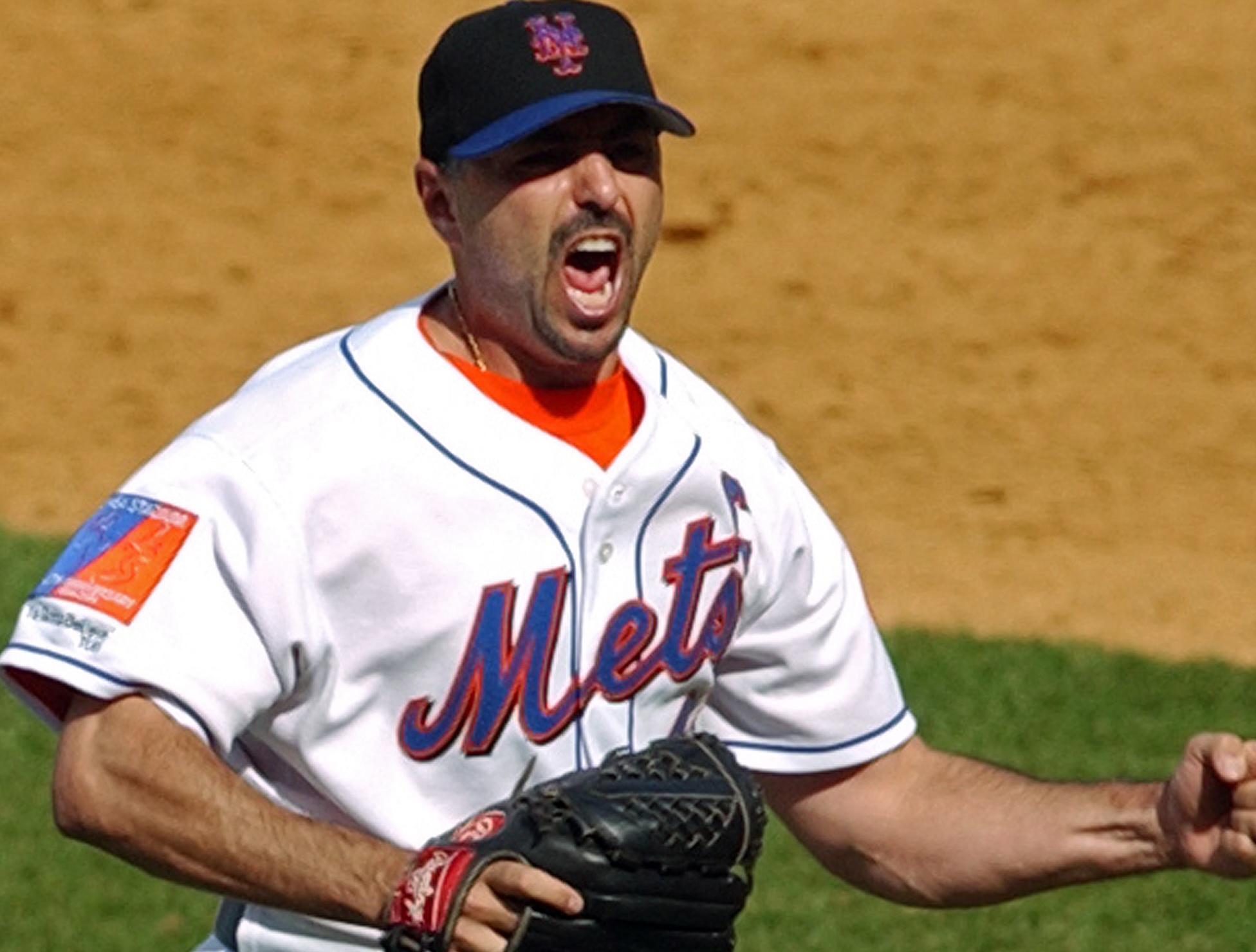
Every time the Baseball Hall of Fame announces a new class without even a serious conversation about John Franco, the institution quietly reinforces one of its longest-running blind spots: how it evaluates relief pitchers, especially those who didn’t fit a neat, modern archetype.
Franco never threw 100 mph. He never struck hitters out at video-game rates. He didn’t arrive with a singular postseason moment that could be looped endlessly on MLB Network. What he did instead was something far more difficult, and far more rare: he was great for a very long time, in the hardest role in the sport, while doing it left-handed, and he did it better than almost anyone who has ever taken the ball in the ninth inning.
History already supports that claim. Franco’s 424 career saves remain the most by a left-handed reliever. When he retired, that total ranked second all-time, trailing only Trevor Hoffman. Even now, he still sits seventh, ahead of six closers already enshrined in Cooperstown. That fact alone should stop any Hall of Fame discussion in its tracks. The Hall has never been shy about honoring elite relievers: Rollie Fingers, Bruce Sutter, Goose Gossage, Dennis Eckersley, Lee Smith, and Mariano Rivera. The question isn’t whether closers belong. The question is why Franco has been left behind.
The common rebuttal is usually some version of this: he wasn’t dominant enough. The numbers say otherwise. Franco’s career ERA (2.89) is better than Eckersley’s and Smith’s. Adjusted for era and ballpark, he ranks among the very best relievers ever, particularly among left-handers, where his longevity separates him from nearly every peer. Dominance doesn’t always mean velocity; sometimes it means never breaking, never wearing down, and never giving managers a reason to look elsewhere when the game is on the line.
That durability matters. Franco pitched in 1,119 games, an eye-opening National League record and third-most in Major League history. That’s not just a trivia note; it’s a testament to trust. Managers don’t run relievers out there that often unless they know exactly what they’re getting. For more than two decades, what they got from Franco was calm, command, and results.
Comparisons only strengthen the case. Billy Wagner, another elite left-hander, was enshrined in the Hall in 2025. Wagner was electric, overpowering, and brief. Franco was steady, surgical, and relentless. Wagner burned brighter; Franco burned longer. The Hall has room for both archetypes, because baseball history does, too.
Then there’s the Rivera comparison, which often gets used unfairly against Franco. Rivera is the gold standard. He should be. But using the greatest closer of all time as the measuring stick for everyone else creates an impossible bar. Franco doesn’t need to be Rivera to belong in Cooperstown; he just needs to be clearly Hall-worthy relative to those already inside. By that standard, his case is overwhelming.
Context also matters. Franco spent the bulk of his career in New York, where failure is magnified, and success is never taken for granted. With the Mets, he became the franchise’s all-time saves leader, a team captain, and a central figure in multiple postseason runs, including a World Series appearance. He wasn’t just closing games; he was stabilizing clubhouses, mentoring younger players, and serving as a visible leader during moments far bigger than baseball, including the organization’s response to 9/11.
That part of his legacy rarely shows up on a stat sheet, but it aligns directly with the Hall of Fame’s stated voting criteria: integrity, sportsmanship, character, and contribution to the game. Franco embodied those ideals. His Lou Gehrig Award wasn’t ceremonial; it was earned through years of quiet, consistent service to his community and his teammates. He represented the game the way the Hall claims it wants its members to represent it.
At this point, Franco’s path runs through the Contemporary Baseball Era Committee, the very mechanism designed to correct oversights like this one. We’ve seen it work recently. Jeff Kent’s election showed that the Hall can still reassess careers that didn’t fully register in their original voting window. Franco’s résumé is at least as compelling, and arguably more historically significant, than many candidates who have already received that second look.
The Hall of Fame isn’t just about peak brilliance. It’s about telling the full story of the sport. That story includes players who adapted, endured, and excelled across eras, players who didn’t dominate loudly but did dominate relentlessly.
John Franco didn’t redefine the closer role with spectacle. He defined it with reliability. And until Cooperstown recognizes that, its telling of baseball history remains incomplete.
Chris R. Vaccaro, an Emmy Award-winning media executive, author, and professor, is a senior editorial advisor for World Baseball Network and vice president of the Italian American Baseball Foundation.