In December, Baseball United completed its first season, playing 27 regular season games and a best-of-three championship series at Baseball United Ballpark in Dubai, United Arab Emirates.
Since the Mid East Falcons took the inaugural United Series with a two-games-to-one win behind an MVP performance by Toronto Blue Jays legend Munenori Kawasaki (he is Japanese!), who had a 2-for-5 night with a ground-rule double in Game 3.
In the four short months since Kawasaki and his teammates hoisted the trophy in the desert, a lot has changed. Kash Shaikh, who led Baseball United from a start-up idea to a showcase event and on through the first season, stepped down on March 1, with John Miedreich being named CEO and Barry Larkin taking over as chairman of the board shortly after the Persian Gulf region was rocked by the conflict between the United States and several gulf nations including the U.A.E. and Iran.
Earlier this week, World Baseball Network’s Leif Skodnick spoke to John Miedreich, the CEO of Baseball United, and Barry Larkin, Baseball Hall of Famer and Baseball United Chairman of the Board, to discuss the league’s progress in growing the game in the Middle East and Indian subcontinent. The questions and answers below have been edited for length and clarity.
World Baseball Network: Looking back at last year, what are your thoughts about the initial season for Baseball United?
Barry Larkin, Baseball United Chairman: I thought the season was well received by the players. I thought the season was fairly well received by the community and the United Arab Emirates.Obviously, I feel like it being our first season, it was a lot of trying new things and seeing how, uh, the public responded to it.
So I believe part of last year was part of our research and development, and as a growing organization, I think our education and the [intellectual property] that we’re getting and that we’re creating from what we’re attempting to do. Every day kind of helps us refine our approach. I thought it was in that respect, I thought it was successful. There are certainly things that we did well. There were certainly things that we didn’t do so well. We did receive a lot of feedback. And so we’ll continue to act on that feedback and try to refine our process, for sure.
WBN: What was the biggest challenge to getting the just the whole program off the ground last year? Was it getting the ballpark built in 40 days? Getting players from all around the world to the UAE and interested in playing ball there?
John Miedreich, Baseball United Co-Founder, CEO, & Board Member: What I would say the biggest challenge we’ve had – I mean all of those are surely challenges, right? Imagine you know building a professional level baseball playing surface in the middle of a sand dune, right? And that’s literally what happened and we did it. Whether it was airlifting clay in from the United States or working with like partners like FieldTurf, an American turf company that produces artificial turf for some of the largest division one programs in the United States, getting them to have their engineers come to the UAE, you know, actually weave the grass or the artificial turf on the ground in Jebel Ali so that we met the time frame we had. Those are all obviously daunting tasks. Getting players from all around the world, Eddie Diaz, our Executive Vice President of Baseball Operations, has done a tremendous job from day one putting quality competitive players on the field.
I would say, though, they’re all those are all challenges. But I think the biggest challenge is kind of what Barry alluded to before about integrating the community into the game of baseball. Baseball’s new to many in the region, and I think that the the most uphill battle we’ve had and will continue to have is just getting people excited and more excited about the game. It’s easy for us as lifelong baseball fans to appreciate what’s going on on the other side of the world when it comes to growing the greatest game on earth. But really, getting more buy-in from partners and the community has not been easy. I would have thought when we started this journey tha we probably could have done that easier than we have, but we’re up to the task and we know it will happen.
It’s just a matter of one step in front of the other. And it’s going to eventually catch on to the level that we want. But it’s not an easy task, you know, whatsoever.
WBN: What steps is Baseball United going to take to try and build that interest for the coming season?
Larkin: Finding out what’s important to them is really the thing. And that’s been our strategy since the end of the season. I believe our approach before the season was we’re going to bring the game of baseball to this region and hopefully they will like it and they’ll like certain aspects of the game. That worked in certain situations relative to the people that knew and understood the game of baseball. but we have the ability to customize our game of baseball. You’ve seen some of the gameplay, you’ve seen the fireball, you’ve seen the home run rule, the re -entry rule. We have an opportunity to customize, as I said, the game in play and the player development side of the game. Those are things that we have not touched on yet and I believe what is going to be and what we have done, I know what we have done is we’ve had conversations with people in the region and we’ve asked them the question, what’s important to you? How can we integrate what we do into your community and what’s important to you, right? I believe before it was kind of a, here we are, this is what we do, like it or not. Now, we are at the point where we are asking questions.
What do you like? How can we become part of the school system? There’s an education part of the game. Are you aware of that? There’s the tech side. There’s the medical side of the game. We can provide you opportunities and all these different soft touch points of the game of baseball if you only take the time to allow us to show you the game of baseball. I believe that’s how we’re going to integrate ourselves into the communities and be able to now get much more fan support, not only at our games, but also at our events that we’re going to be doing within the communities, you know, things that we haven’t done.
We haven’t really integrated ourselves into the school systems, right? We haven’t talked about the educational aspects, how math really equates into the game of baseball, how tech integrates into the game of baseball, right? How the whole education piece integrates into the game of baseball and is such an important and vital part of the game of baseball. Baseball, in its essence, at the level that we’re playing, is eliminating certain athletes and human species. The girls pretty much cannot compete at the level that we’re playing, right? However, we do want boys, girls, men, women, athletes,to be part of what we’re doing, the movement that we’re doing. So all these different aspects where they can become involved in the game of baseball is what we want to bring to this area. And we have that at our disposal. So not only can we customize the game on the field, but we can educate people in the community and really integrate ourselves in that way.
Miedreich: So just to add on that, one example of exactly what Lark’s talking about, just understanding what’s important to the community, you know, us understanding what moves the needle for them, not necessarily the other way around.
A great example of that is for you, we’ve had a tremendous relationship with the Dubai Little League and we’ve had a presence on the ground almost every weekend that that’s going on. So that’s closer to downtown Dubai, where we’ll have our local employees on the ground interacting with the community and that’s been great. But we’ve come to realize what’s important to them is maybe giving their players an opportunity to play, on a higher level field on a bigger stage in a nicer environment. And what we’ve done sincethe end of last season was, you know, every single week we’ll have Dubai Little League out playing at Baseball United Ballpark, where they’ll play two or three games per weekend with an elevated experience than just “your normal Little League game.” So it’s a great thing, understanding what’s important to the community and then us executing on that.
WBN: Going into this season, what’s going be the biggest challenge baseball-wise? Because obviously, there’s a lot happening in that part of the world that might make players from elsewhere a little reluctant to go to the U.A.E. to play.
Larkin: That’s a great point and a [difficult] situation… that we’re just not in control of. There will come a time and point where we have to decide, from a business perspective, ‘Okay, this is our go or no-go date.’ And, you know, it affects our marketing of the product, it affects our ticket sales, it affects a lot of different things if we go past a certain date. We would never ever put our players in harm’s way. If the conflict is not resolved, and resolved in a manner that we feel [safe] …Most importantly, it’s Dubai, [that] they feel that it’s safe for us, because they want us to be there. They want us to have a great experience. That part of the world is really important to them. Tourism is a huge part of what they do. And so we’re working with the Department of Tourism. They want us to have a great experience, and they certainly do not want any tourists to come there and be exposed to the conflict. So there’s going to become a date where It’ll be a go or no go for us, but certainly that barometer will be the safety and health of all the players as well as their families.
WBN: Obviously, you guys can’t control what happens with the war, but is there any thought to potentially an alternate venue for next season or playing maybe in India or somewhere else if you can’t play in the UAE?
Larkin: Yes, we have some contingency plans. We can’t share and won’t share all that right now, but certainly we’ve circled the wagon on a lot of this. A lot of our decisions are based on the communication that we’re getting. We do have people on the ground in Dubai who are monitoring the situation. We’re going to have a hard ‘go or no-go date.’ And we have some contingency plans that we are working on right now, if, indeed that’s a no-go.
WBN: In terms of recruiting players, it seemed like last year the level of play was probably comparable to Low-A in the United States, with some guys that were fairly well above that, especially the Japanese pitchers from the Mid-East Falcons. What’s it going to take to bring that level of play on the field up?
Miedreich: One of the things that Eddie Diaz, Executive Vice President of Baseball Operations, has been doing, is working with the leadership team to go out and recruit the best players and really raise the level of competition on the field. One of our strategies immediately after season one was to reach out, communicate, and partner with really competitive leagues all over the world. Now, as you you refer to the Japanese players from the Mideast roster, you know, we’ve expanded you know, our communication.
We’ve gotten a lot of interest from other teams within Nippon Professional Baseball to come in and send us more of their high level prospects and players. We’ve spoken with the KBO, the Korean Baseball Organization, with the CPBL, the Chinese Professional Baseball League, the Mexican teams as well. So what we’ve done is obviously we’re continuing our recruitment and our scouting and cross-checking of players here in the United States and globally the same way we have while looking at just raising the level of play. We’re tracking more players than we did last year, but at the same time it’s creating these strategic partnerships with different high-level leagues that understand what we’re building and were quite impressed with what the league was in season one. So now we’ve gotten a lot of these other organizations excited about committing players within their system to come play winter ball with us.
WBN: Any thought to rule changes? Is the fireball going to be back? The money ball, all the, all the interesting stuff?
Larkin: It’s about making sure that we appease those that are watching our game and we’ll look through the surveying that we have done and the feedback that we’re getting. So, we will certainly make it more about the individual players on the game or in the game and we’ll just try to highlight those guys. We have talked about some of the feedback, we’ve surveyed the players and asked, ‘How can we make it better for you as players?’ We’ve surveyed the fans and asked, ‘How we can make it better for you as fans?’ We’ve surveyed those that viewed our over the 120 countries that we’ve sent or streamed our games. We’ve spoken to those outlets and those individuals and we have that data. So whatever that data tells us, we’re willing to kind of move in that direction.
Miedreich: One of the things that we’ve committed to post season one and beyond is this, you know, Lark talks often times about, you know, collaborative internally and externally. So we’ve created these committees that help understand questions that you just asked, for example, and we have a sports development committee that it’s led by Eddie Diaz, but many of our Major League Baseball owners are represented on that committee and as well as community members who have an interest to see baseball grow. That committee is tasked with understanding… those dynamics and making recommendations back to the board and the organization. So we’re making intelligence-based decisions, intelligence-led decisions instead of just operating in a silo, and not just like throwing darts and seeing what happens.
WBN: So what else is ahead for Baseball United?
Larkin: Well, we have plans to expand in the area. I don’t know if you’re aware of that, but we definitely have plans to expand. Listen, this is an important season for us, especially in our relationship with Major League Baseball.
The [Major League Baseball] CBA is expiring at the end of the 2026 season. We have an opportunity here if indeed there is any void in play to provide content. So this is a very important year for us and our ownership group. As John mentioned, over 20 Major League Baseball players have come and been part of our ownership group. So that’s a pretty powerful thing. So if Major League people, Major League fans are looking for content, I know I would turn to the group of 20 Major League Baseball players, present and former Major League Baseball players to help provide content. So those are some of the discussions that we’re having as well.
Miedreich: One of the other things I would say that is important to us as an organization from a messaging and really just a culture and mission perspective, you know, our mission hasn’t changed to grow the game and bring the game of baseball to the Middle East, right? That’s the vision. That’s the mission. Now, unfortunately, what’s going on is going on, which is obviously out of our control. But we’ve been on we’ve been in constant communication with our government partners, with our vendors and partners on the ground in the U.A.E., and all we’ve done is double down our commitment on that.
It’s more important now than ever for Baseball United to stand with the region, right? Apolitical, but with the region in the sense that this is what our mission is. We still want to integrate ourselves into the community. We haven’t pulled out of the community, as Lark said. We have employees who are still on the ground in Dubai. Even if we have to adjust and, we weren’t able to play season, it doesn’t mean we’re not committed to growing the game and to being on the ground in the region.
Even more so now than ever, one of the things that we’ve done is we’ve really communicated, maybe even over-communicated, is our commitment to the U.A.E., to Saudi Arabia, to Qatar, and the overall Gulf Cooperation Council, as well as the Indian subcontinent, because it’s important. When things are going smoothly and perfect, yeah, it’s easy for somebody to say, ‘Hey, we want to be there.’ But now with this challenge that unfortunately, you know, the world’s going through, it’s even more important for us as an organization to double down on our commitment that we believe that sports can unite people and cut across religious, cultural, language barriers, physical barriers.
And we believe that more now than ever. And we know that there is surely a place for Baseball United when we get over this, you know, current situation. We believe that, you know, it will play a big role in kind of putting it all together.
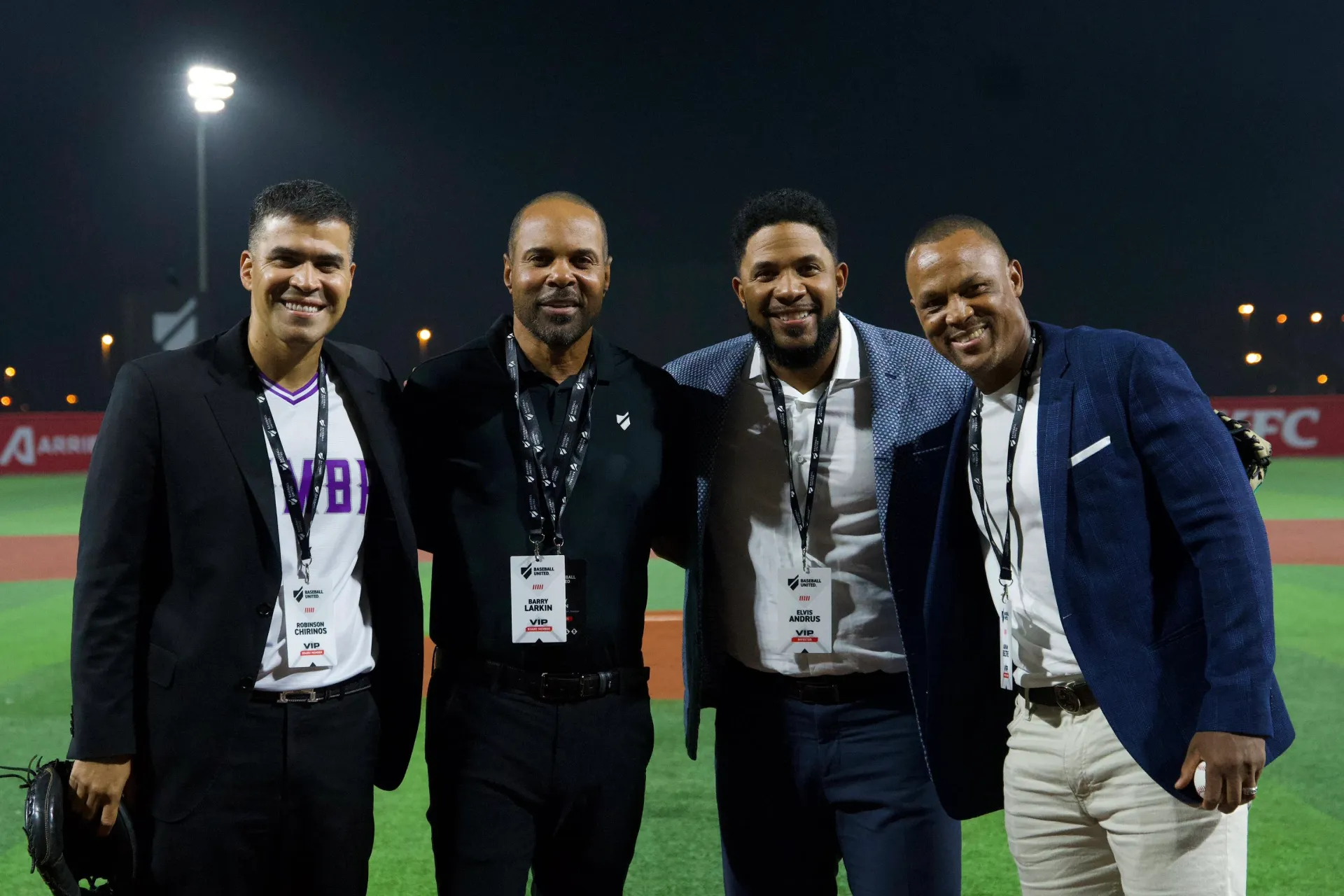
Photo: Barry Larkin, middle left, is surrounded by Baseball United c0-owners and former Major League Baseball players Robinson Chirinos, left, Elvis Andrus, middle right, and Adrian Beltre. (Photo courtesy of Baseball United)