Perhaps he wasn’t blessed with the vocal timbre of Vin Scully or Jon Miller, but as with Scully and Miller, when you heard John Sterling’s voice, you know exactly what you were hearing.
It was Yankees baseball, and whether it was on WABC, WCBS, or WFAN, and for fans of a certain generation, one that includes yours truly, the sound of John Sterling’s voice was the sound of summer for nearly 35 years. Sterling passed away Monday at the age of 87, less than two years after calling his final game, a 7-6, series-ending loss to the Los Angeles Dodgers in Game 5 of the 2024 World Series.
Years ago, Mel Allen, the former New York Yankees broadcaster, teamed up with sportswriter Frank Graham Jr. and penned a book titled It Takes Heart, a collection of stories about courage and heroism on the field when athletes dug down and found “that extra something.”
Allen, with whom Sterling briefly teamed up on cable tv, likely could have written a book with the same title about Sterling’s career, because it takes heart to call 5,060 consecutive Yankees games between 1989 and 2019, not missing a single one until he finally took a day off on his birthday – July 4 – after 30 years.
Consider, for a moment, that by the time Sterling became the Yankees radio broadcaster in 1989, he had already been working in broadcasting for nearly 30 years, and as a play-by-play man in major league sports since 1970, when he called the games of the NBA’s Baltimore Bullets. He returned to his native New York the next year, calling the games of the ill-fated New York Raiders of the World Hockey Association, the New York Islanders of the NHL, the New York and later, New Jersey Nets of the NBA, while also hosting one of the first sports talk radio shows in the nation’s biggest market on WMCA.
From 1980 until he took the Yankees job, Sterling worked for Turner Sports, calling the games of the Atlanta Braves and Atlanta Hawks, and his call of Braves reliever Rick Camp’s legendary homer in the 18th inning on July 4, 1985 is memorable.
“Ernie, if he hits a home run to tie this game, this game will be certified as absolutely the nuttiest in the history of baseball,” he said to partner Ernie Johnson Sr. as Camp stepped into the batter’s box with two outs and the Braves trailing the Mets by one in the wee hours of the morning of July 5.
Quickly down 0-2 to Mets reliever Tom Gorman, Sterling’s voice rose with the flight of the ball as it carried over the left field fence, his incredulity at the absurdity of the moment reaching its peak as Mets left fielder Danny Heep put his hands on his head as the ball flew over the wall, tying the game at 11-apiece.
“It is… Gone! Holy Cow! Oh my goodness! I don’t believe it! I don’t believe it!” Sterling intoned, with not a hit of embellishment. The moment was truly that crazy. It was Camp’s only MLB homer. “Rick Camp! Rick Camp! I don’t believe it! Remember what I just said? If he hits a home run? That certifies this game as the wackiest, wildest, most incredible game in history!”
Four years later, he began the run in New York that made him as much of a Yankees legend as Ruth, Dimaggio, Mantle, Berra, and Derek Jeter and Mariano Rivera. Consider that over the course of those 5,060 games, he called every single pitch of Jeter and Rivera’s Hall of Fame careers. Every hit by Jeter, every save by Rivera, all narrated by that same inimitable voice.
And yes, Sterling wasn’t perfect. You noticed his New York accent – if it was turned down, it was there – but it wasn’t jarring. His signature home run calls were frequently imitated, especially in recent years as Aaron Judge drove the ball out of the park a a rate Yankee fans hadn’t seen since 1961. Some of the home run calls were hokey; for example, calling Jason Giambi “The Giambino” was a little bit much, and the “David John! Long Gone!” for D.J. LaMahieu was, well, kinda flat, but I’ll concede that you can’t rhyme much with “LaMahieu.”
And there were the gaffes. Frequently enough that it was noticeable, Sterling would get overly exuberant, starting his signature home run call, “It is high! It is far! It is…” only have finish it of with, “foul,” after drawing most of the Yankee Universe out of their collective seats. And there was one hit by Giancarlo Stanton against the Toronto Blue Jays that was easily pulled in on the warning track by Raimel Tapia, with Sterling saying, “It is high! It is far! It is… gone! … but caught. At the wall, caught by Tapia. Boy, I thought that was gone.”
But let’s be honest, there are going to be gaffes when you call 15,000-plus hours of Major League Baseball without a day off, and when you’re the voice of the biggest brand in MLB, well, the gaffes are a bit more noticeable.
Amid the hokey homer calls and the occasion high and far fouls, he called four World Series championships, Doc Gooden’s no-hitter, perfect games by David Wells and David Cone, and possibly the single-most storybook moment in Yankees history.
Just out of grad school and unwilling to plunk down the $250 or so to get into Yankee Stadium to see them play the Orioles on Sept. 25, 2014, I opted, instead, to listen to the game at home, listening to what would be Derek Jeter’s final game.
When Jeter came to the plate in the bottom of the ninth, Sterling rose to the moment, one that will likely be remembered as his best.
“Could it be? Could it happen? Here’s Derek Jeter with the winning run at second,” Sterling asked as Jeter walked from the on-deck circle to the plate with one out in the bottom of the ninth. “I know what you’re thinking: It would be true Hollywood if Jeter got a hit to win the game.”
Jeter, of course, did just that, taking the first pitch the other way to right field, with the speedy Antoan Richardson racing home and diving across the plate as the throw came in high from Baltimore’s Nick Markakis in right field.
“Richardson scores on a base hit by Derek Jeter! Was that unbelievable, or was that unbelievable?” Sterling said. “Yankees with the ballgame! Ballgame over! Yankees win! Theeeeeeeeeee Yankees win!”
There were more games after that, nearly a decade’s worth, but none, not even Aaron Judge’s 62nd homer of the year to break Roger Maris’s record in 2022, were nearly as memorable.
Sterling’s voice will forever be linked with the moment that punctuated Jeter’s career and so many others over his 35 years with the Yankees.
No, John Sterling wasn’t baseball’s greatest voice, but he earned his place among the greats, and for New York baseball fans of a certain age, he certainly was ours.
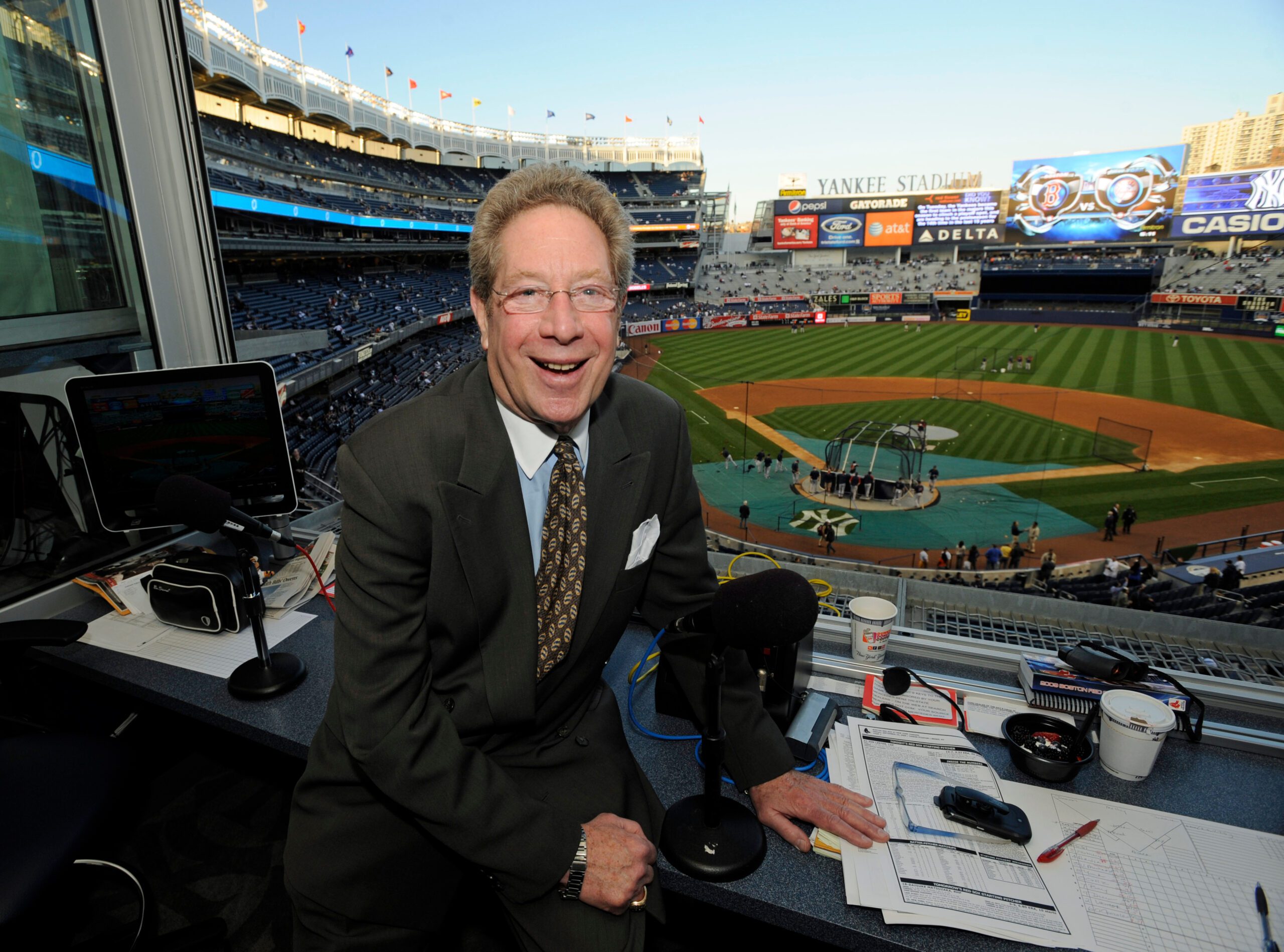
Photo: In this Sept. 25, 2009 file photo shows New York Yankees broadcaster John Sterling sitting in his booth before a baseball game against the Boston Red Sox at Yankee Stadium in New York. (AP Photo/Bill Kostroun, file)