USA — The Chicago Cubs and St. Louis Cardinals meet Tuesday night at Busch Stadium in the second game of a four-game series, carried nationally on TBS. Here is every voice you can find it on.
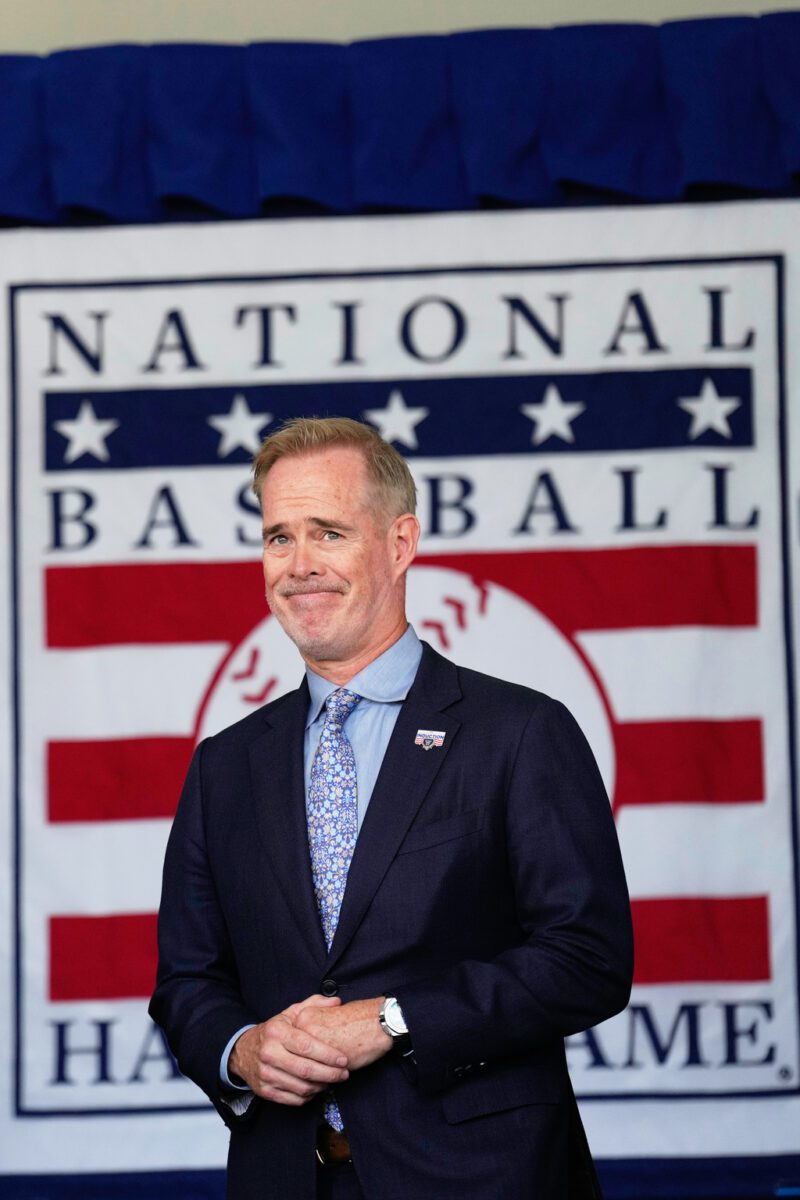
Frick Award winner Joe Buck is introduced during the Baseball Hall of Fame induction ceremony in Cooperstown, N.Y., Sunday, July 26, 2026. (AP Photo/Seth Wenig)
World Baseball Network recently caught up with Joe Buck in Cooperstown at his HOF induction ceremony.
Where to watch and listen
First pitch: 7:45 p.m. ET / 6:45 p.m. CT · Busch Stadium, St. Louis
National television — TBS
Part of MLB Tuesday, in its fifth season, with a 30-minute pregame and postgame show. TBS’s 2026 booth features play-by-play announcers Brian Anderson and Alex Faust with analysts Ron Darling and Jeff Francoeur. Lauren Shehadi reports and hosts studio segments alongside Pedro Martínez, Curtis Granderson and Jimmy Rollins.
Cardinals — Cardinals.TV
Chip Caray on play-by-play, with Al Hrabosky, Brad Thompson and Mark Sweeney as analysts. Jim Hayes, Scott Warmann and Dani Wexelman handle hosting and reporting.
Wexelman is new to the booth this season and a St. Louis native — a 2011 Missouri journalism graduate who worked at SNY in New York and covered baseball for ESPN before coming home. Her approach, she said in March, is to chase the human material behind the box score: “I’m trying to humanize the sport.”
Cardinals — radio, KMOX 1120 AM / 104.1 FM
John Rooney on play-by-play, with analysts Ricky Horton and Mike Claiborne. Spanish-language coverage on WIJR AM 880 with Polo Ascencio and Bengie Molina.
Cubs — Marquee Sports Network
Jon Sciambi on play-by-play, Jim Deshaies on color. Rick Sutcliffe, Ryan Dempster, Cliff Floyd and Elise Menaker rotate through secondary roles.
Cubs — radio, 670 The Score
Pat Hughes on play-by-play, Ron Coomer on color, Zach Zaidman hosting pregame and postgame.
Hughes has held the Cubs radio chair since 1996. He was named the 2023 Ford C. Frick Award winner, the 47th recipient, joining Jack Brickhouse and Harry Caray as the only Cubs announcers to receive it. He called Kerry Wood’s 20-strikeout game, eight Cubs no-hitters, and became the first Chicago broadcaster to call a Cubs World Series championship in 2016.
He has also shared a booth with three Hall of Famers: Bob Uecker, Ron Santo — and Harry Caray.
The booth this rivalry built
That last detail is the thread. The chairs being filled tonight sit in a lineage unlike any other in American sport, and it runs directly through this matchup: multiple Frick Award winners, four generations of one broadcasting family, and one president of the United States.
That last one is not a figure of speech. Scroll the list of Chicago Cubs broadcasters and you will find, between Pat Flanagan and Russ Hodges, the entry: Ronald Reagan (1933–36).
June 7, 1934
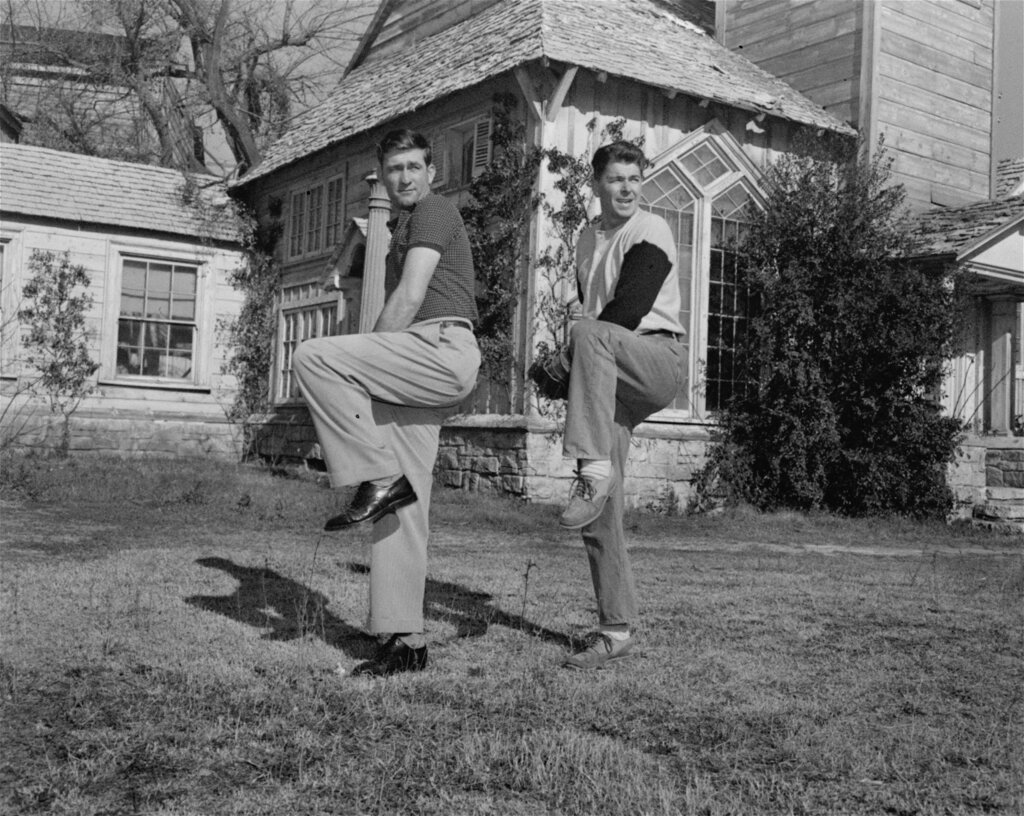
Actor Ronald Reagan, right, gets some firsthand instruction from pitcher Bob Lemon of the Cleveland Indians at Burbank, California, December 10, 1951. Reagan has the role of Pete Alexander, the great Grover Cleveland Alexander of pitching fame, and Lemon is trying to add realism to Reagan’s task. The actor, incidentally, once played baseball at Eureka College in Illinois. (AP Photo)
A 23-year-old announcer at WHO in Des Moines was calling a Cubs-Cardinals game he could not see. That was normal for the era. He worked from a studio hundreds of miles from the ballpark, reading a telegraph operator’s typed slips and building a word picture as though he were sitting behind home plate.
The score was 0-0 in the ninth. Billy Jurges was batting. Dizzy Dean was on the mound. The wire went dead.
Rather than lose his audience, Dutch Reagan improvised a streak of foul balls that lasted nearly twelve minutes, until the line came back. By his own account, he told that story for the next fifty years.
There is a footnote to it. Dean — the pitcher Reagan was inventing foul balls off of — would join the Cardinals broadcast booth himself in 1941 and stay through 1946.
The trip to Catalina
Reagan had grown up moving between small Illinois towns as his father, an itinerant shoe salesman with a drinking problem, lost one job after another. He graduated from Eureka College in 1932 into an economy where roughly a fifth of the country was out of work.
He looked around the Midwest and saw no film studios. He saw radio stations.
In 1937 he persuaded his bosses at WHO to send him to Cubs spring training on Catalina Island, off the coast of Los Angeles, pitching it as a way to get to know the players. He had another reason. Once in California, he slipped away to Warner Brothers for a screen test, and Jack Warner liked what he saw.
“He basically conned the owner of the radio station,” biographer Max Boot said of the trip on The Ryen Russillo Podcast, describing a man whose aw-shucks manner concealed ferocious ambition.
Fourteen years later, back on a Burbank lot, Reagan took pitching instruction from Cleveland’s Bob Lemon while preparing to play Grover Cleveland Alexander in The Winning Team.
Twenty-five years, one voice
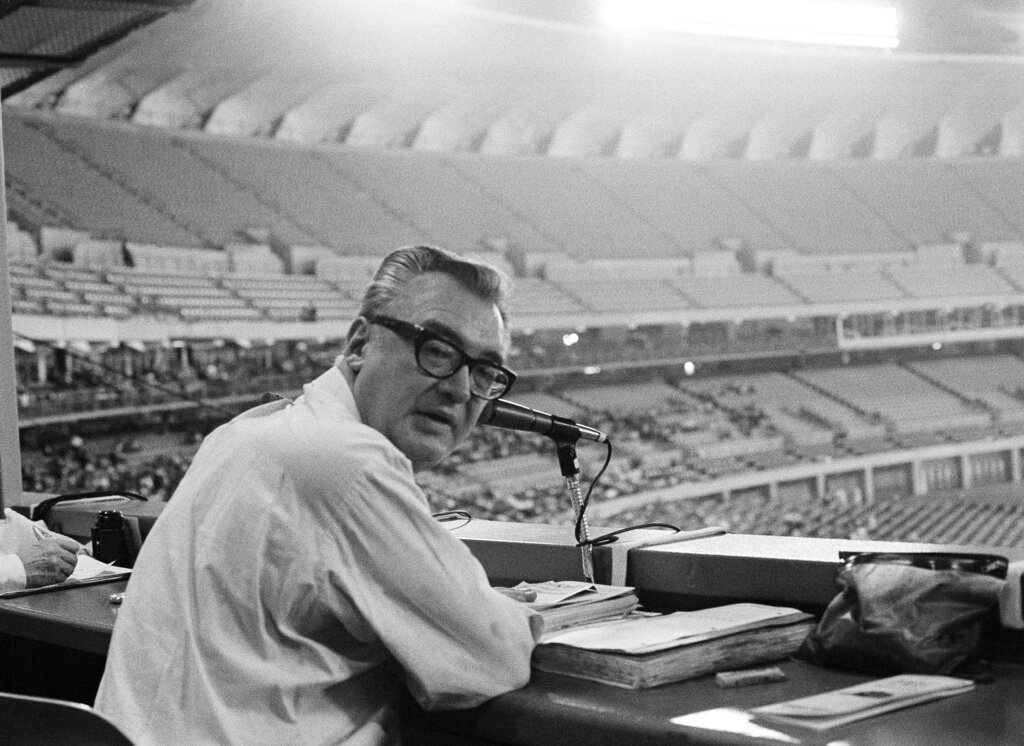
Harry Caray, shown announcing the final Cardinal game of the seasons against the Phillies was told by club owner August A. Busch, Jr., that his contract is not being renewed, Thursday, Oct. 2, 1969 in St. Louis. Caray has been the voice of the Cardinals for more than 25 years. (AP Photo)
Harry Caray called Cardinals games from 1945 to 1969. Jack Buck arrived in 1954, and across fourteen seasons together they formed one of the sport’s great two-man booths.
It ended abruptly. After the 1969 season, owner August A. Busch Jr. informed Caray his contract would not be renewed. He eventually landed with the Cubs, calling their games from 1982 to 1997 and becoming a fixture on the other side of the rivalry he had spent a quarter-century describing from St. Louis. He received the Frick Award in 1989.
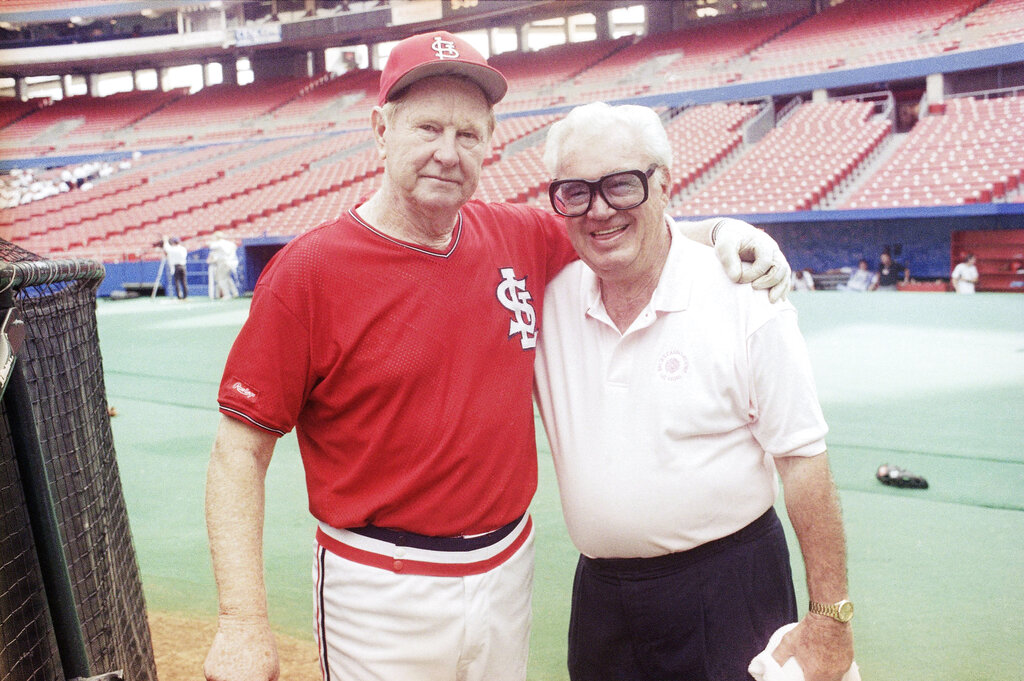
St. Louis Cardinals coach Red Schoedienst, left, and Marry Caray, voice of the Chicago Cubs share a moment prior to the start of the Cardinals-Cubs game at night on Tuesday, July 25, 1989 in St. Louis, MO. Both were inducted into the Baseball Hall of Fames July 23, 1989. (AP Photo/Leon Algee)
Editor’s note: the wire caption above misspells both Red Schoendienst and Harry Caray.
Two days after both were honored at Cooperstown, Caray and Cardinals coach Red Schoendienst shared a moment before a Cardinals-Cubs game in St. Louis.
The night Jack Buck walked out
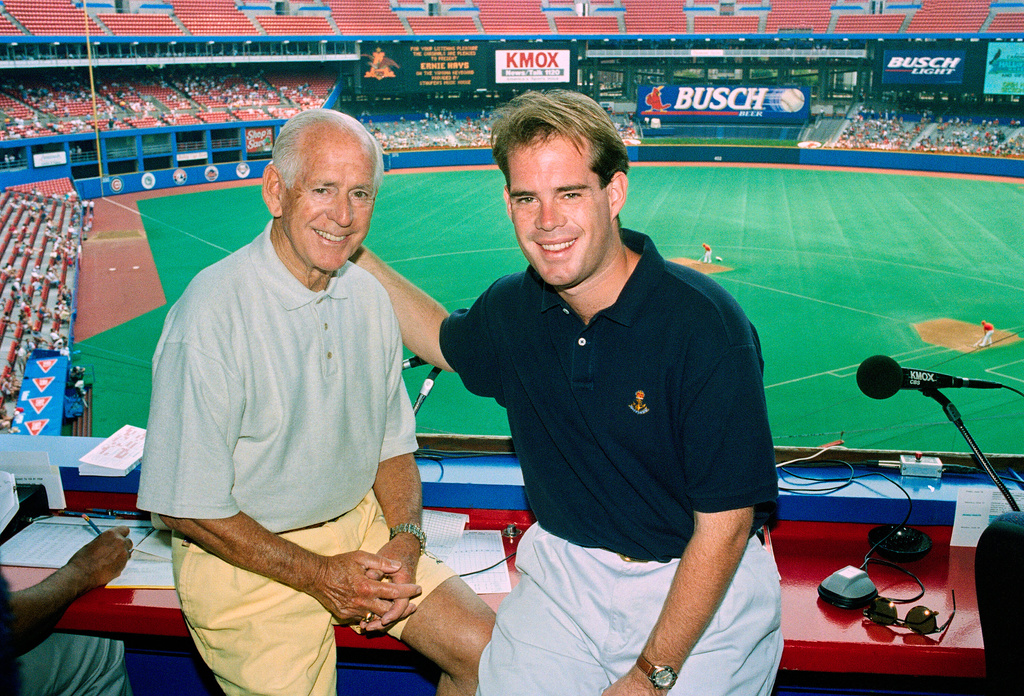
FILE – St. Louis Cardinals Hall of Fame Broadcaster Jack Buck, left, and his son, Joe Buck, celebrate Father’s Day as they go into their fifth season of broadcasting the St. Louis Cardinals Baseball in St. Louis, June 18, 1995. (AP Photo/Leon Algee, File)
Jack Buck called Cardinals games from 1954 to 1958 and again from 1961 until 2001 — more than four decades. In 1986 he left the KMOX booth mid-broadcast and handed the microphone to his 17-year-old son, alone, live, in front of a Cardinals radio audience.
Joe Buck swam. He joined the Cardinals broadcasts in 1991 and stayed through 2007, then became a national voice calling World Series and Super Bowls across three decades.
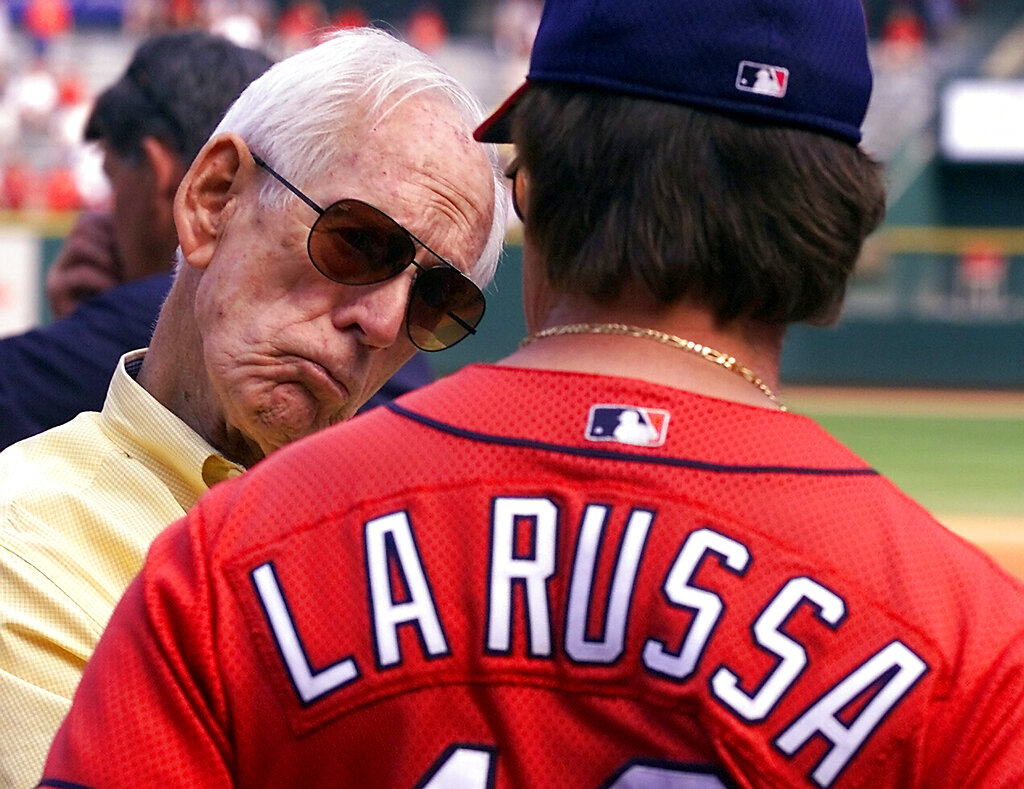
Hall-of-fame broadcaster Jack Buck interviews St. Louis Cardinals manager Tony La Russa at Busch Stadium in St. Louis on June 23, 2001. (AP Photo/Tom Gannam)
Jack Buck died in June 2002. The mourning in St. Louis was of a kind usually reserved for players.
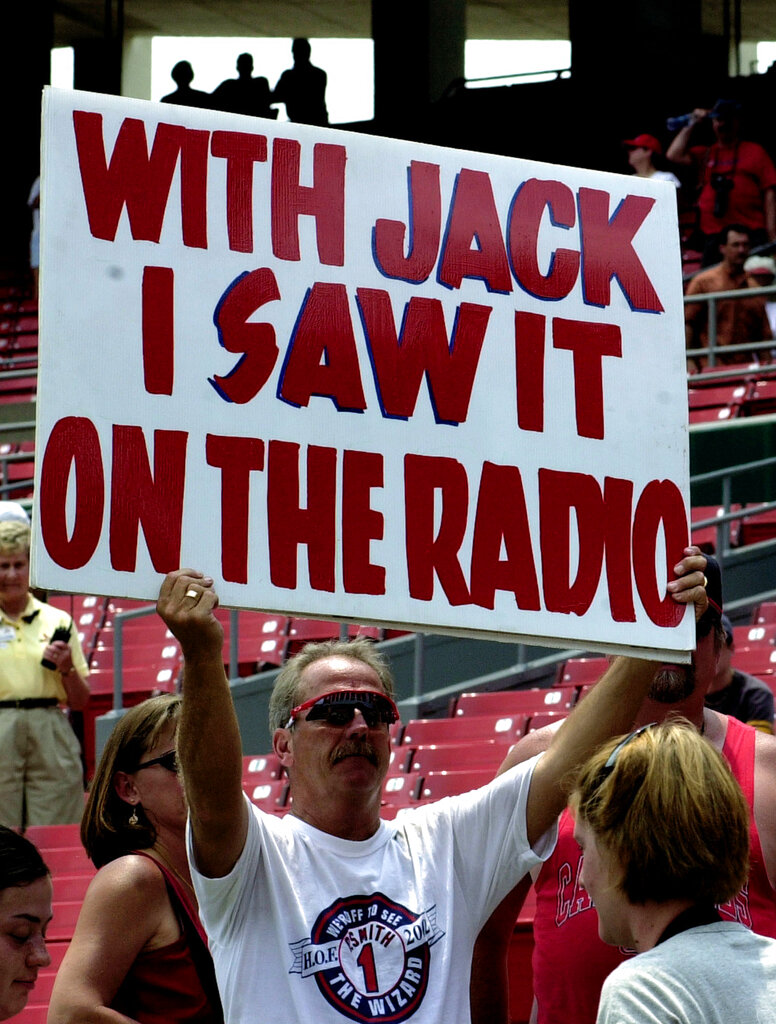
FILE – In this June 18, 2002, file photo, Marty Prather, of Springfield, Mo., holds a sign in rememberance of Jack Buck, the legendary St. Louis Cardinals broadcaster, at Bush Stadium in St. Louis. Unlike basketball or football or other major sports where the action is nonstop, baseball provides many opportunities for broadcasters to fill with stories and personal anecdotes. They weave in updates about their gardens and their travel experiences and their everyday adventures.(AP Photo/Diane L. Wilson, File)
On Sunday, July 26, 2026, Joe Buck was introduced at the Hall of Fame induction ceremony in Cooperstown as the 50th recipient of the Ford C. Frick Award — the honor his father received before him.
Four generations of Carays
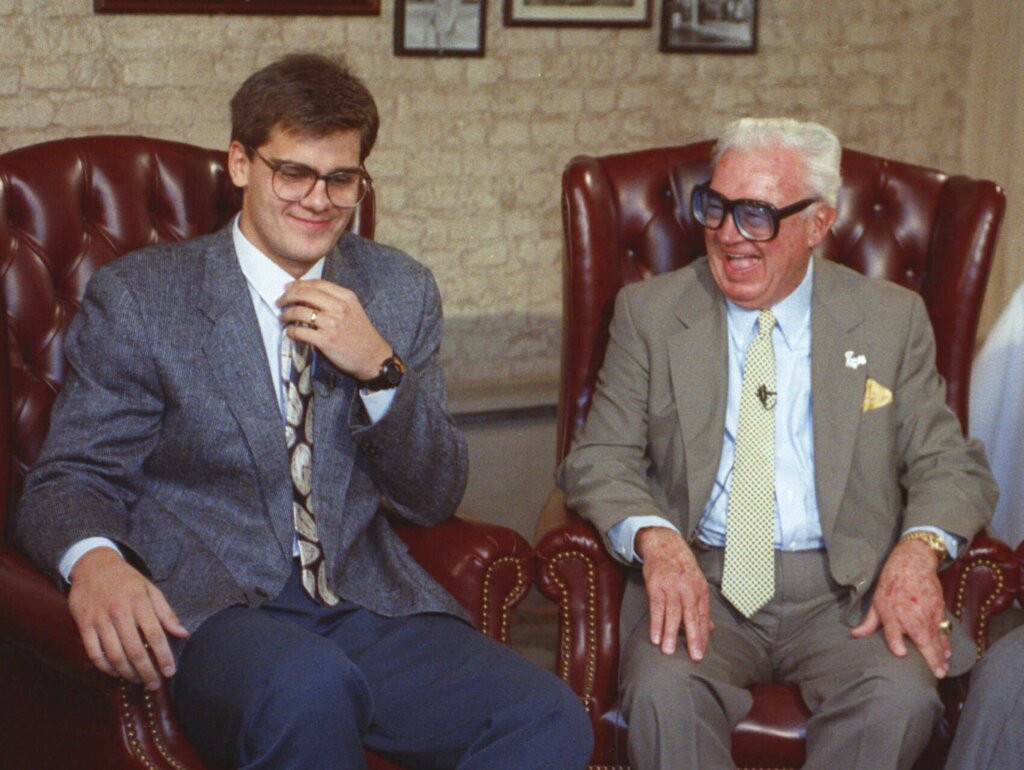
FILE – Hall of Fame baseball announcer Harry Caray, right, laughs with his grandson Chip in Chicago in this May 13, 1991 photo. Longtime broadcaster Chip Caray is taking over as the play-by-play voice of the St. Louis Cardinals, more than five decades after his grandfather and Hall of Fame broadcaster Harry Caray became a baseball staple with the same club. Bally Sports Midwest announced Caray’s hiring in a statement Monday, Jan. 30, 2023. (AP Photo/John Zich, file)
Harry’s son Skip called Braves games for decades. Skip’s son Chip called Cubs games from 1998 to 2004 — the same booth his grandfather had held — then took over as the play-by-play voice of the Cardinals in 2023, more than five decades after Harry had that job. Chip was also TBS’s play-by-play voice when Turner Sports took over National League Championship Series coverage in 2007, meaning the network carrying tonight’s game has a Caray in its own history.
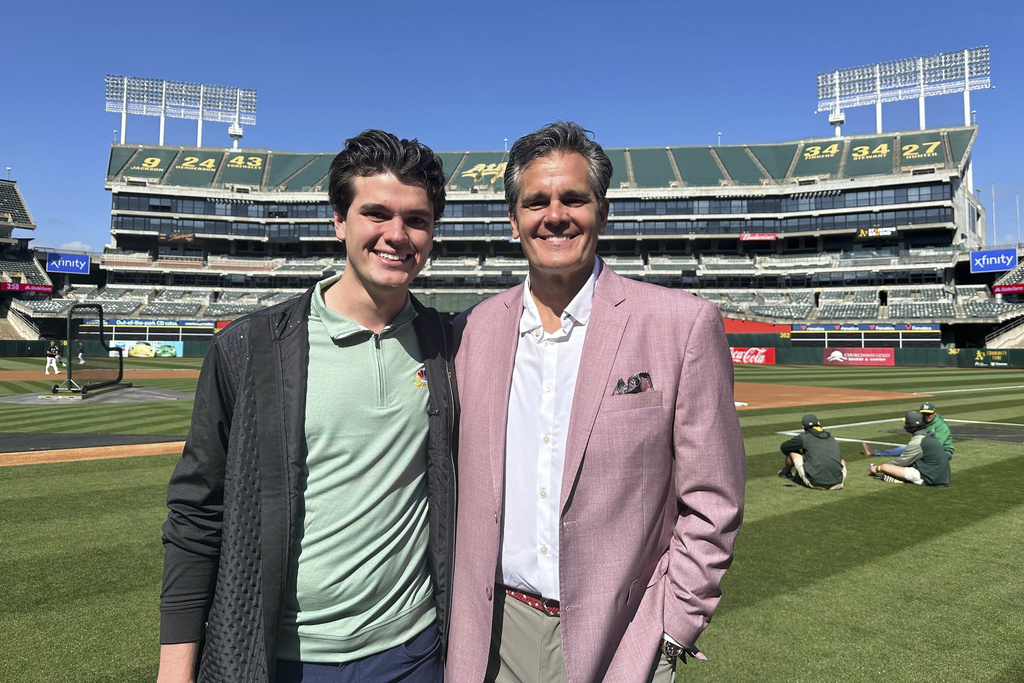
Oakland Athletics broadcaster Chris Caray, left, and his father, Chip, the play-by-play announcer for the St. Louis Cardinals, stand for a photo before the teams’ baseball game Monday, April 15, 2024, in Oakland, Calif. (AP Photo/Janie McCauley)
Chip’s twin sons make four generations. Chris Caray broadcasts for the Athletics. Stefan Caray works for the Cardinals and has shared a booth with his father, including a Spring Breakout game against the Marlins in March 2025.
Ahead of that broadcast, Chip was asked whether he might pull a Jack Buck and walk out on his son.
“Do I still get paid?” he said.
Stefan had an answer ready: “Well, dad’s not as good as Jack Buck, so he hasn’t earned that right.”
The two families are not separate stories. Stefan’s great-grandfather and Chip’s grandfather are the same man — and that man spent fourteen seasons beside Jack Buck before either family had a second generation in the business.
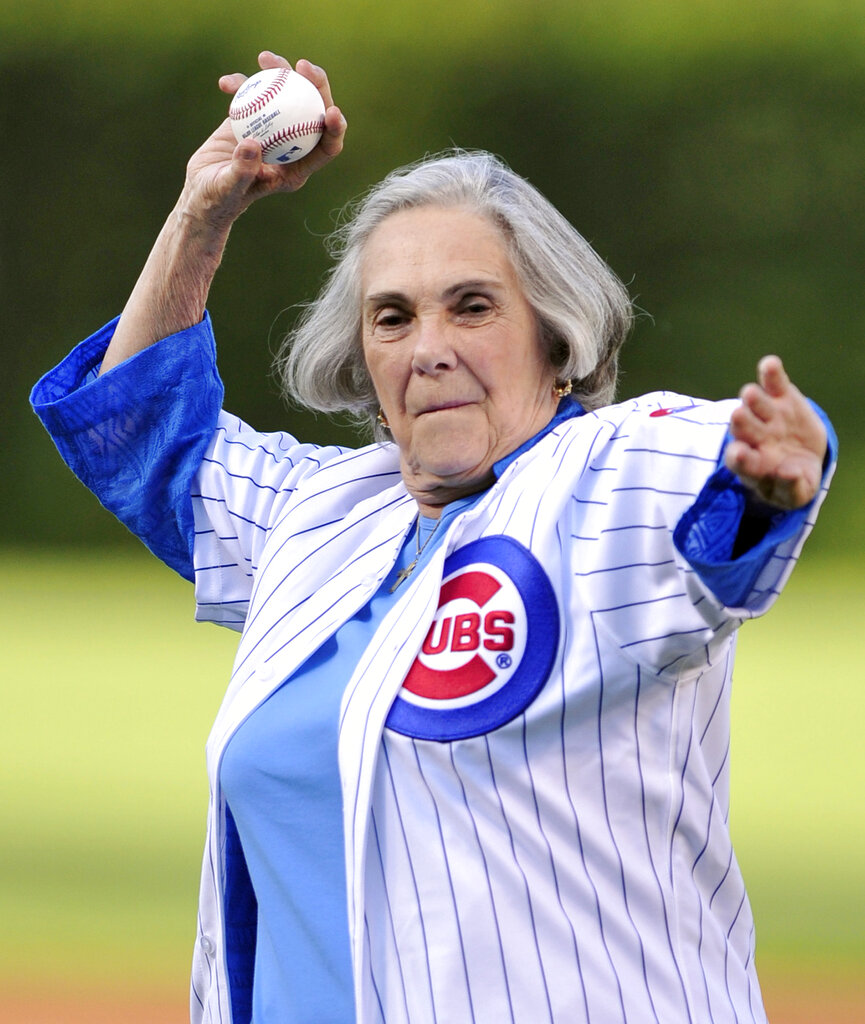
Dutchie Caray, widow of Cubs broadcaster Harry Caray, throws out a ceremonial first pitch before a baseball game between the St. Louis Cardinals and the Chicago Cubs in Chicago, Saturday, July 13, 2013. (AP Photo/Paul Beaty)
Back to Wrigley
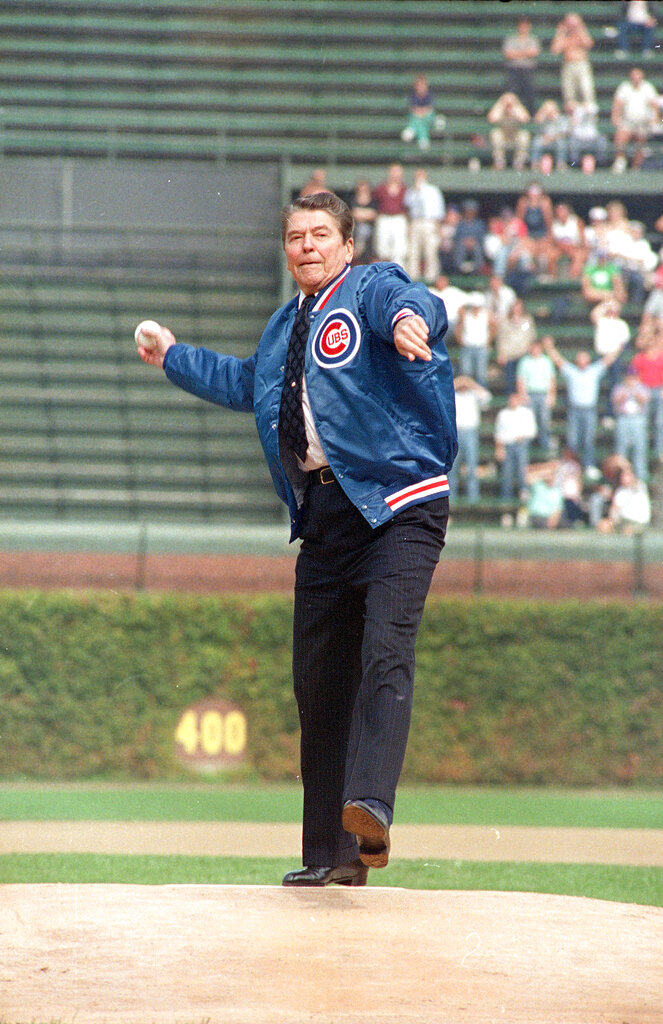
U.S. President Ronald Reagan throws out the ceremonial first pitch at Wrigley Field in Chicago, Ill., Friday, Sept. 30, 1988. The Chicago Cubs host the Pittsburgh Pirates. The president later went to the broadcast booth and helped announce the first part of the game. (AP Photo/Charles Tasnadi)
On September 30, 1988, with a few months left in his presidency, Ronald Reagan returned to Wrigley Field and threw out a ceremonial first pitch before the Cubs hosted the Pirates.
Then he went up to the booth and called part of the game alongside Harry Caray.
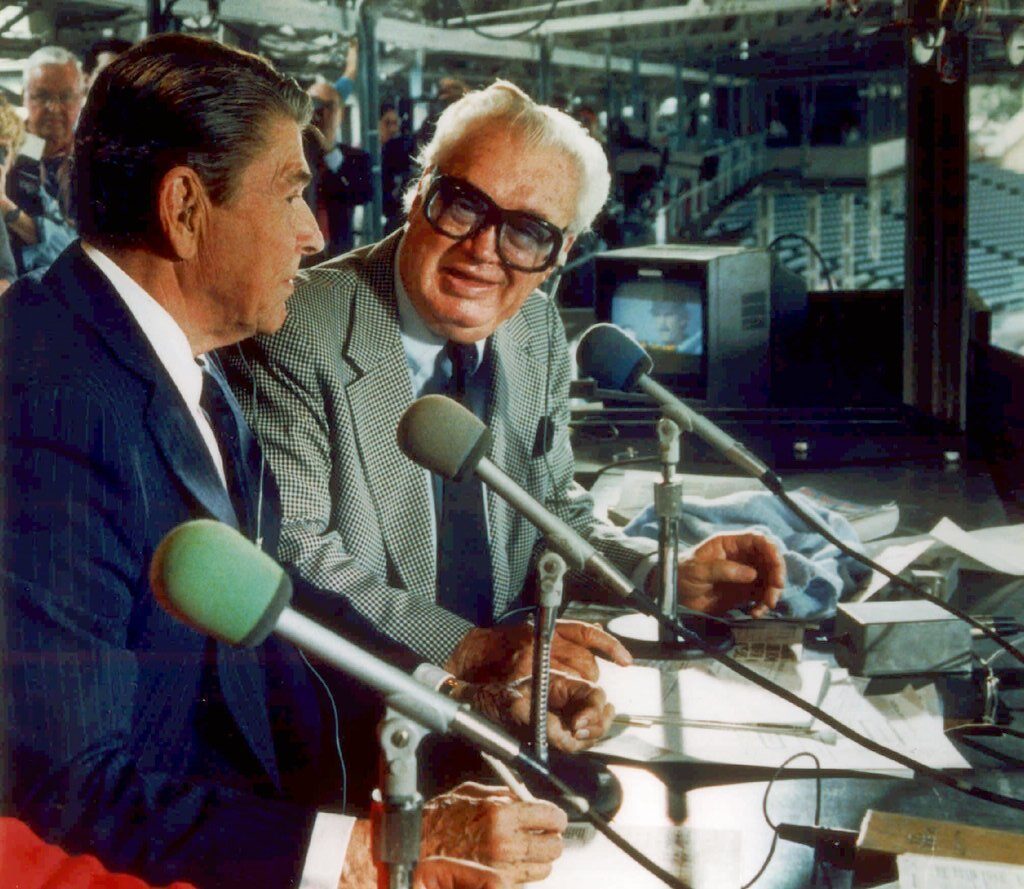
Chicago Cubs broadcaster Harry Caray is joined in the booth by President Reagan during a surprise visit to Wrigley Field in Chicago on Sept. 30, 1988. (AP Photo/Charles Tasnadi)
“You know, in a few months I’m going to be out of work,” Reagan said, “and I thought I might as well audition.”
Fifty-four years after he invented twelve minutes of foul balls in a Cubs-Cardinals game he never saw, he was back in the chair — beside a man who had called both clubs, in a booth that has since produced Frick winners and four generations of a single family.
Somebody sits down in it again at 7:45 tonight.