For decades, international collegiate baseball has been a series of handshakes. The U.S. and Japan have played a “friendship series” 45 times since 1972. The U.S. and Chinese Taipei have done the same 21 times since 1987. Good baseball, real competition, but exhibitions all the same — no medals, no bracket, no stakes beyond bragging rights and player development reps.
That changes this July.
USA Baseball, the Chinese Taipei Baseball Association, and the Japan University Baseball Federation have jointly created the World Collegiate Baseball Championship, with the inaugural tournament running July 11-15 at Taichung City Intercontinental Baseball Stadium in Taiwan. Korea, representing the Korea Baseball Softball Association, joins as this year’s wild card. It’s a four-team, five-day format: three days of pool play, semifinals on July 14, gold- and bronze-medal games on July 15.
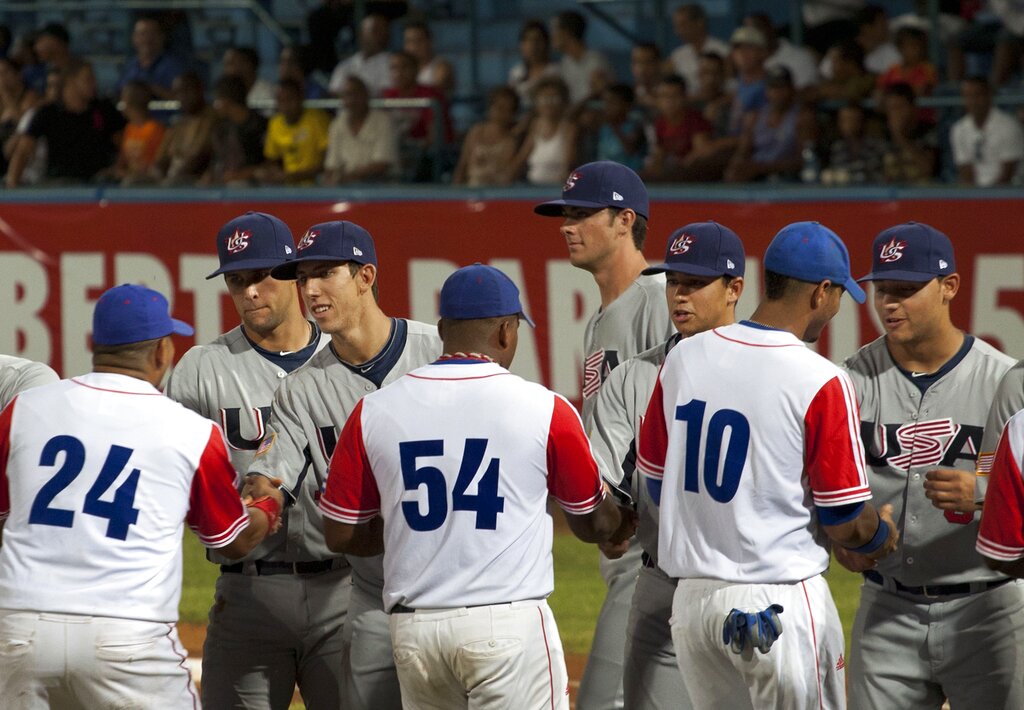
U.S. baseball collegiate stars team members greets members of a veteran Cuban national squad, back to camera, before a friendly baseball game in Havana, Cuba, Thursday, July 5, 2012. A team of collegiate stars representing the United States faced off with a veteran Cuban national squad in Havana on Friday night, reviving a series between two baseball-mad nations 16 years after it was called off. (AP Photo/Ramon Espinosa)
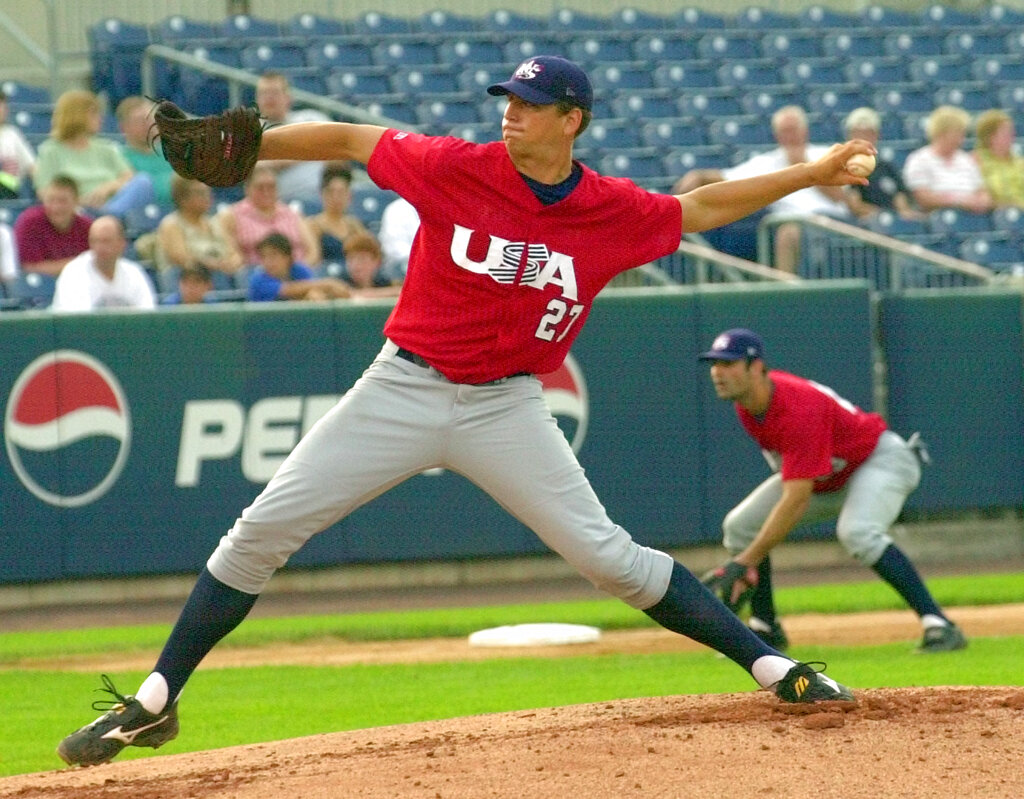
Kyle Bakker pitches for the USA National Team against Japan in the first inning of a Japan-USA Collegiate Baseball Series game in Bridgeport, Conn., Saturday, June 29, 2002. (AP Photo/Bob Child)
USA’s Kyle Bakker pitches against Japan in the 2002 Japan-USA Collegiate Baseball Series in Bridgeport, Conn. The bilateral series, dating to 1972, evolves into the four-team World Collegiate Baseball Championship this summer. (AP Photo/Bob Child)
It’s not the first time international collegiate baseball has tried to build a championship. The World University Baseball Championship, sponsored by FISU, ran from 2002 to 2018 — eight tournaments across Italy, Cuba, Czech Republic, Taiwan, Japan, and elsewhere. The U.S. won it three times (2004, 2006, 2008). Cuba won twice. Japan and Chinese Taipei medaled repeatedly. But the event lapsed after 2018, was effectively replaced on the WBSC calendar by the 23U Baseball World Cup, and the college-specific international stage went dark.
The WCBC fills that vacuum, but with a sharper structure. Where the FISU event was open to whichever federations could field a team, the WCBC is built as a three-federation compact with rotating hosts (U.S. in 2027, Japan in 2028) and a host-selected wild card. That’s institutional weight from day one rather than asking it to grow into relevance.
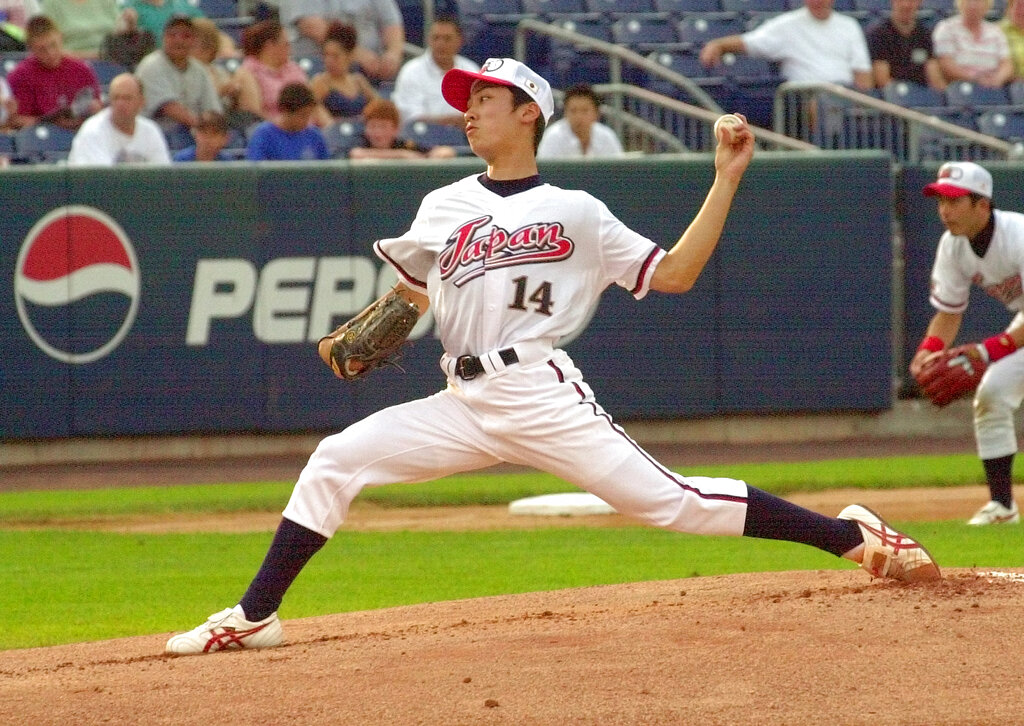
Japan’s Tsuyoshi Wada pitches in the first inning of the Japan-USA Collegiate Baseball Series in Bridgeport, Conn., Saturday, June 29, 2002. (AP Photo/Bob Child)
Japan’s Tsuyoshi Wada pitches in the 2002 Japan-USA Collegiate Series. Wada went on to a decorated Nippon Professional Baseball career with the SoftBank Hawks and a brief MLB stint — a template for the kind of player the new WCBC will showcase. (AP Photo/Bob Child)
The pipeline these three federations produce is not a small thing. Alex Bregman and Kyle Schwarber came through the U.S. collegiate program. Sugano Tomoyuki and Morishita Shota came through Japan’s. Lin An-Ko and Sung Chia-Hao came through Chinese Taipei’s. All six played for their countries at the 2026 World Baseball Classic. Whoever emerges from Taichung this July will, in many cases, be on a WBC roster within a decade.
The U.S. is the favorite, but it’s not a coronation. American collegiate teams have historically dominated these friendship series, but the talent gap has narrowed considerably. Japan’s collegiate program has produced four NPB MVPs over the last decade. South Korea’s wild card entry draws from the same talent base that built the KBO’s current generation. And Chinese Taipei’s baseball ecosystem is in arguably its strongest moment ever — the senior team beat Japan 4-0 at Tokyo Dome to win the 2024 Premier12, snapping a 27-game Japanese winning streak and claiming Taiwan’s first senior international title.
Worth flagging: Taiwan’s player-development pipeline doesn’t map cleanly onto the U.S. or Japanese model. Top Taiwanese high-school arms can be drafted directly into the CPBL or signed into MLB organizations without ever playing college ball. Yu-Min Lin, who started that Premier12 final, signed with the Diamondbacks at 17. The college roster Chinese Taipei sends to Taichung in July will be deep, but it represents one development track among several. Same with Korea — the KBO drafts heavily from high schools.