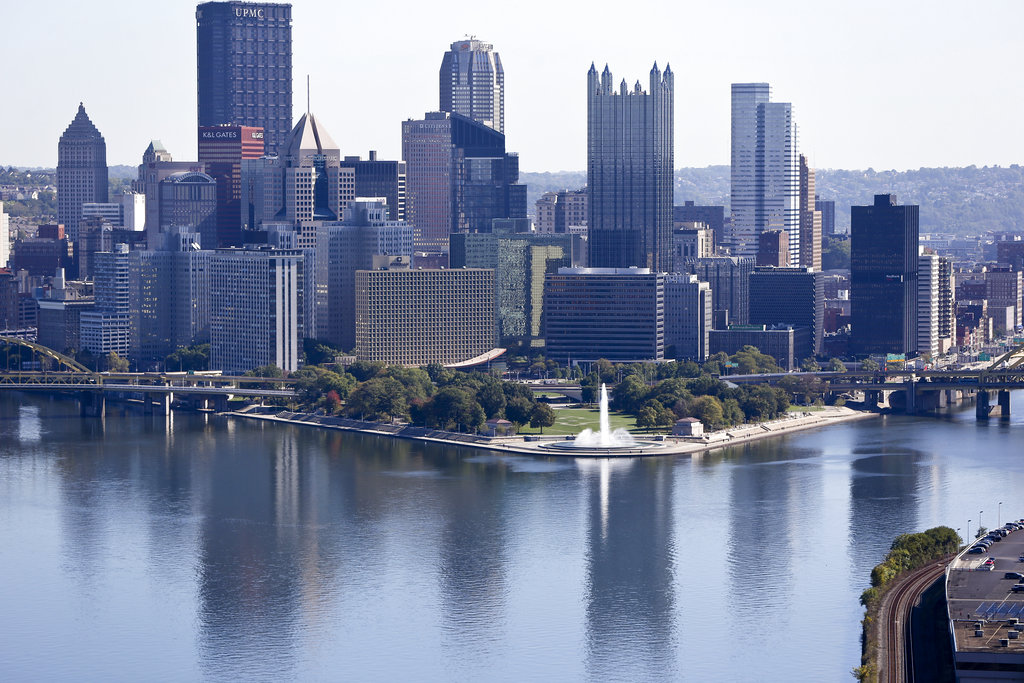
The skyline of downtown Pittsburgh, known as the Golden Triangle, is seen from the West End-Elliott Overlook Park on Wednesday, Oct. 18, 2017, in Pittsburgh. (AP Photo/Keith Srakocic)
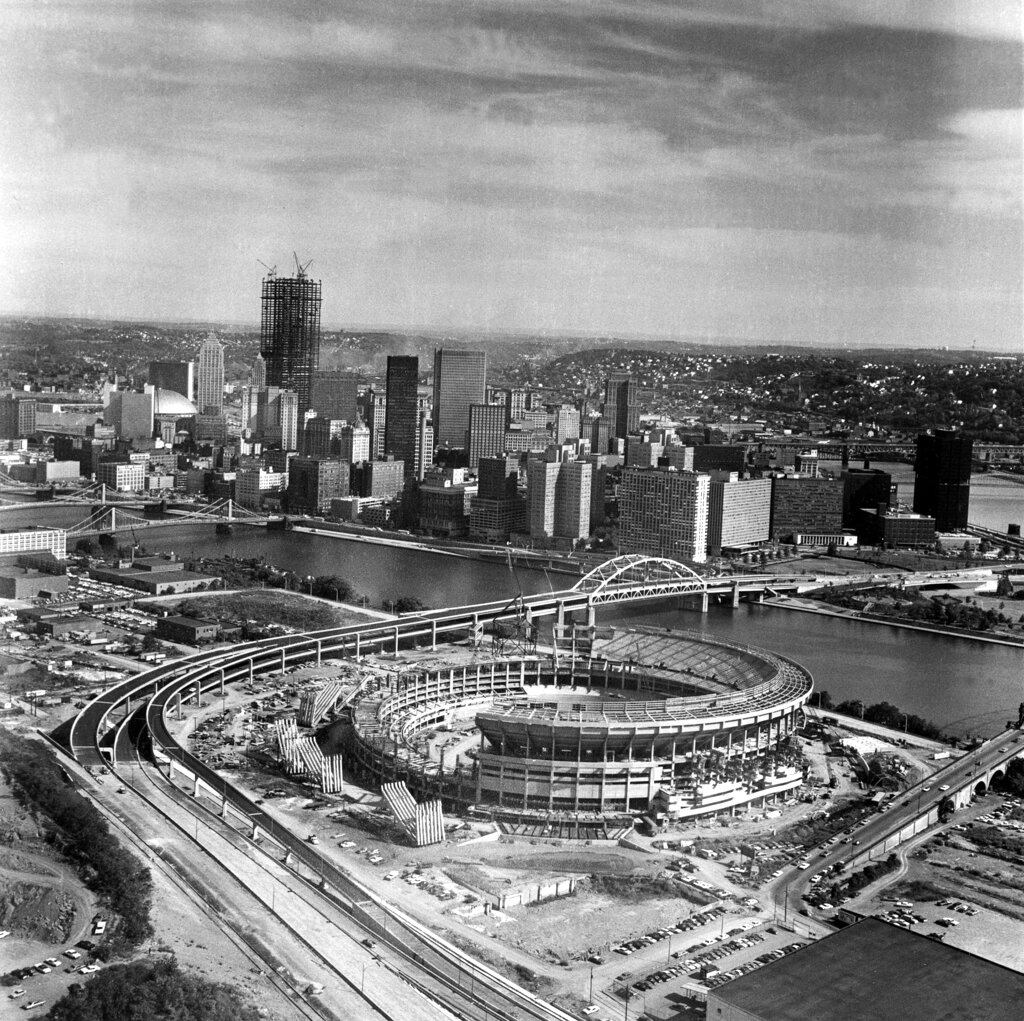
Construction goes on at Three River Stadium at Pittsburgh’s North Shore, seen here on September 18, 1969. Behind the construction site the Fort Duquesne Bridge leads over the Allegheny river into the city’s famed Golden Triangle, a downtown business development with the new 65-story U.S. Steel Tower under construction; seen on the far left. (AP Photo)
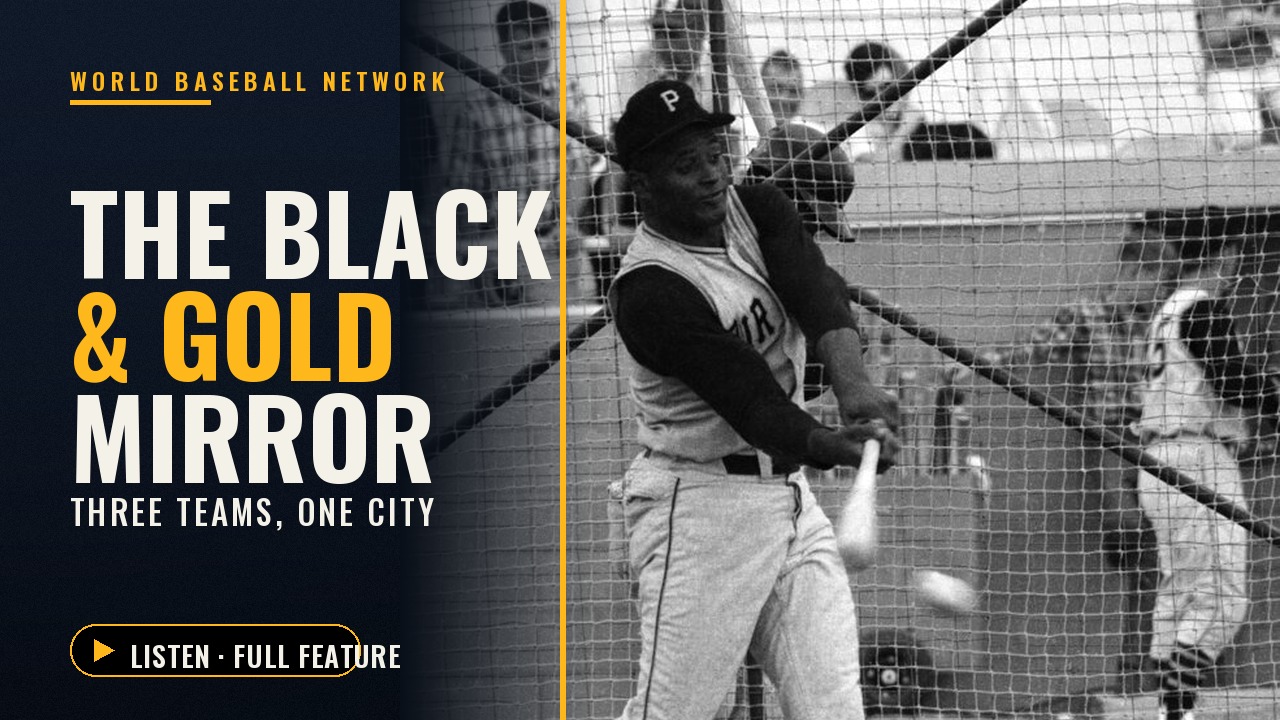
The Black & Gold Mirror — Three Teams, One City
A meditation on identity, memory, and the civic mythology of Pittsburgh told through its three great franchises. An immersive audio feature by Reginald Armstrong with a subtle jazz accompaniment, best experienced start to finish in transit, on a walk, or in a quiet moment.
▶ Listen: The Black & Gold Mirror — Three Teams, One City
I. Opening Movement — The Black & Gold Mirror
Pittsburgh wears its colors like a creed. Black and gold are not an aesthetic choice here; they are a civic inheritance, a palette that binds bridges to banners, neighborhoods to dynasties, eras to memory.
Three franchises share those colors, but only one predates the palette itself. Before the Steelers forged an industrial mythology, before the Penguins carried the city into its global era, the Pirates were already the vessel of Pittsburgh’s identity — the first team to carry the city’s name, the first to reflect its contradictions, its resilience, its longing, and its capacity to reinvent.
Founded in 1882, the Pirates are the city’s oldest story, the franchise that has lived through every version of Pittsburgh: the immigrant wards, the steel boom, the civil rights era, the industrial collapse, the medical renaissance, the robotics revolution, and the rise of AI. Their history is not a straight line of triumph; it is a mirror — one that reveals what the city has been, what it has endured, and what it continues to hope for.
In a place that has rebuilt itself more than once, the Pirates remain the quiet fulcrum. The Steelers became the civic mythology. The Penguins became the emblem of modern ambition. But the Pirates — the first thread in the city’s tapestry — became the memory. They are the franchise that holds the city’s past even as Pittsburgh continues to redefine its future.
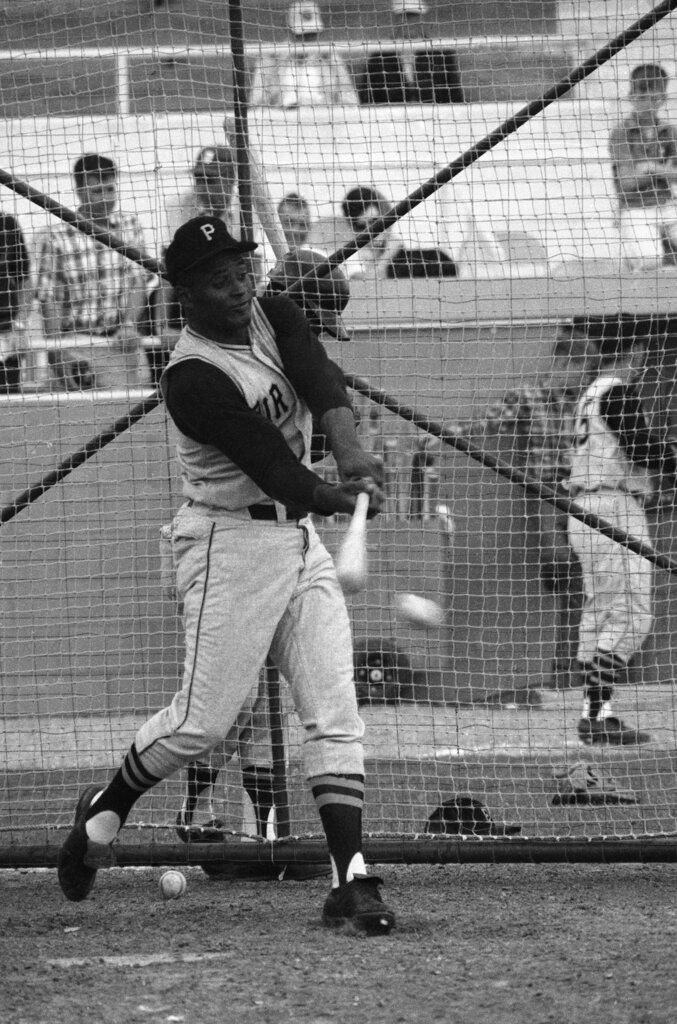
Roberto Clemente, Pittsburgh Pirates outfielder, gets some wood on the ball in practice batting cage, March 25, 1968 at the club?s Ft. Myers, Fla., spring training camp, though he says ?nothing comes easy, including the art of hitting a baseball.? Clemente, who is among top ten in all nine of the club?s hitting categories, says, ?I work hard. No one works harder than I do.? (AP Photo)
II. The Franchise That Carries Every Version of the City
Long before Pittsburgh learned to speak in championships, it learned to speak in ballparks. Forbes Field stood in the Oakland neighborhood, the city’s first civic commons — a place where millhands, students, immigrants, and executives sat under the same summer light. It was there that Pittsburgh first understood itself as a city capable of shared experience, not just shared labor. The Pirates were the thread that stitched those early neighborhoods together, the team that gave the city its first modern rituals.
When Forbes Field was finally demolished in 1971, it felt less like the loss of a ballpark and more like the closing of a civic chapter — the end of the city’s first shared commons, and the quiet fading of a parallel diamond where the Grays and Crawfords had once played some of the greatest baseball ever seen.
The eras that followed became chapters in Pittsburgh’s own evolution. The 1960 Pirates, guided by Danny Murtaugh, delivered the city’s first great sporting myth — Mazeroski’s home run, a civic lightning bolt that still feels like folklore. That moment wasn’t just a championship; it was the first time Pittsburgh felt the world tilt in its direction. It marked the city’s arrival on the national stage, not as an industrial powerhouse, but as a place capable of producing moments that transcended geography.
Three Rivers Stadium carried the next iteration of the city — the concrete symbol of a Pittsburgh trying to modernize, to centralize, to imagine itself beyond the mills. The Pirates moved there as the city itself was shifting: neighborhoods changing, industries tightening, the first signs of economic strain appearing on the horizon. Through it all, the team remained the civic constant, the familiar cadence in a city learning to navigate uncertainty.
And woven through these eras was the unmistakable, baritone voice of Bob Prince, “The Gunner,” whose broadcasts became the soundtrack of Pittsburgh summers. Prince didn’t merely describe baseball; he narrated the city’s mood. His optimism, his quirks, his unfiltered warmth — they made him a civic companion. For many Pittsburghers, Prince was the first voice they trusted in sports, the one who made the Pirates feel like family even when the city itself was changing beneath their feet.
By the time the 1970s arrived, the Pirates had already become more than a team. They were the franchise that had carried every version of Pittsburgh — the immigrant city, the industrial city, the uneasy city, the hopeful city. And they were about to become something even more: the cultural spine of a city learning to define itself through inclusion, pride, and possibility.
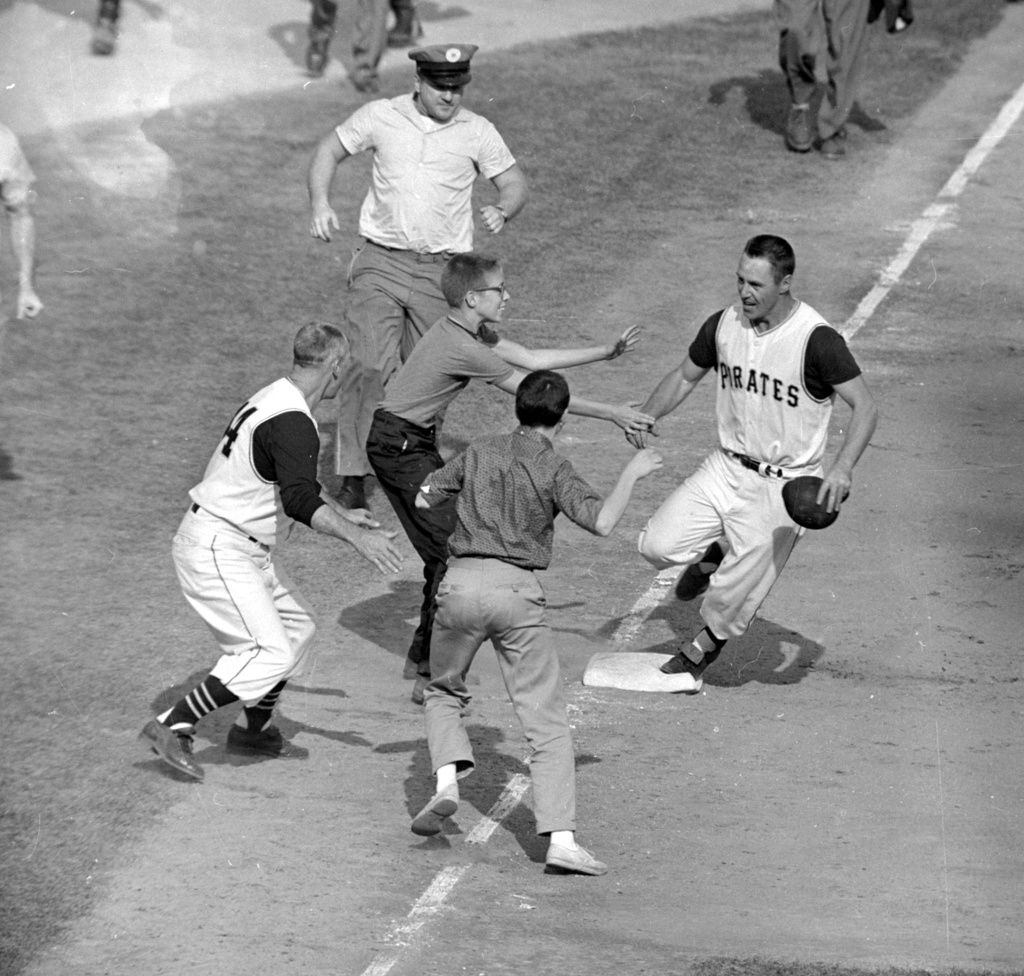
FILE – In this Oct. 13, 1960 file photo, jubilant Pittsburgh Pirates fans rush onto the field to congratulate second baseman Bill Mazeroski as he rounds third base after hitting a ninth inning home run to win Game 7 of baseball’s World Series against the New York Yankees in Pittsburgh, Pa., on Oct. 13, 1960. (AP Photo/Harry Harris, File)
III. The Parallel Diamond — The Negro Leagues at Forbes Field
Forbes Field was more than the Pirates’ home; it was one of Pittsburgh’s great civic stages, a place where the city gathered for baseball and football alike, with the early Steelers sharing the field before the move to Three Rivers. Long before integration, the ballpark hosted the Homestead Grays and Pittsburgh Crawfords, two of the most formidable Negro Leagues franchises ever assembled. On those afternoons and evenings, the field became a parallel civic commons — a place where Black Pittsburgh carved out its own baseball identity, its own heroes, its own sense of belonging in a city still divided by law and custom.
The names that passed through Forbes Field in those years were not merely great players; they were architects of the sport itself. Josh Gibson, whose power remains the stuff of legend. Cool Papa Bell, whose speed became folklore. Oscar Charleston, often called the greatest all‑around player who ever lived. These men did not simply complement the Grays and Crawfords; they elevated Pittsburgh into one of the true capitals of American baseball.
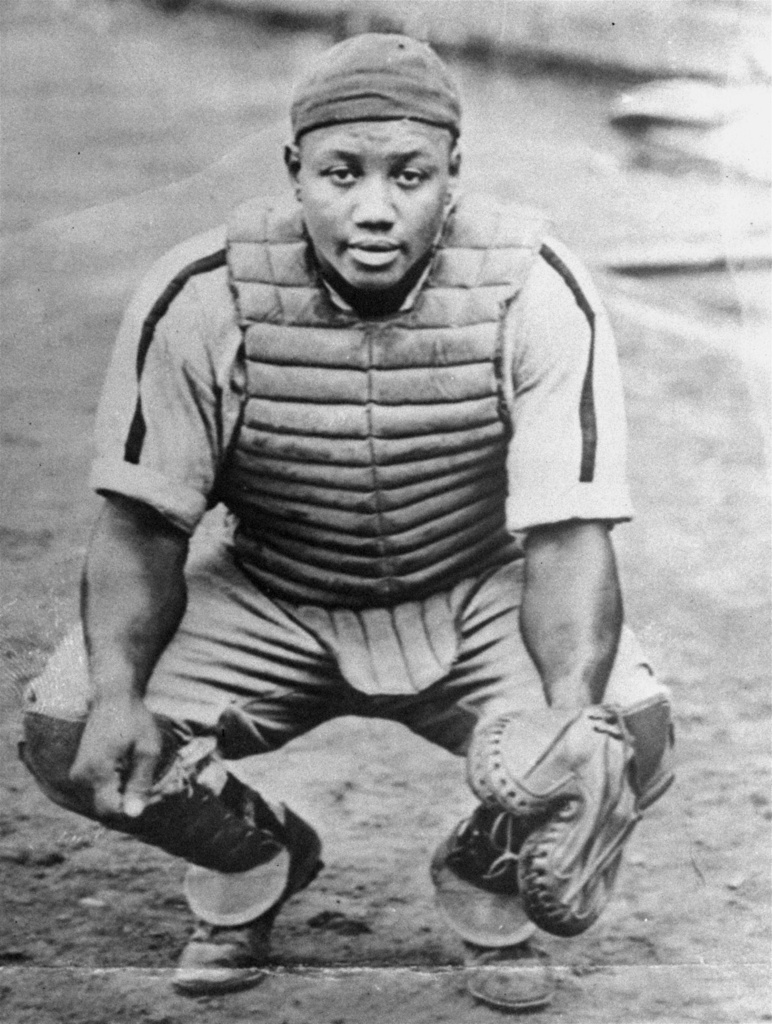
FILE – Baseball catcher Josh Gibson in an undated photo. Josh Gibson became Major League Baseball’s career leader with a .372 batting average, surpassing Ty Cobb’s .367, when records of the Negro Leagues for more than 2,300 players were incorporated after a three-year research project. (AP Photo/File)
Their presence gave the city a dual baseball identity — one white, one Black, both brilliant, both essential. And when integration finally arrived, Pittsburgh became one of the few cities where the transition felt like a continuation rather than a rupture. The Grays and Crawfords had already taught the city what excellence looked like. The Pirates would soon learn to embody it.
This parallel diamond matters because it reveals a deeper truth about Pittsburgh: the city’s baseball soul was shaped as much by the Negro Leagues as by the National League. Forbes Field was the bridge — the place where two baseball traditions lived side by side, each shaping the other, each preparing the city for the multicultural identity it would later embrace.
And when Brooklyn is referenced here, it is Brooklyn, New York — the borough whose baseball legacy was shaped by Jackie Robinson, just as Pittsburgh’s was shaped by Roberto Clemente. It could be argued that the two most important Black men in the history of Major League Baseball represented those two cities.
IV. Roberto Clemente — Greatness, Conscience, and the Civic North Star
Roberto Clemente was not merely important — he was great. All‑time great. Too often he is remembered first as the humanitarian, the Afro‑Latino icon, the Puerto Rican conscience, the moral exemplar. All true. All essential. But anyone who actually knows the game understands that Clemente was one of the greatest baseball players who ever lived — not “great for his era,” not “great for a Latino player,” not “great for a right fielder.” Great, full stop. A true five‑tool, apex‑tier, generational talent whose game would stand comfortably in the modern Ohtani–Judge–early‑Trout tier, and whose completeness belonged in the rare air of Mays and Aaron. He did it without load management, without specialized training, without optimized travel, without modern medical support, without analytics‑driven positioning — just raw, transcendent ability.
And the tragedy matters: Clemente was not declining when the plane went down. He had just won his twelfth Gold Glove, hit .312, remained one of the best defensive outfielders alive, and was on pace for a career that would have carried him past 3,300 hits, 500 doubles, 300 home runs, fifteen Gold Gloves, and into the inner circle of baseball immortality. The crash froze his numbers, but it did not freeze his greatness.
Pittsburgh understood this, which is why the city canonized him — with a bridge in his name and the league’s highest humanitarian honor bearing his legacy. Among Latino players, he remains the north star, the figure whose excellence and dignity defined what representation could mean. And yet, as Clemente himself often acknowledged, there could be no Clemente without Jackie. Their legacies are not parallel lines; they are a continuum — two Black men whose greatness, courage, and permanence shaped Brooklyn and Pittsburgh forever.
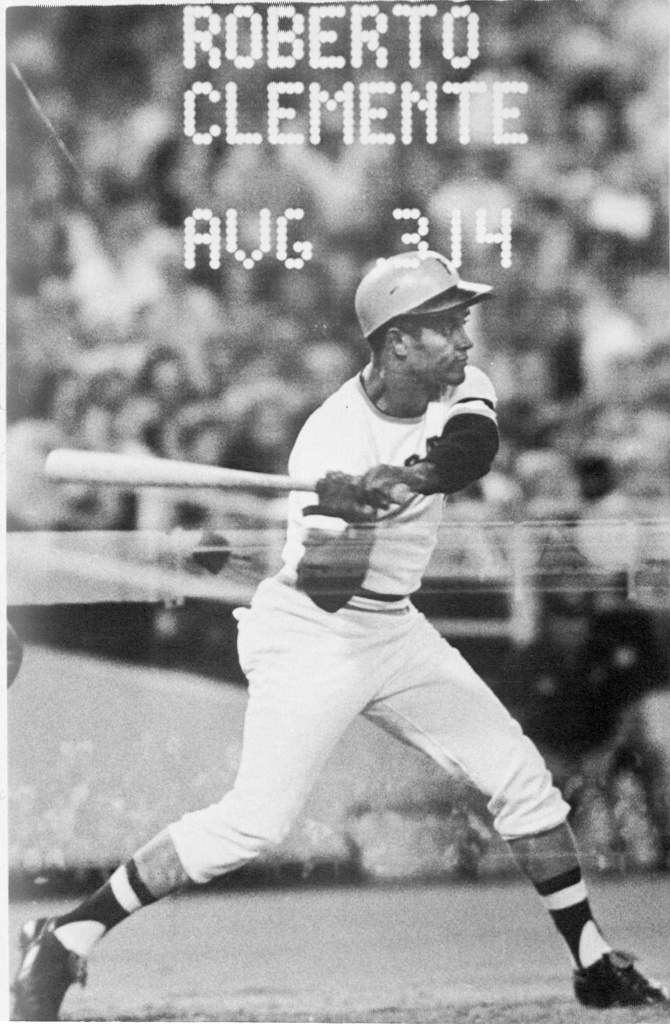
Pirates right fielder Roberto Clemente looks at a pitch in Pittsburgh, Sept. 29, 1972, during action with the Mets. He went hitless in the game that the Mets won, 1-0. Clemente needs one hit to make 3,000 for his major league career. (AP Photo/Harry Cabluck)
V. The Multicultural Spine
Pittsburgh multicultural identity did not emerge from a single neighborhood or a single moment; it was shaped by the Hill District — the Harlem of Pittsburgh — by Polish Hill, Irish, Italian, Jewish, and later Caribbean and Latin families who built their lives within sight of the ballpark. The Pirates became the vessel through which those identities found a shared civic expression — not by erasing difference, but by carrying it onto the field.
This wasn’t a declaration of being “first” or “ahead” of anyone — certainly not ahead of Brooklyn’s legacy in New York, which stands in its own cathedral. Pittsburgh’s multicultural identity emerged in its own way, in its own time, through its own neighborhoods. And the Pirates became the vessel that carried that evolution with dignity.
The multicultural spine of the Pirates did not begin or end with Roberto Clemente, though his presence gave it its first global dimension. Clemente expanded the city’s sense of itself — but the mosaic that defined Pittsburgh baseball stretched across generations. It carried through Willie Stargell, whose leadership in the 1970s turned the clubhouse into a civic metaphor. Stargell didn’t just hit home runs; he built community. His presence made the Pirates a reflection of a city learning to embrace its own complexity. When the 1979 team declared “We Are Family,” it wasn’t branding — it was truth. Pittsburgh was becoming a city that understood the strength of its differences.
Behind that clubhouse stood Chuck Tanner, a New Castle son shaped by the wider Western Pennsylvania inheritance. Tanner believed in people the way Pittsburgh believes in its neighborhoods — fiercely, loyally, without pretense. His leadership style mirrored the city’s own: humble, steady, rooted in trust rather than theatrics.
The Pirates’ multicultural identity was not accidental. It was the product of a franchise that understood — long before the vocabulary caught up — that talent, dignity, and belonging are not bound by geography or lineage. The Pirates became the civic bridge between communities that rarely crossed paths elsewhere. They were the team that made Pittsburgh feel like a shared project.
This is why the Pirates matter in ways statistics cannot measure. They are the franchise that taught Pittsburgh how to see itself — not as a monolith, but as a mosaic. They are the team that made the city’s diversity feel like destiny rather than disruption. And as Pittsburgh moved into the late 1970s, that mosaic would become the foundation for one of the most culturally resonant teams in American sports history — a team that carried the city’s identity with pride, swagger, and unity.
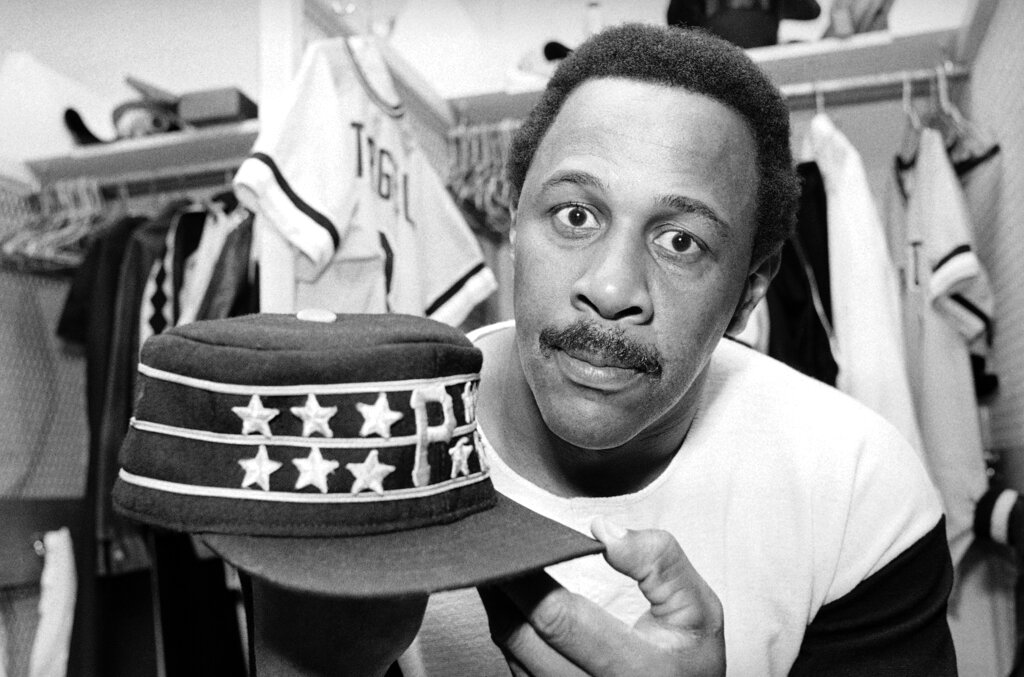
Pittsburgh Pirates first baseman Willie Stargell talks in dressing room at night, Thursday, Sept. 22, 1979 in Philadelphia after game with the Philadelphia Phillies as he points out the little cloth stars he supplies to teammate to wear on their caps to signify outstanding performances. Stargell at 38 is the Pirates patriarch but still very much one of the gang. (AP Photo/Kennedy)
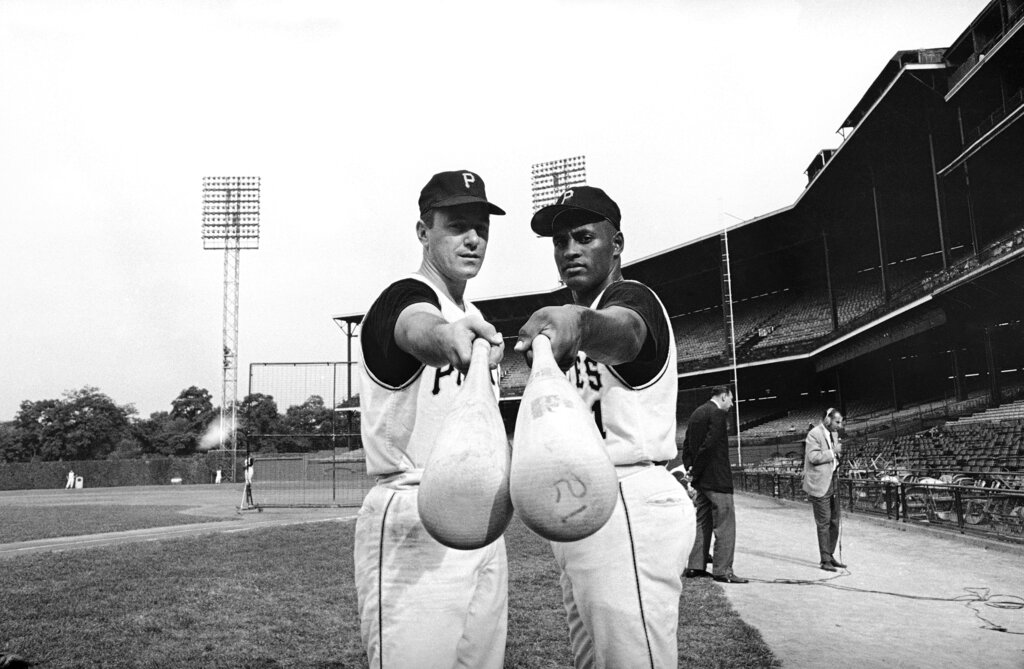
Pittsburgh Pirates Roberto Clemente, right, and Bill Mazeroski, holding out bats, were credited by their manager, Harry Walker, as the big guns behind the Pirates current winning streak, in Pittsburgh, June 11, 1965. Mazeroski missed the early part of the season because of a foot injury and Clemente was out of the lineup for a while with malaria. With the two veterans back in action, the Pirates won 18 of their last 20 games, climbing from last place to fifth place in the National League. (AP Photo/Spencer Jones)
VI. Two Apexes — 1971 and 1979
Before 1979 became the city’s cultural shorthand, 1971 had already changed what Pittsburgh — and baseball — could be. On September 1, 1971, the Pirates fielded the first all‑Black and Afro‑Latino starting lineup in Major League history. Rennie Stennett at second, Gene Clines in center, Roberto Clemente in right, Willie Stargell in left, Manny Sanguillén behind the plate, Dave Cash at third, Al Oliver at first, Jackie Hernández at short, and Dock Ellis on the mound — nine men whose presence together was not staged, not symbolic, not a gesture. It was a manager putting his best nine on the field, and in doing so, the Pirates aligned the game with the lived reality of Pittsburgh’s own melting‑pot identity.
That 1971 club, which went on to win the World Series, was a different kind of apex: competitive, historic, and quietly revolutionary. It showed that the Pirates were not just a team that reflected a diverse city; they were a team willing to act in a way that made history inevitable. Clemente’s World Series MVP that year was not just an individual honor; it was the visible tip of a deeper structural truth about how the franchise was built.
By the time the 1979 team arrived, the foundation laid in 1971 had matured into a fully formed civic identity. The roster was deeper than any single name — Dave Parker, Kent Tekulve, Bill Madlock, John Candelaria, Phil Garner, Omar Moreno, and others who gave the team its edge, its style, its sense of inevitability. “We Are Family” worked because it was true: the Pirates’ clubhouse, dugout, and lineup were a living expression of a city that had learned to see strength in its variety.
Taken together, 1971 and 1979 form a twin apex in the Pirates’ story. One night in 1971 quietly reset the terms of who could take the field together. One season in 1979 gave the city its last great portrait of the old Pittsburgh — confident, cohesive, and still anchored in steel, even as the ground was beginning to shift. After that, the city’s economy, skyline, and emotional center would move. The Pirates had carried Pittsburgh to the edge of that transition.
From here, the civic mythology would begin to migrate — from Forbes and Three Rivers to cold Sundays, to a different kind of huddle, to a franchise that would come to define the city’s next era.
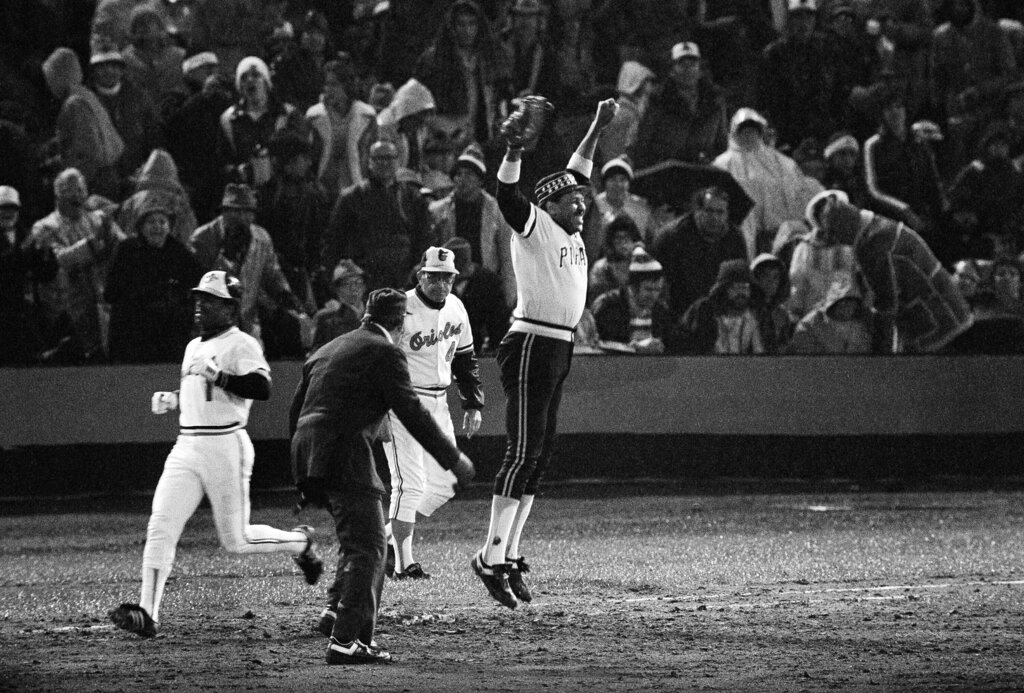
Willie Stargell, the Bucs’ captain, leaps for joy after recording the third and final out of Game 2 of the World Series against the Orioles at Baltimore’s Memorial Stadium, Oct. 11, 1979. The Bucs won, 3-2, to even the series at one game apiece. Al Bumbry, O’s center fielder, was the final out. Watching are O’s first base coach Jim Fry and umpire Russ Goetz. (AP Photo)
The 1979 club adopted Sister Sledge’s “We Are Family” as its anthem — the disco standard that became the soundtrack of that championship drive:
VII. The Economic Architecture — Why the Pirates Became What They Are
Major League Baseball’s economic structure has shaped the modern Pirates as much as any decision made inside the organization. The league’s absence of a salary cap, its uneven revenue distribution, and its limited competitive balance mechanisms have created an environment where the largest markets can compound advantage while the smallest must choose between development and retention. Pittsburgh did not become the face of this imbalance by choice; the architecture of the sport made it inevitable.
This reality stands in contrast to the franchise’s proud history. The Pirates have won five World Series championships — 1909, 1925, 1960, 1971, and 1979 — each tied to a different chapter of Pittsburgh’s civic identity. Those banners are not nostalgia pieces; they are evidence that the franchise has reached the summit when the structure of the sport allowed it to compete on equal footing.
The early 1990s made the modern constraints unmistakable. Jim Leyland’s clubs — Bonds, Bonilla, Drabek, Van Slyke — were built to win a championship, but the economics of the era made their breakup unavoidable. The Braves NLCS heartbreaks were not just postseason losses; they were reminders that Pittsburgh’s ability to develop stars exceeded its ability to retain them. The city was entering economic transition, and the Pirates were entering structural transition. The parallels were clear.
The Pirates operate in a system that offers them no structural protection, and in that environment operational excellence is not optional — it is the only path. The Braves and Rays have shown that small‑market clubs can thrive when their processes are disciplined and their decisions compounding. Pittsburgh’s margin for error is thinner, not nonexistent — and in a system without guardrails, the difference between thriving and unraveling is the discipline of the operation.
The pattern repeated across generations. Gerrit Cole left Pittsburgh and became one of the top pitchers in baseball, rewarded accordingly by the Yankees. Tyler Glasnow left and became an ace. Joe Musgrove, Josh Bell, Austin Meadows — the list is long, and the frustration is familiar. Pittsburghers have watched players they invested in become stars elsewhere, not because the Pirates lacked vision, but because the system rewarded other markets for what Pittsburgh developed.
Now the franchise stands at another inflection point. Paul Skenes is the most important Pirate since Barry Bonds — a generational ace with the potential to redefine the franchise’s trajectory. His arbitration clock is already running, and his eventual “Skubal moment” will arrive for Pittsburgh as well. The Pirates must determine whether this era will break from the past or repeat it.
At the same time, Konnor Griffin, the 20 year old phenom, represents a different kind of organizational bet. His long-term contract echoes the Braves’ model — Acuña, Albies, Harris, Strider — and the Roman Anthony blueprint in Boston. It signals a franchise attempting to build continuity early, to create stability through commitment, and to give the city a future that feels tangible rather than theoretical.
The December CBA will shape the next decade. It may introduce reforms that narrow the gap between markets, or it may reinforce the current structure. Either way, the Pirates’ future will be determined not by sentiment or nostalgia, but by how effectively the club navigates the realities of its sport.
The Pirates are not a cautionary tale. They are a franchise working within the conditions of their league, adapting, recalibrating, and searching for the model that can sustain success in a system that rewards imbalance. Their next chapter will be defined by choices, timing, and opportunity — not by inevitability.
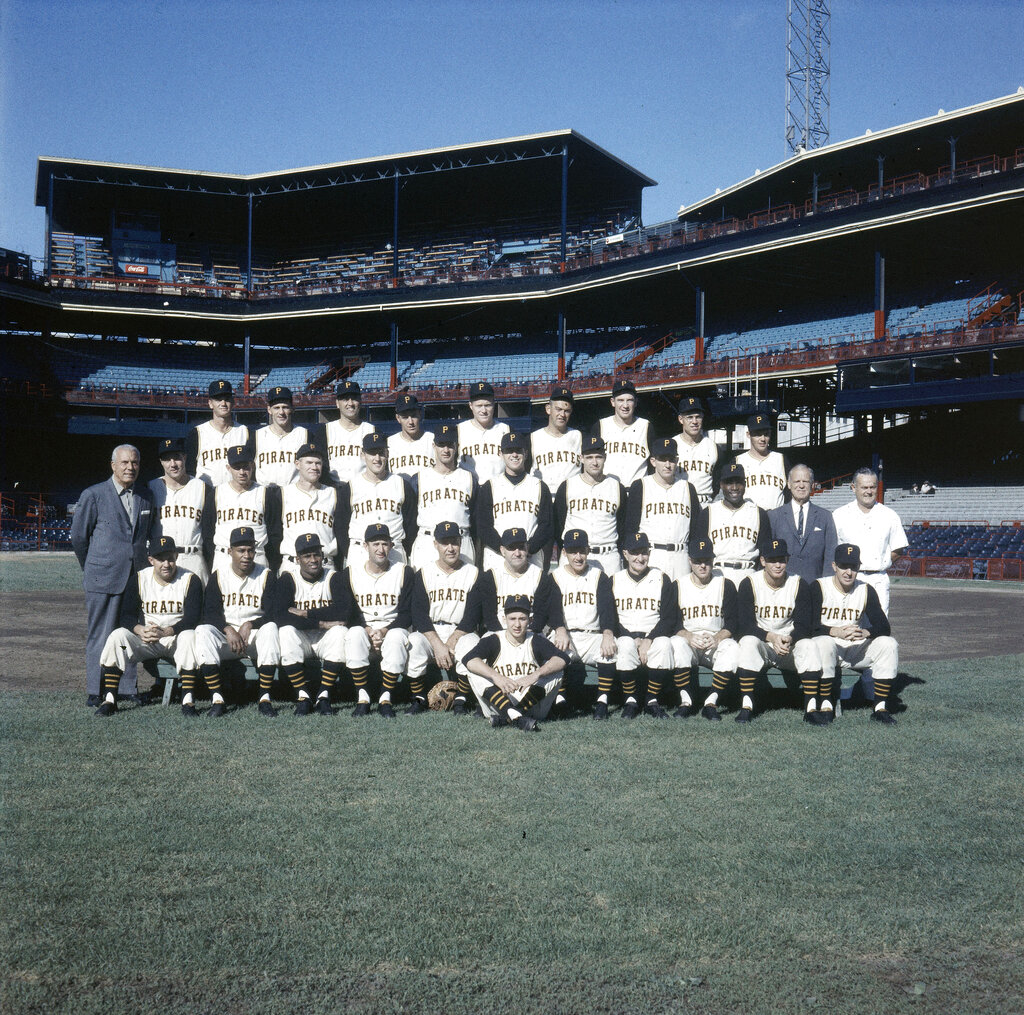
These are the members of the Pittsburgh Pirates, the 1960 National League pennant winners, shown Oct. 1, 1960. Back row, left to right: Tom Cheney, Dick Groat, Gino Cimoli, Bill Mazeroski, George Witt, Clem Labine, Bob Skinner, Bill Virdon and Roy Face. Middle row, left to right: travelling secretary Bob Rice, Bob Friend, Harvey Haddix, Rocky Nelson, Vernon Law, Fred Green, Dick Stuart, Vinegar Bend Mizell, Joe Gibbon, Joe Christopher, batting coach George Sisler and trainer Danny Whelan. Front row, left to right: Smoky Burgess, Gene Baker, Roberto Clemente, coach Mickey Vernon, coach Sam Narron, manager Danny Murtaugh, coach Frank Oceak, coack Bill Burwell, Dick Schofield, Don Hoak and Hal Smith. Seated on the ground in front is batboy Bobby Recker. (AP Photo)
VIII. A Club in Formation — Skenes, Cruz, Reynolds, Griffin, and the New Identity
The Pirates of today are not a franchise waiting for a break; they are a club assembling an identity in real time. For the first time in decades, Pittsburgh has a core whose timelines align, whose ceilings are complementary, and whose presence gives the city something it has not had since the early 1990s — a sense that the future is not theoretical, but visible.
Paul Skenes is the anchor. His presence on the mound changes the geometry of a season, the psychology of a clubhouse, and the expectations of a fan base. He is not simply a top prospect; he is the kind of pitcher who alters the competitive horizon of an organization. His development, his workload, and his eventual contract decision will define the next era of Pirates baseball. Every franchise has a moment when it must decide whether to build around a player or build past him. For Pittsburgh, that moment will arrive sooner than the city expects.
Oneil Cruz brings a different kind of gravity — a player whose gifts are so rare that they defy positional precedent. His combination of size, speed, and power makes him a singular figure in the modern game, and his presence gives the Pirates a dimension few clubs can match. He is not a finished product, but he is a foundational one, the kind of player who forces opponents to adjust simply by taking the field.
Bryan Reynolds is the stabilizer — a player whose consistency, professionalism, and all around game give the roster its spine. His long term commitment to Pittsburgh is more than a contract; it is a signal that the franchise can retain talent when the timing, structure, and vision align. In a sport defined by departures, Reynolds represents continuity.
And then there is Konnor Griffin, the 20 year old whose early commitment places him at the center of the club’s long term blueprint. Griffin is not yet the face of the team, but he is the face of the plan — a player whose development will determine whether the Pirates can build a sustainable core rather than a fleeting one.
Together, this group gives the Pirates something they have not had in a generation: a synchronized window. Their ages align. Their arcs align. Their skill sets align. And for the first time in years, the franchise’s competitive horizon is not defined by what it has lost, but by what it is building.
This is not a finished roster. It is a roster in formation — one with volatility, promise, and the possibility of becoming something the city has not seen in decades. The Pirates are not waiting for a future to arrive; they are constructing one, piece by piece, inning by inning, season by season.
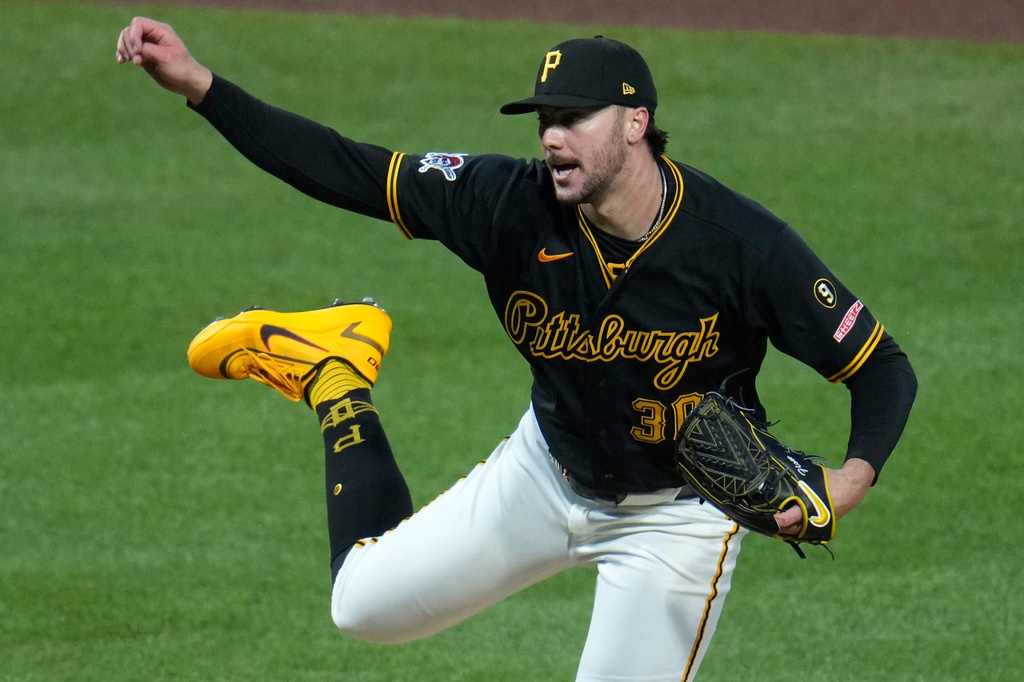
Pittsburgh Pirates pitcher Paul Skenes follows through on a pitch during the sixth inning of a baseball game against the San Diego Padres in Pittsburgh, Tuesday, April 7, 2026. (AP Photo/Gene J. Puskar)
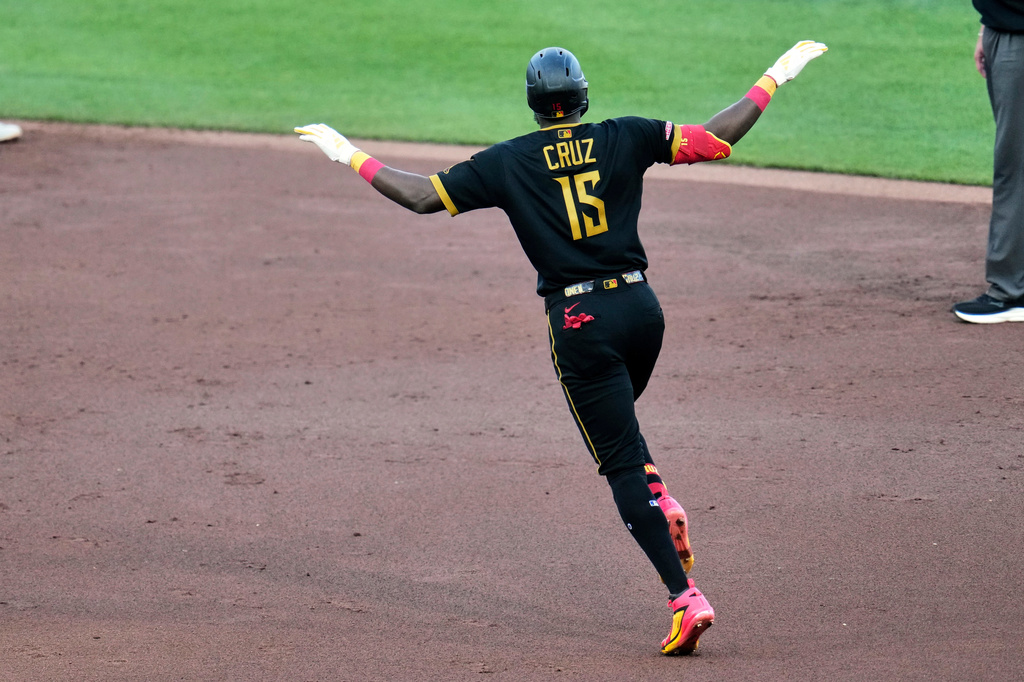
Pittsburgh Pirates’ Oneil Cruz rounds the bases after hitting a solo home run off Minnesota Twins pitcher Taj Bradley during the third inning sof a baseball game in Pittsburgh, Friday, May 29, 2026. (AP Photo/Gene J. Puskar)
IX. The Pirates as the City’s Memory
Long before the skyline changed, before the mills fell silent, before the city learned to reinvent itself, the Pirates were the vessel that carried Pittsburgh’s sense of continuity. They were the team that connected generations — grandparents who remembered Forbes Field, parents who lived through Three Rivers, children who grew up with PNC Park as their summer cathedral. In a city that has rebuilt itself more than once, the Pirates have remained the through line, the reminder that identity is not erased by change.
The franchise’s history is not simply a record of seasons; it is a record of eras. Mazeroski’s swing in 1960, Clemente’s grace in 1971, Stargell’s leadership in 1979 — these moments are not just baseball memories. They are civic memories, the kind that anchor a city’s sense of itself. They endure because they were shared, because they were lived collectively, because they became part of Pittsburgh’s emotional vocabulary.
Even in the lean years, the Pirates have held a place that is deeper than standings or payrolls. The cap is worn not as a symbol of dominance, but as a symbol of origin. It signals where someone is from, what shaped them, what they carry. In a city defined by work, resilience, and reinvention, the Pirates represent the part of Pittsburgh that remembers — the part that refuses to let its past be forgotten even as its future evolves.
Today’s club, with its youth, its volatility, and its promise, sits at the intersection of memory and possibility. The names are new, the stakes are different, and the economics are more complex, but the emotional role remains unchanged. The Pirates are the city’s oldest mirror, the team that reflects not what Pittsburgh is at any given moment, but what it has been across time.
In a city that has learned to adapt, the Pirates remind Pittsburgh of the value of continuity. In a city that has learned to rebuild, they remind it of the power of roots. And in a city that has learned to look forward, they remind it that the past is not a burden — it is a foundation.
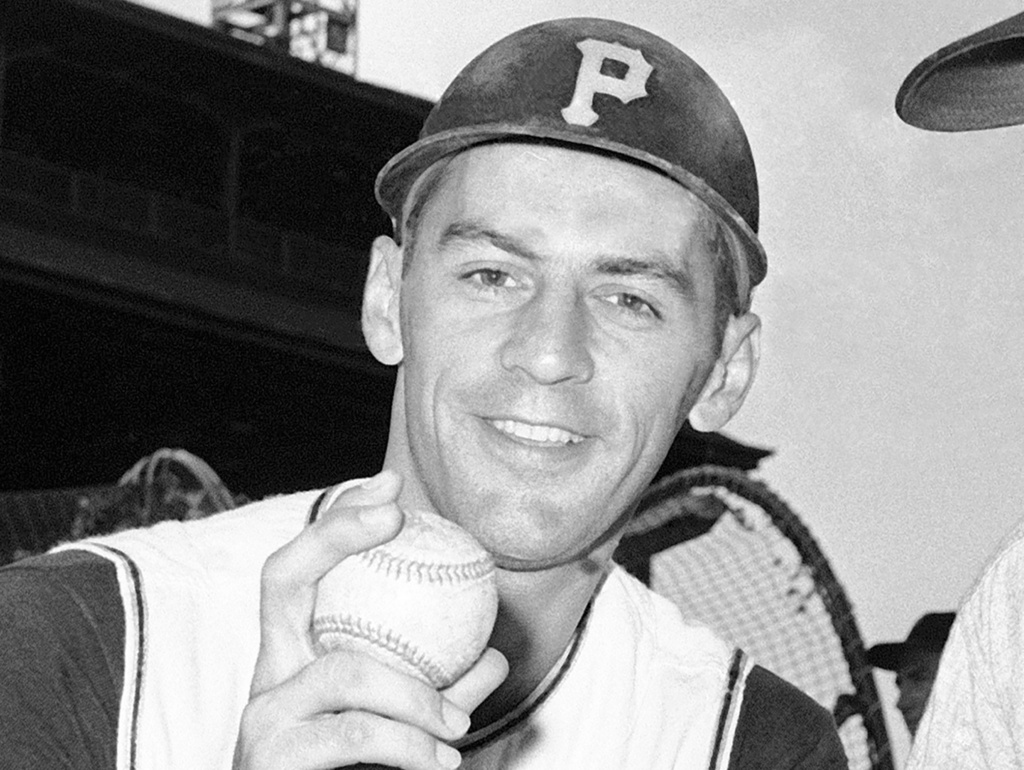
FILE – Pittsburgh Pirates Dick Groat is shown at Forbes Field in Pittsburgh, Aug. 11, 1960. Groat, a two-sport star who went from All-American guard in basketball to a brief stint in the NBA to ultimately an All-Star shortstop and the 1960 National League MVP while playing baseball for his hometown Pittsburgh Pirates, has died. He was 92. Groat’s family said in a statement that Groat died early Thursday morning, April 27, 2023, at UMPC Presbyterian Hospital due to complications from a stroke. (AP Photo/File)
X. The Civic Counterweights — Steelers and Penguins
Pittsburgh is a city whose identity is carried by three franchises, each reflecting a different dimension of its civic character. The Pirates hold the city’s memory, the Steelers embody its resilience, and the Penguins represent its capacity for reinvention. Together, they form a composite portrait of a place that has lived through transformation without losing its sense of self.
The Steelers emerged as the avatar of the industrial era. Their rise in the 1970s coincided with the city’s hardest years, and their style of play — physical, disciplined, unadorned — matched the temperament of a workforce that understood endurance better than comfort. The team’s mythology was built on names that became civic shorthand: Greene, Lambert, Harris, Bradshaw, Blount, Ham, Webster. They were not just champions; they were symbols of a city refusing to break. The Steelers offered Pittsburgh a new emotional center at the moment the mills were beginning to fade, and the city embraced them with a fervor that transcended sport.
The Penguins, by contrast, became the emblem of Pittsburgh’s reinvention. Their ascent in the Lemieux era paralleled the city’s transition from steel to medicine, technology, and research. Lemieux was more than a generational talent; he was a steward — first as a player, then as an owner — who helped stabilize the franchise and anchor it to the city’s future. The institutional era that followed, shaped by figures like Scotty Bowman, Jim Rutherford, and later Mike Sullivan, turned the Penguins into a model of modern competitiveness. Their five Stanley Cups are not just banners; they are markers of a city learning to thrive in a new economy.
Together, the Steelers and Penguins serve as Pittsburgh’s civic counterweights — one rooted in the grit of the industrial past, the other in the innovation of the modern city. The Pirates remain the memory. The Steelers remain the posture. The Penguins remain the imagination. Three teams, one city, each carrying a different part of Pittsburgh’s identity.
XI. The Pre‑Noll Steelers — Ernie Stautner
Before the dynasty, before the mythology, before the city found its football posture, the Steelers had one figure who carried the franchise’s dignity through the lean years: Ernie Stautner.
Born in Bavaria, Germany, and raised near Albany, New York, after his family immigrated to the United States, Stautner arrived in Pittsburgh with a hardness shaped long before football entered the picture. He became the Steelers’ first great defensive cornerstone — a relentless, disciplined lineman whose toughness was forged well before Pittsburgh claimed him as its own.
From 1950 to 1963, Stautner was the heartbeat of a team that had not yet learned how to win but had already learned how to fight. He played with a ferocity that bordered on myth, earning nine Pro Bowls, ten All‑Pro selections, and the respect of every opponent who lined up across from him. His legacy was later immortalized in Canton, where his Hall of Fame bust stands as a testament to the standard he set.
But Stautner’s influence did not end in Pittsburgh. After retiring, he became Tom Landry’s defensive architect in Dallas, helping build the Doomsday Defense — a unit that reshaped the modern NFL. His coaching legacy became as significant as his playing career, linking the Steelers’ early grit to the league’s evolving sophistication.
Stautner was the bridge between eras — the man who carried the franchise through obscurity and then helped define the sport from the sidelines. He was the Steelers’ first pillar, the proof that excellence could exist even before the city learned how to win.
XII. The Heartbeat of Pittsburgh — The Immaculate Reception
The modern Steelers story begins on December 23, 1972 — the moment when Pittsburgh’s emotional center shifted from the mills to the field. The Immaculate Reception was not simply a play; it was the city’s rebirth in real time. Franco Harris, the son of a Black serviceman and an Italian mother, became the unlikely bridge between communities, generations, and identities. His catch was improbable, impossible, and unforgettable — the kind of moment that cities build mythology around.
From that instant, the Steelers became more than a team. They became the heartbeat of Pittsburgh.
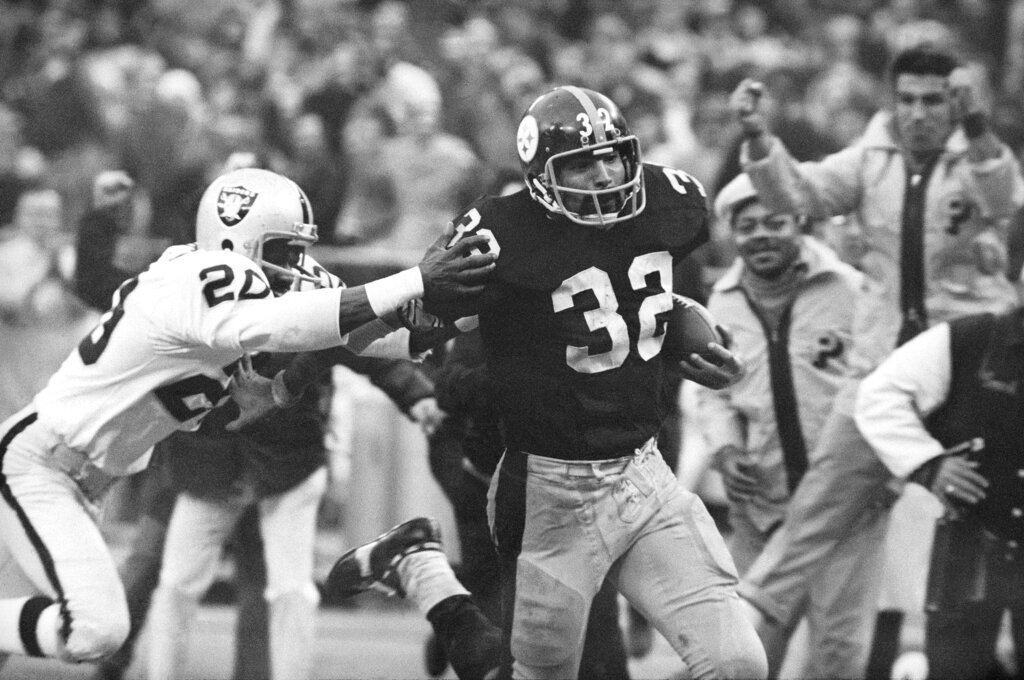
FILE – Pittsburgh Steelers’ Franco Harris (32) eludes a tackle by Oakland Raiders’ Jimmy Warren as he runs 42-yards for a touchdown after catching a deflected pass during an AFC Divisional NFL football playoff game in Pittsburgh, Dec. 23, 1972. Harris’ scoop of a deflected pass and subsequent run for the winning touchdown — forever known as the “Immaculate Reception” — has been voted the greatest play in NFL history. On the 50th anniversary of the “Immaculate Reception” — Friday, Dec. 23, 2022 — Pittsburghers recall how it boosted morale during the collapse of the steel industry and has served as a cultural rallying point ever since. (AP Photo/Harry Cabluck, File)
Chuck Noll had already begun reshaping the franchise, but the catch accelerated everything. Noll’s philosophy — quiet, disciplined, rooted in preparation — matched the temperament of a city built on work rather than spectacle. Under his leadership, the Steelers became a meritocracy in a league that often wasn’t. He drafted with clarity, developed with patience, and trusted players who embodied the city’s values.
The result was a roster that would become a civic pantheon. Not names mentioned in passing — names carved into the city’s identity:
- “Mean” Joe Greene, the emotional axis of the dynasty
- Jack Lambert, the snarl that defined an era
- Jack Ham, the elegance inside the violence
- Mel Blount, the cornerback who changed the rules
- Franco Harris, the city’s bridge
- Terry Bradshaw, the quarterback who delivered four Lombardis
- Mike Webster, the iron center
- John Stallworth, the technician
- Lynn Swann, the acrobat
These were not players. They were archetypes — the living vocabulary of Pittsburgh’s resilience.
The dynasty that followed — four Super Bowls in six years — was not experienced as dominance. It was experienced as affirmation. At a time when the city’s industrial foundation was eroding, the Steelers gave Pittsburgh a posture with which to face the world: disciplined, unbreakable, unafraid.
Joe Gilliam’s story belongs in this era, but in its proper place — a meaningful chapter, not the fulcrum. His emergence in 1974 as the first Black quarterback to win an NFL season opener carried cultural weight, revealing both the progress and the tensions of the time. His talent was real, his arc complicated, and his legacy often overlooked. But he was part of the mosaic — not the center of it.
The Steelers of the 1970s became the city’s emotional infrastructure. They were the institution that held Pittsburgh together through transition, uncertainty, and reinvention. They became the standard by which the city measured itself — and the foundation upon which every era of Steelers football would stand.
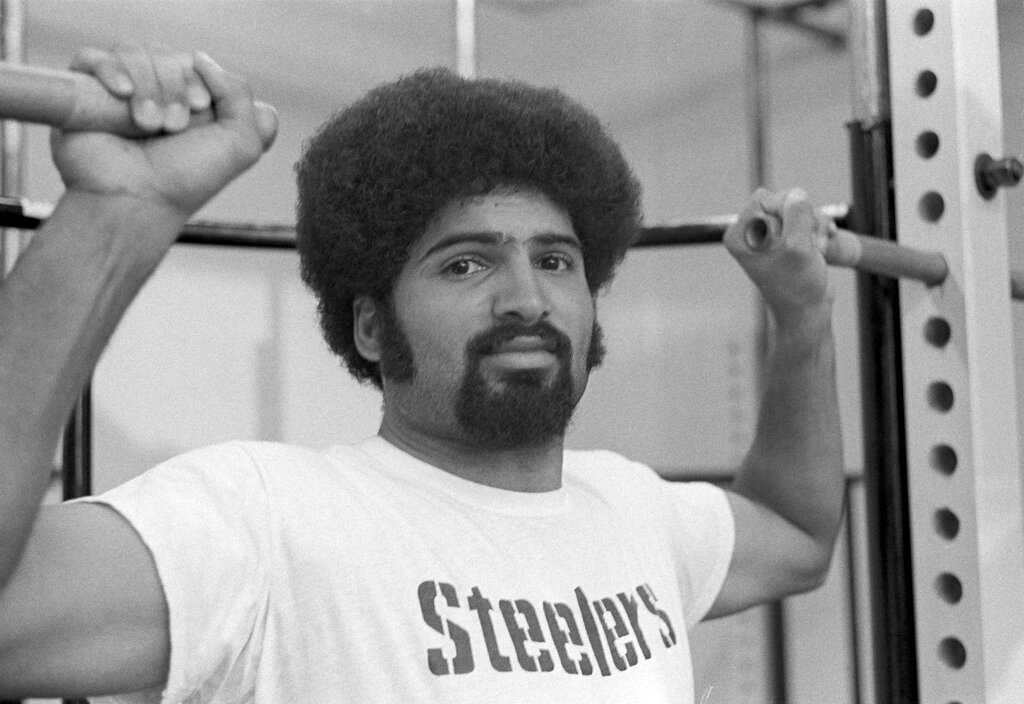
Pittsburgh Steelers’ running back Franco Harris (32) pushes through a weight lifting routine as part of his training in Pitssburgh, Pa., Nov. 29, 1972. (AP Photo/Harry Cabluck)
XIII. The Noll Revolution — The Making of a Dynasty
The Steelers’ transformation did not begin with a catch. It began with a philosophy. When Chuck Noll arrived in 1969, the franchise had never won a playoff game in its entire history. Pittsburgh was a football city without a football identity. Noll changed that not with slogans or spectacle, but with a worldview: football was a craft, excellence was a habit, and talent meant nothing without discipline.
Noll’s revolution was quiet, methodical, and absolute. He built a culture where preparation mattered more than personality, where players were expected to think as much as they hit, and where accountability was non‑negotiable. The Rooney family gave him the stability to build patiently, and Noll repaid them by constructing a system that would become the envy of the league.
His drafting philosophy was radical for its time. Noll valued intelligence, character, and fit as much as raw athleticism. He sought players who could grow within the system, who could handle responsibility, and who could elevate the culture. The result was not merely a collection of talented individuals, but a roster built with intentionality — a team where every piece reinforced the others.
The 1974 draft became the emblem of this philosophy. It remains the greatest single draft class in the history of American sport — not because of luck, but because Noll and the Rooney organization understood exactly what they were building. They were not assembling stars; they were assembling a structure.
By the mid‑1970s, the Steelers were no longer a team in ascent. They were a machine. The Steel Curtain defense became the league’s immovable object. The offense evolved from conservative to explosive. The quarterback matured into a leader capable of breaking games open. And Noll’s steady hand ensured that the team never drifted from its identity.
The dynasty that followed — four Super Bowls in six years — was not a miracle. It was the logical outcome of a system built with clarity, discipline, and purpose. The Steelers became the standard by which all other franchises measured themselves. They became the model of how to build, how to sustain, and how to win.
Noll did not just change the Steelers. He changed Pittsburgh. He gave the city a blueprint for resilience — one built on preparation, humility, and the belief that excellence is earned, not inherited.
This was the making of a dynasty. The next movement is the dynasty itself.
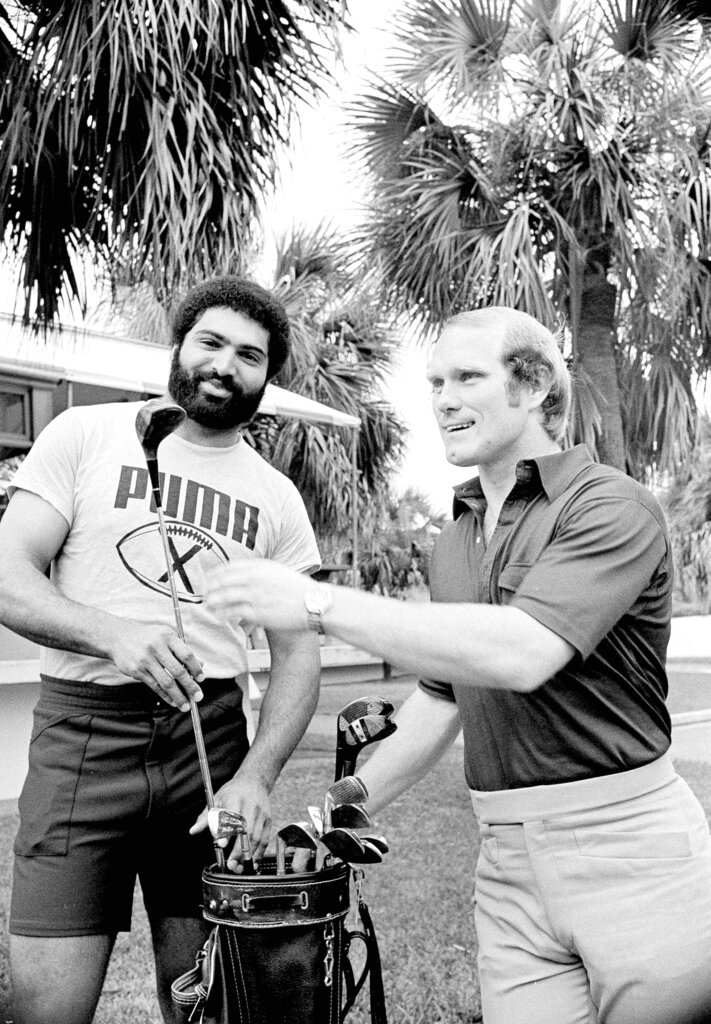
Pittsburgh Steelers running back Franco Harris, left, picks a wood from a bag of golf clubs as he and quarterback Terry Bradshaw relax in Miami, Fla, Jan. 15, 1976. The Steelers are practicing to meet the Dallas Cowboys in Super Bowl X on Sunday. (AP Photo/Jim Kerlin)
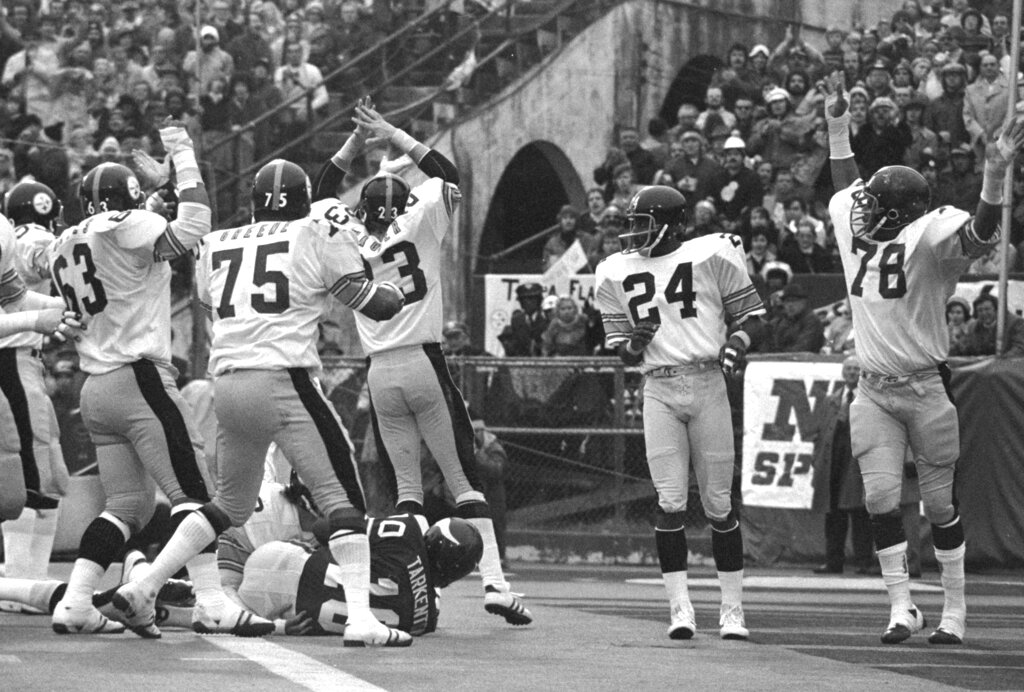
** FILE ** The Pittsburgh Steelers defense react as Minnesota Vikings’ quarterback Fran Tarkenton (10) recovers his own fumble in the end zone for a safety in second quarter of Super Bowl IX in New Orleans at Tulane Stadium, in this Jan. 12, 1975 photo. Identifiable players are Steelers’ Ernie Holmes (63), Joe Greene (75), and Mike Wagner (23). The Steelers won 16-6. They remain the only NFL team to win four Super Bowls in six years, yet what might separate the Steel Curtain Steelers of the 1970s from other NFL champions is what they did off the football field. (AP Photo/Charlie Kelly)
XIV. The Western Pennsylvania Football Nursery
Long before the Steelers became the heartbeat of Pittsburgh, Western Pennsylvania had already established itself as one of the most improbable football nurseries in the world. The region’s hills, mills, and neighborhoods produced quarterbacks and leaders with a frequency that defied logic. It was not coincidence. It was culture — a culture shaped by work, pressure, and the expectation that adversity was something to be met, not avoided.
From Aliquippa to Beaver Falls to Monongahela, the region became a proving ground. Boys grew up throwing footballs in narrow streets, on sloped yards, in frozen parks, and behind row houses where space was limited, but imagination was not. The game became a language — a way to express toughness, precision, and accountability. It was not recreation. It was identity.
The lineage is astonishing. Johnny Unitas from Pittsburgh’s Bloomfield neighborhood — the prototype of the modern quarterback. Joe Namath from Beaver Falls — the charisma and arm talent that redefined the position. Dan Marino from Oakland — the release, the velocity, the inevitability. Jim Kelly from East Brady — the competitor who carried Buffalo to four straight Super Bowls.
Four Hall of Fame quarterbacks from a single region, across a single generation, shaped by the same cultural forces. No other place in America has produced anything like it.
This was the soil into which the Steelers dynasty was planted. The city and its surrounding towns understood football not as spectacle, but as craft — a craft that demanded resilience, intelligence, and the ability to perform under pressure. The Steelers did not create this identity. They inherited it, refined it, and ultimately became its most visible expression.
Western Pennsylvania’s football nursery explains why the Steelers resonated so deeply with the region. The team reflected the values that had been forged in backyards, schoolyards, and mill towns for decades. The dynasty of the 1970s was not an anomaly. It was the flowering of a culture that had been producing leaders long before the Lombardis arrived.
In Pittsburgh, football was never just a game. It was a way of understanding the world.
XV. The Cowher Era — The Return to the Standard
When Chuck Noll stepped down after the 1991 season, Pittsburgh faced a rare moment of uncertainty. The dynasty had aged, the roster had thinned, and the city wondered whether the identity forged in the 1970s could survive a generational transition. The answer arrived in the form of a young coach from Crafton — Bill Cowher, a Western Pennsylvania native whose jawline, intensity, and presence restored the franchise’s posture almost instantly.
Cowher did not attempt to imitate Noll. Instead, he re‑anchored the franchise in the values that had defined it: toughness, discipline, and accountability. His teams played with an edge that felt familiar to Pittsburghers — a physicality that echoed the Steel Curtain, a commitment to defense that honored the city’s temperament, and a competitive fire that made every Sunday feel consequential.
Under Cowher, the Steelers became perennial contenders. The Blitzburgh defenses of the mid‑1990s — led by Greg Lloyd, Kevin Greene, Carnell Lake, and Rod Woodson — reintroduced fear into the AFC. They were fast, aggressive, and unapologetically disruptive. The 1995 team reached Super Bowl XXX, signaling that the franchise had fully reentered the league’s elite.
Cowher’s tenure was defined by resilience. His teams reached the AFC Championship Game six times, often with different quarterbacks, different offensive identities, and different supporting casts. What remained constant was the standard — the expectation that the Steelers would play with force, intelligence, and emotional clarity.
The breakthrough came in the 2005 season. With a young Ben Roethlisberger at quarterback and Jerome Bettis in his final campaign, the Steelers became the first sixth seed to win the Super Bowl. They did it the Pittsburgh way — on the road, through adversity, with defense and resolve. Super Bowl XL was more than a championship. It was the culmination of Cowher’s long arc, a validation of his leadership, and a reaffirmation of the franchise’s identity.
Cowher’s era restored the standard. The next era would sustain it.
XVI. The Tomlin Era — The Modern Standard
When Mike Tomlin arrived in 2007, he inherited a franchise with a defined identity and a demanding standard. What he built was not a replica of the past, but a modern extension of it — a continuation of the values forged under Noll and refined under Cowher, adapted to a new era of the league.
The modern Steelers became defined by a new set of pillars:
Ben Roethlisberger — the quarterback who delivered two Lombardis and carried the franchise through a decade of constant contention. His improvisation, toughness, and late‑game brilliance became the defining traits of the era.
Hines Ward — the smile that hit like a linebacker. Ward embodied the city’s duality: joyful and punishing, charismatic and relentless. He became the face of Pittsburgh’s offensive identity.
Jerome Bettis — the Bus, the civic uncle, the emotional anchor. His final chapter — winning a Super Bowl in his hometown of Detroit — became one of the most beloved arcs in franchise history.
James Harrison — the embodiment of relentlessness. Undrafted, overlooked, and unstoppable, Harrison became the avatar of Pittsburgh’s defensive ethos. His 100‑yard interception return in Super Bowl XLIII remains one of the greatest plays in NFL history.
Troy Polamalu — the mystic. The instinct. The icon. Polamalu played the game like a form of intuition, turning defense into improvisational art. He became the spiritual center of the modern Steelers.
Alan Faneca — the quiet anchor of the offensive line, the technician whose excellence made everything else possible.
Rod Woodson — the bridge between eras, the rare player whose brilliance transcended scheme, era, and position.
Under Tomlin, the Steelers became a model of stability in a league defined by volatility. His leadership — poised, principled, unflinching — extended the franchise’s identity into the 21st century. He became the steward of the standard, the keeper of the culture, and the modern architect of Pittsburgh’s football posture.
The Tomlin era is not an epilogue. It is the continuation of the lineage — the proof that the Steelers’ identity is not tied to a single decade, but to a civic expectation.
XVII. The Native Son — Mike McCarthy and the Circle Closing
Pittsburgh has always valued lineage — not in the genealogical sense, but in the civic one. The city responds to leaders who understand its temperament, its rhythms, its expectations. After the long arcs of Noll, Cowher, and Tomlin, the franchise reached a moment where the next chapter required not just a coach, but a figure who could speak the city’s language instinctively.
That figure is Mike McCarthy.
A Western Pennsylvania native shaped by the region’s fields, schools, and sensibilities, McCarthy grew up inside the same football ecosystem described in the Western PA nursery — where toughness is assumed, accountability is cultural, and football is not entertainment but inheritance. His arrival was not a marketing gesture. It was a civic alignment.
But McCarthy represents a different Pittsburgh lineage than the defensive tradition that defined the franchise for half a century. Noll was a defensive technician. Tomlin is a defensive strategist. And Bill Cowher — the Crafton native — was the embodiment of Western Pennsylvania defensive football, a linebacker who coached with the same edge he played with. Together, they formed the city’s defensive coaching lineage: structure, pressure, discipline, and the belief that identity begins on that side of the ball.
McCarthy comes from the other branch of the Western Pennsylvania tree — the offensive one. The lineage of Unitas, Namath, Marino, Kelly. The lineage of timing, precision, and quarterback fluency. The lineage that sees the field not as a battlefield first, but as a geometry.
This is what makes his arrival so compelling. He is a local son, but not a local replica.
Where Noll built from the inside out, McCarthy builds from the quarterback out.
Where Tomlin’s clarity shaped defenses, McCarthy’s fluency shapes offenses.
Where Cowher’s fire fueled pressure, McCarthy’s calm fuels structure.
He understands the weight of the jersey because he grew up watching those who carried it. He understands the standard because it shaped his own football identity. But he brings something Pittsburgh has not had in decades: a native son whose expertise lies on the offensive side of the ball.
His mandate is not to recreate the past. It is to extend the lineage — to carry forward the institutional values while adapting to a league that evolves faster than ever. The modern NFL demands innovation, flexibility, and the ability to manage rosters that turn over more quickly than in any previous era. McCarthy steps into this landscape with both the grounding of Pittsburgh and the adaptability of a modern coach.
The city responded immediately. Not with fanfare, but with recognition. Pittsburghers know their own. They know when someone carries the region’s sensibility — the blend of humility, toughness, and quiet confidence that has defined Western Pennsylvania leaders for generations. McCarthy’s presence feels less like a new chapter and more like a continuation of the civic story.
The Steelers are not merely hiring a coach. They are reaffirming an identity — one that now includes the offensive lineage of Western Pennsylvania as fully as the defensive one.
The circle closes — not because the past is returning, but because the lineage remains unbroken. The franchise that once found its heartbeat in Franco, its discipline in Noll, its fire in Cowher, and its clarity in Tomlin now finds its next voice in Mike McCarthy, a leader who understands that Pittsburgh football is not a brand. It is a birthright.
He steps forward not to replace a legacy, but to inherit one.
XVIII. The Penguins — The City’s Modern Renaissance
If the Steelers are the bedrock of Pittsburgh’s identity, the Penguins are its modern imagination — the franchise that carried the city from its industrial past into its innovative present. Their rise did not mirror the mills or the steelworkers. It mirrored the skyline that emerged after them: sharper, faster, more global, more ambitious.
The transformation began with Mario Lemieux, whose arrival in 1984 altered the city’s trajectory. Lemieux was not simply a great player. He was a civic force — the artist who saved the franchise financially, resurrected it competitively, and gave Pittsburgh a new kind of heroism. Under his leadership, the Penguins won their first two Stanley Cups in 1991 and 1992 — the first under coach Bob Johnson, the second under Scotty Bowman, one of the greatest coaches in hockey history, who had helped shape the roster from the front office before taking the bench.
The second transformation came with Sidney Crosby, drafted in 2005, the heir to Lemieux’s legacy and the face of a new generation. Alongside Evgeni Malkin and Kris Letang, Crosby led the Penguins to three more championships — 2009 under Dan Bylsma, and 2016 and 2017 under Mike Sullivan, whose clarity and system restored the franchise to the top of the sport.
These championships were not echoes of the Lemieux era. They were a reinvention — faster, more global, more modern. The Penguins became the symbol of Pittsburgh’s civic rebirth: a city shifting from steel to science, from mills to medicine, from manufacturing to robotics and AI.
Five Stanley Cups. Two generational icons. A franchise that expanded the city’s identity.
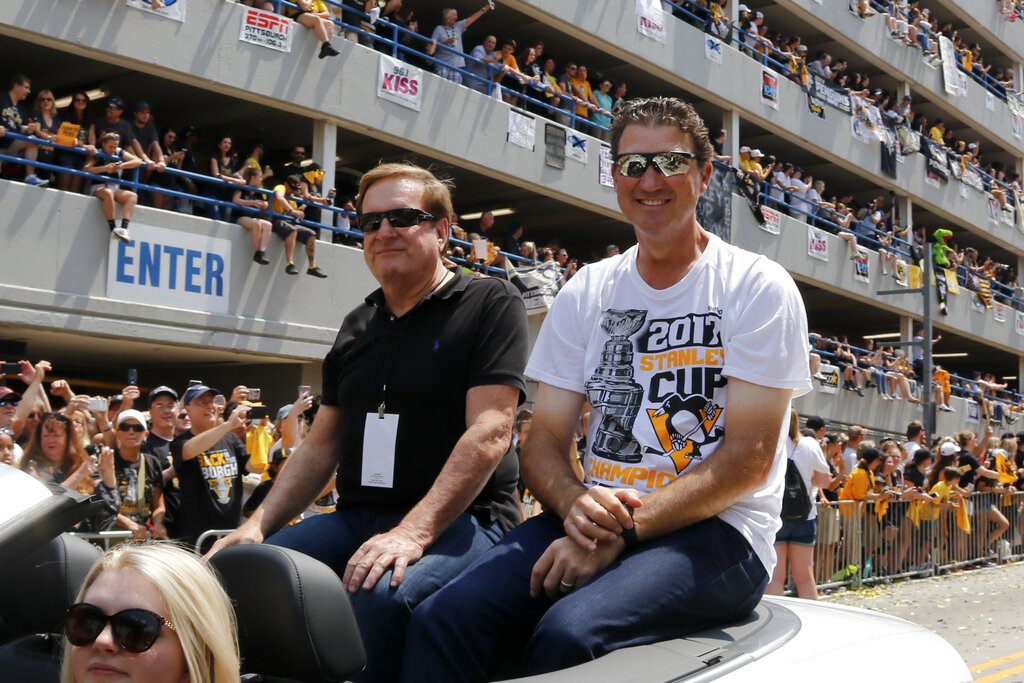
This June 14, 2017 file photo shows Pittsburgh Penguins owners Mario Lemieux, right, and Ron Burkle riding in the Stanley Cup victory parade in Pittsburgh, Wednesday, June 14, 2017. (AP Photo/Gene J. Puskar, File Photo)
XIX. The Lemieux Era — Salvation, Artistry, and the First Renaissance
Pittsburgh’s modern identity cannot be understood without understanding Mario Lemieux. His arrival in 1984 did more than elevate a struggling franchise — it altered the city’s civic trajectory. Lemieux was not merely a great player. He was a generational force whose presence reshaped Pittsburgh’s relationship with sport, culture, and possibility.
The Penguins of the early 1980s were a franchise on the brink — financially unstable, competitively irrelevant, and culturally peripheral. Lemieux changed all of that the moment he stepped onto the ice. His brilliance was unlike anything Pittsburgh had ever seen: elegant, fluid, effortless, transcendent.
Under Bob Johnson and then Scotty Bowman, the Penguins transformed from fragile to formidable. The 1991 and 1992 Stanley Cups were not simply championships; they were declarations that Pittsburgh could excel in a sport defined by speed, creativity, and global reach. Jaromír Jágr — the most gifted European player of his generation — extended the Lemieux era into the modern game.
The voice of this era was Mike Lange, whose theatrical, joyful calls became part of Pittsburgh’s cultural fabric. He didn’t just narrate games; he narrated a renaissance.
Lemieux’s impact extended beyond the ice. He saved the franchise financially — twice. He became an owner. He kept the team in Pittsburgh when relocation was a real threat. He built the foundation for the youth‑hockey boom that would reshape Western Pennsylvania for decades.
The Lemieux era was not simply a period of success. It was a civic awakening.
XX. Pittsburgh as a Hockey Town — The Cultural Transformation
The most remarkable legacy of the Penguins is not found in their five Stanley Cups. It is found in the culture they created — a hockey identity that did not exist in Western Pennsylvania before Lemieux, and that matured into a full civic ecosystem during the Crosby era.
The early 1990s introduced the sport to a region that had long defined itself through football and steel. Lemieux made hockey aspirational. Jágr made it magnetic. Success made it communal.
The second wave came with Sidney Crosby. His arrival coincided with Pittsburgh’s broader reinvention — a shift toward technology, medicine, and innovation. Under Mike Sullivan, the Penguins’ style of play — speed, precision, intelligence — became a model for the league and a blueprint for youth programs across the region.

Pittsburgh Penguins’ Sidney Crosby plays during Game 6 in the first round of the NHL hockey Stanley Cup playoffs series Wednesday, April 29, 2026, in Philadelphia. (AP Photo/Matt Slocum)
The result was a generational shift. Western Pennsylvania began producing elite talent consistently: Brandon Saad, J.T. Miller, John Gibson, Vince Trocheck, Logan Cooley. Rinks filled. Travel programs matured. Coaching professionalized. Hockey became part of the region’s athletic identity, not an imported curiosity.
By the late 2010s, Pittsburgh was no longer a football city that tolerated hockey. It was a dual‑sport capital — steel and ice, grit and grace, tradition and reinvention.
The Penguins did not simply win championships. They changed what Western Pennsylvania believed it could produce. They changed what young athletes aspired to become. They changed the region’s relationship with winter, with competition, with creativity.
This is the Penguins’ third legacy: not the Cups, not the stars — but the culture.
XXI. The Civic Spine — The Institutions That Hold Pittsburgh Together
Pittsburgh’s identity is not carried by its civic institutions alone. Its emotional life is shaped by the three franchises that have defined generations of families and neighborhoods: the Steelers, the Penguins, and the Pirates. Each occupies a different place in the city’s cultural architecture, and together they form the emotional canopy under which Pittsburgh lives its seasons.
The Pirates are the city’s memory — the oldest franchise, the multicultural spine, the Clemente legacy, the 1960 and 1971 and 1979 championships, the summer soundtrack of the region. They are the civic inheritance passed from grandparents to grandchildren, the team that shaped Pittsburgh’s identity long before the Steelers became a dynasty or the Penguins became a renaissance. Their presence is quieter today, but no less foundational. They remain the city’s long arc — the reminder of what Pittsburgh has been and what it still carries.
The Steelers are the civic posture — the embodiment of the city’s industrial toughness, discipline, and continuity. Their success across eras, their stability in leadership, and their national stature give Pittsburgh a sense of identity that extends far beyond football. They are the city’s autumn heartbeat.
The Penguins are the modern imagination — the franchise that carried Pittsburgh into its innovative era. Their artistry, speed, and global reach mirror the city’s transformation from steel to science, from mills to medicine, from manufacturing to robotics and AI. They are the city’s winter pulse.
But the emotional canopy is only one part of the civic spine. The city’s continuity — its resilience, its reinvention, its long‑arc stability — comes from the institutions that anchor Pittsburgh’s daily life.
The universities form the intellectual core. Carnegie Mellon drives global leadership in computer science, robotics, and artificial intelligence. The University of Pittsburgh and UPMC anchor one of the most influential medical and research ecosystems in the world.
The foundations — Heinz, Mellon, Hillman — provide the long‑term capital that allows Pittsburgh to rebuild deliberately rather than reactively. Their investments in culture, public space, and community infrastructure ensure that the city’s reinvention is not merely economic, but civic.
The business community evolved from steel giants to a diversified economy built on technology, medicine, finance, and advanced manufacturing. Institutions like PNC and UPMC became national players, while a constellation of tech firms reshaped the Strip District, East Liberty, and Lawrenceville into modern innovation corridors.
Civic leadership guided the city through transformation — reclaiming riverfronts, expanding green spaces, preserving historic neighborhoods, and building a livable urban core that reflects both heritage and ambition.
And through it all, the people of Pittsburgh — workers, teachers, nurses, engineers, small‑business owners, community organizers — remained the city’s constant. Their humility, resilience, and quiet pride form the cultural bedrock that allows Pittsburgh to adapt without losing itself.
The Pirates, Steelers, and Penguins give the city its emotional architecture. The civic spine gives it its stability.
Pittsburgh’s story is not one of decline and rebirth. It is one of adaptation — a city that carries its history forward without being trapped by it.
XXII. The City That Endures
Few American cities carry their history forward with the steadiness of Pittsburgh. Where other regions fractured under economic collapse or demographic contraction, Pittsburgh adapted — not by abandoning its past, but by integrating it into a new civic identity. This continuity is the city’s defining strength.
The emotional canopy — the Pirates, Steelers, and Penguins — gives Pittsburgh its rhythm. Each franchise holds a distinct part of the civic psyche: memory, posture, imagination. Together, they shape how the city experiences its seasons and narrates its own story.
The civic spine — the universities, foundations, medical institutions, and diversified economy — provides the structural stability that allowed Pittsburgh to move from steel to science, from mills to medicine, from manufacturing to robotics and AI. Reinvention here was not a rupture; it was a disciplined evolution.
But the city’s endurance is rooted most deeply in its people. Pittsburghers carry a cultural posture defined by humility, seriousness, and quiet ambition. They do not chase spectacle. They do not inflate themselves. They build, they adapt, they endure. This temperament allowed the city to survive industrial collapse without losing its character.
Pittsburgh’s identity today is not a departure from its past. It is an extension of it.
The mills are gone, but the ethic remains.
The smoke has lifted, but the pride endures.
The industries have changed, but the seriousness persists.
The city’s institutions — civic, cultural, athletic — form a continuity that stretches from the steel era to the innovation era. Pittsburgh did not reinvent itself by erasing its history. It reinvented itself by carrying its history forward with clarity and discipline.
This is the city’s defining trait: It endures. It adapts. It remains itself.
Pittsburgh is not a comeback story. It is a continuity story — a city that learned how to change without losing its character.
XXIII. The Civic Stewards — The Leaders Who Shaped Pittsburgh’s Metamorphosis
Pittsburgh’s evolution was not driven by political cycles. It was shaped by a small lineage of civic stewards whose work defined the city’s trajectory from the steel era through collapse, reinvention, robotics, and AI. These individuals mattered not because they held office, but because their leadership altered the city’s direction.
- David L. Lawrence (circa 1945–1960) Architect of the first Renaissance. Smoke control, urban renewal, and the public‑private civic model that became Pittsburgh’s governing DNA. He proved the city could rebuild itself deliberately.
- Richard Caliguiri (circa 1977–1988) The steward of the steel collapse. His “Renaissance II” vision kept Pittsburgh focused on diversification, culture, and livability when its economic foundation disappeared. He preserved the city’s civic confidence during its most vulnerable decade.
- Sophie Masloff (circa 1988–1994) The stabilizer. Her leadership provided continuity as Pittsburgh absorbed the shock of industrial decline. She kept the civic fabric intact when the city could have fractured.
- Tom Murphy (circa 1994–2006) The physical reformer. Riverfront reclamation, stadium construction, and neighborhood reinvestment created the urban framework that Pittsburgh’s innovation economy would later inhabit. Controversial, but foundational.
- Mark Nordenberg (circa 1995–2014) The academic builder. Under his leadership, Pitt became a global medical and research powerhouse, anchoring the city’s scientific identity.
- Jared Cohon (circa 1997–2013) The technological catalyst. He elevated Carnegie Mellon into a world leader in robotics, computer science, and AI — the intellectual engine of Pittsburgh’s modern economy.
- Rich Fitzgerald (circa 2012–2024) The regional integrator. As county executive, he aligned infrastructure, workforce, and planning across Allegheny County, enabling the robotics and AI sectors to scale.
These individuals were not merely public figures. They were the architects of Pittsburgh’s metamorphosis.
They formed a civic relay — a lineage of leadership that carried the city from smoke to science, from steel to software, from collapse to reinvention. Their work ensured that Pittsburgh’s transformation was not accidental or externally imposed. It was self‑directed, locally governed, and civically anchored.
The franchises gave Pittsburgh its emotional architecture. These stewards gave it its direction.
XXIV. The Through‑Line — A City, Its Character, and Its Oldest Allegory
Every city has a story. Pittsburgh has a through‑line — a continuity that runs from steel to science, from collapse to reinvention, from the mills to the robotics labs. It is not a straight line, but it is an unbroken one.
And no institution reflects that continuity more clearly than the Pirates.
Not because they win. Not because they dominate headlines. But because they endure — decade after decade, era after era — carrying the city’s memory, its humility, its stubbornness, and its quiet belief that tomorrow can still be shaped.
The Pirates are the allegory for Pittsburgh’s character:
Continuity — the oldest franchise, the longest thread, the team that connects generations.
Resilience — surviving eras of constraint without losing identity.
Patience — the long view that defines the city’s temperament.
Possibility — the belief that a new chapter is always available, even if it arrives slowly.
The Steelers gave Pittsburgh its posture.
The Penguins gave it its imagination.
But the Pirates gave it its shape — the emotional architecture that predates everything else and still frames the city’s sense of itself.
In their highs, the Pirates showed Pittsburgh what excellence could look like.
In their lows, they showed Pittsburgh what endurance requires.
In their continuity, they mirrored the city’s own.
Pittsburgh is not a comeback story. It is a continuity story — a city that adapts without discarding, evolves without forgetting, and carries its history forward with a seriousness that never needs to announce itself.
The Pirates are the metaphor for that posture. They are the city’s long arc — imperfect, resilient, rooted, and still capable of surprise.
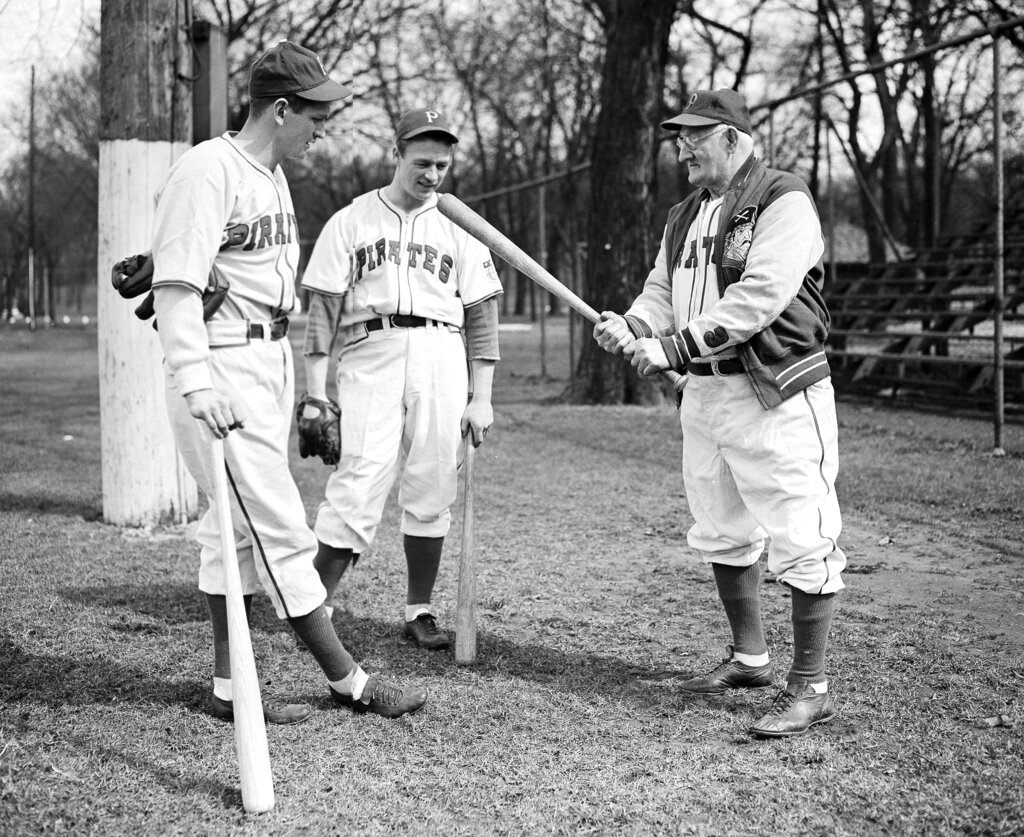
Honus Wagner, right, Pittsburgh Pirates coach and one of baseball’s greatest shortstops of former years, is pictured with outfielders James Russell, left, and Frank Colman during spring training, March 19, 1943. (AP Photo/Ed Maloney)
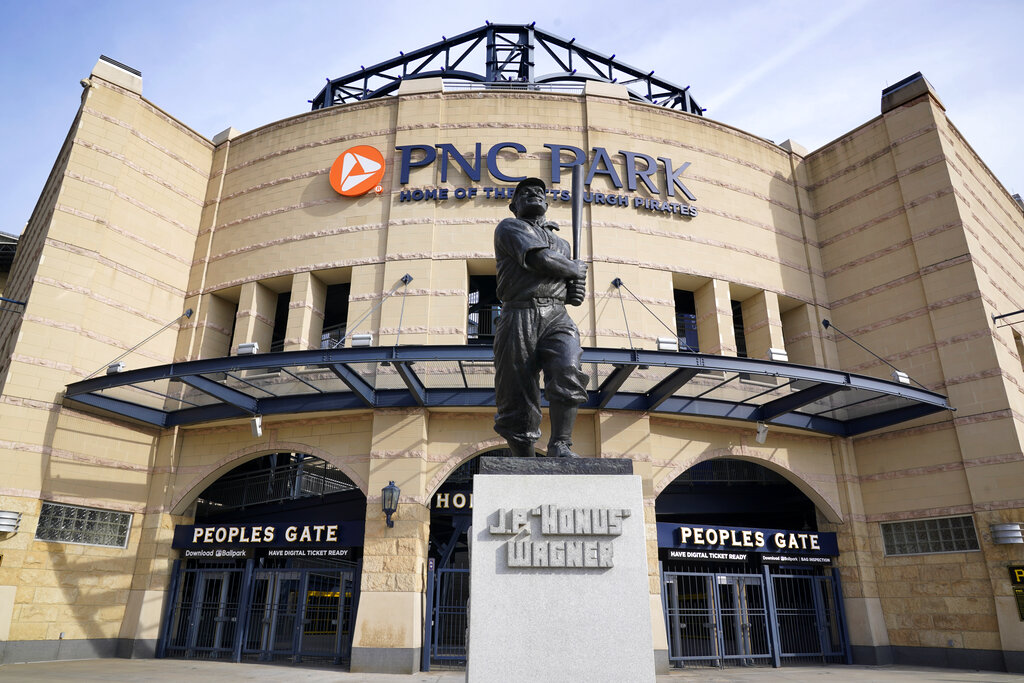
A statue honoring Pittsburgh Pirates shortstop Honus Wagner, a member of the first class of inductees into the Baseball Hall of Fame in 1936, stands outside PNC Park, the home of the Pittsburgh Pirates, on Friday, March 11, 2022. The Pirates’ home opener is April 12, 2022 against the Chicago Cubs. (AP Photo/Gene J. Puskar)
And if the Pirates are the city’s oldest allegory, then Honus Wagner is the first great figure to give that allegory its form. A native of Chartiers, raised in the working‑class rhythms of Western Pennsylvania, Wagner was the sport’s first true five‑tool player — a craftsman whose excellence defined early baseball. He won eight batting titles, dominated the basepaths, fielded with a quiet mastery, and in 1909 led the Pirates to their first World Series championship, outdueling Ty Cobb in a matchup that shaped the young game’s mythology. When the Hall of Fame opened in 1936, Wagner was one of its first five inductees — not for fame, but for foundational greatness. More than a century later, his legacy remains the prologue to Pittsburgh’s sporting identity: the local boy whose work ethic, humility, and mastery set the template for everything this city would come to admire in every era that followed.
And that is the truth at the center of this entire work:
Pittsburgh endures.
Pittsburgh adapts.
Pittsburgh remains itself.
And in the Pirates — in their struggle, their continuity, and their rare, hard‑earned triumphs — the city recognizes the part of itself that never stops believing.
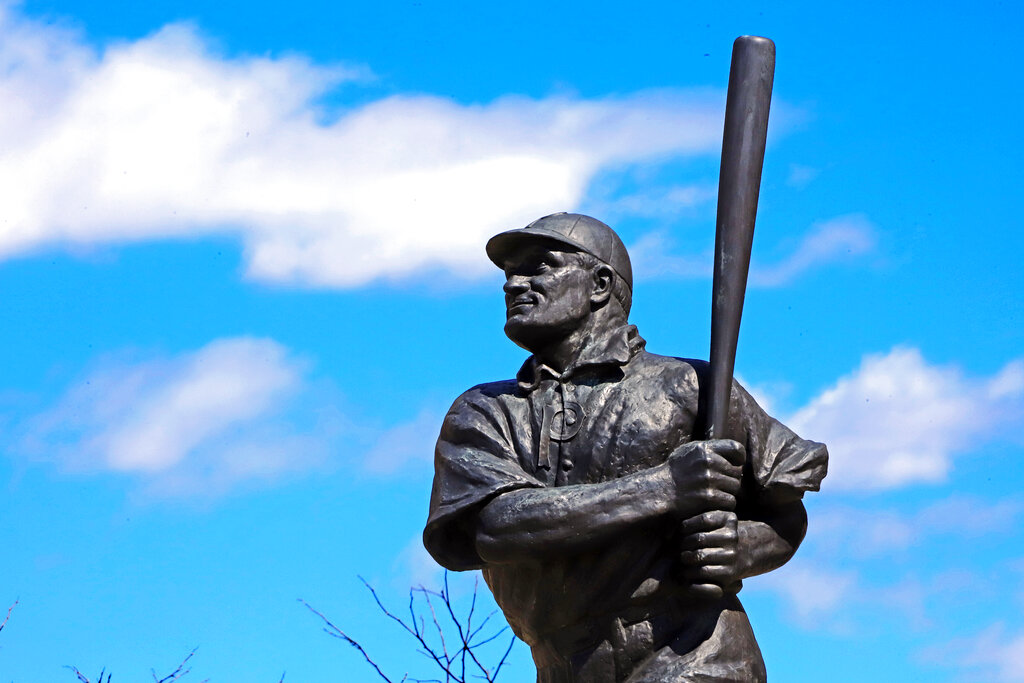
A statue of Pittsburgh Pirates Baseball Hall of Fame infielder Honus Wagner stands outside the main entrance to PNC Park, home of the Pittsburgh Pirates on Thursday, April 2, 2020. It would have been the season opening home baseball game for the Pittsburgh Pirates against the Cincinnati Reds, had the Major League Baseball season not been postponed to mitigate the spread of the COVID-19 virus.(AP Photo/Gene J. Puskar)
Narrated by Reginald Armstrong for World Baseball Network.
Photos: Associated Press. Music: “We Are Family” performed by Sister Sledge (official video, embedded). Baseball Without Borders.